Wondering how to turn a gifted collaboration into a paid collaboration — without awkward conversations or feeling like you’re “asking for too much”?
If you’re a creator, influencer, or UGC creator, chances are your inbox is full of brands offering “gifted collabs.” And while these offers can feel flattering (especially early on), most creators aren’t actually taught how to turn a gifted collaboration into a paid collaboration — or how to do it without damaging the relationship.
As a lawyer who works with creators and brands every day, I see this from both sides. Gifted collaborations aren’t automatically bad, but they’re often poorly structured. That’s when creators end up doing real work, taking on legal and tax obligations, and still walking away with nothing more than a product they didn’t even ask for.
In this post, you’ll learn what a gifted collaboration actually is, why structure matters more than most creators realize, and — most importantly — how to turn a gifted collaboration into a paid collaboration realistically. We’ll cover small base fees, commission-based setups, long-term collaboration strategies, and exactly what to say in each situation.
By the end, you’ll know how to respond to a gifted collab offer with confidence — and how to choose a structure that makes sense for you, the brand, and your long-term goals.
This post is all about how to turn a gifted collaboration into a paid collaboration — without the awkwardness.
👉 If you want to work with brands professionally (even on small deals), having the right structure — and the right brand collaboration agreement — makes all the difference.
How to Turn a Gifted Collaboration Into a Paid Collaboration
1. What Is a Gifted Collaboration

Before you can decide how to turn a gifted collaboration into a paid collaboration, you need to be clear on what a gifted collaboration actually is — because this is where a lot of confusion (and bad deals) start.
A gifted collaboration usually means a brand sends you a product or provides a service in exchange for promotional content. There’s no upfront payment, and the agreement often happens casually via DMs or email. You post, they repost (or hope to), and everyone moves on.
At least, that’s how it’s supposed to work.
The problem is that gifted collaborations are often treated as “no big deal” — when in reality, they already involve:
Content creation
Promotion of a commercial product
Expectations around timing, messaging, or deliverables
So, once you’re creating content for a brand, you’re no longer just doing a favor — you’re entering a commercial transaction, even if no money changes hands.
This is also why gifted collaborations are the easiest place for things to quietly go wrong. Without structure:
Brands may assume they can reuse your content however they want.
You may feel pressured to deliver more than you agreed to.
There’s no clear path to getting paid later, even if the collaboration performs well.
And while we’re not going deep into tax rules here, it’s important to know that in most countries, specifically in the US, UK, and EU countries, gifted products may be treated as taxable income when they’re clearly exchanged for promotional services. That’s another reason why casually accepting gifted collabs without thinking through the structure can backfire.
The takeaway isn’t to never do gifted collaborations. But a gifted collaboration is still a business transaction — and once you treat it that way, it becomes much easier to turn it into a paid one.
That’s exactly what the rest of this post focuses on: practical, realistic ways to upgrade a gifted collab into something that actually pays.
2. The Cleanest Upgrade: Asking for a Small Base Fee for Gifted Collabs

If you want to know how to turn a gifted collaboration into a paid collaboration without making things awkward, this is the cleanest place to start: asking for a small base fee.
A lot of creators hesitate here because they assume:
the brand will say no,
it will “ruin the vibe,” or
they’re not big enough yet to ask.
In practice? Brands are far more open to this than creators expect — especially when the request is framed professionally, and you have a good argument they can’t argue with.
A small base fee does a few important things at once:
It clearly turns the collaboration into a commercial transaction.
It compensates you for your time, production, and admin.
It creates a natural foundation for paid upgrades later.
This doesn’t mean asking for a huge budget. Even a modest fee can completely change how the collaboration is treated.
When asking for a small fee makes the most sense
This approach works especially well when:
The content requires real effort (filming, editing, scripting).
The product is high-value or time-consuming to feature (and you definitely don’t want to pay taxes over that.
And yes — this applies even if the brand initially framed the deal as a “gifted collab.”
What to say (without making it awkward)
You don’t need a long explanation or legal justification. Keep it simple and confident.
Here’s a creator-friendly line that works well in practice:
“I usually work with a small base fee to cover production and admin, and I’m happy to keep the rest performance-based if that works for your budget.”
That sentence does a lot of work for you:
It normalizes payment.
It shows flexibility.
It keeps the door open instead of closing it.
If the brand truly can’t pay upfront, this also sets you up perfectly for commission-based or hybrid structures later — which we’ll cover next.
Why structure matters here
Once money is involved (even a small amount), expectations shift. Suddenly:
Deliverables become clearer.
Usage rights are easier to define.
Future paid collaborations feel like a natural next step.
This is also where using a proper Brand Collaboration Agreement makes a difference. Instead of negotiating everything from scratch, the agreement:
Clearly states what the fee covers
Limits how the brand can use your content
Leaves room for upgrades (paid usage, additional posts, longer-term work)
You’re not “asking for more.” You’re setting a professional baseline — and that’s often exactly what brands expect.
3. Gifted Collaboration Taxes: When Paying Tax Yourself Makes Sense (and When It Doesn’t)

Not every gifted collaboration can — or should — be turned into a small paid deal.
Sometimes, the brand genuinely won’t pay a fee. And in some situations, it can still be a rational business decision to accept a gifted collaboration and handle the tax consequences yourself — as long as you do it consciously and with boundaries in place.
This is especially true when:
The brand has strong long-term potential
The collaboration is strategically valuable (not just “exposure”)
You’re building a relationship you realistically want to grow
Think of scenarios like working with a globally recognized brand, a household name, or a company you genuinely want to partner with long-term. In those cases, pushing for a small fee may not be realistic — and turning the opportunity down outright may not be the smartest move either.
When this approach can make sense
Paying tax on the value of the gifted product yourself can be reasonable if:
The product value is manageable for you
You actually want the product
You see a realistic path to future paid collaborations
You are not giving away unlimited rights or ongoing obligations
In other words, you’re treating the gifted collaboration as a strategic investment, not unpaid labor disguised as a favor.
When it usually doesn’t make sense
This approach is rarely worth it when:
The product is expensive and creates a meaningful tax burden
The brand expects multiple deliverables or revisions
The brand wants broad or ongoing usage rights
There’s no discussion of future collaboration at all
In those cases, you’re taking on real costs — time, effort, and tax — without a clear upside.
What to say to keep it professional and future-focused
If you decide to accept a gifted collaboration without a fee, it’s still smart to set expectations clearly.
Here’s an example of how to frame that conversation:
“I’m happy to treat this as a gifted collaboration for now. Just so we’re aligned, this would be limited to the agreed deliverables, and any future content, extended usage, or follow-up collaborations would be paid.”
This does two important things:
It confirms that the current gifted collaboration is one-off and limited.
It opens the door to paid work later — without pressure or awkwardness.
Why a brand collaboration agreement still matters here
Even when no money changes hands, a Brand Collaboration Agreement is what protects this decision from backfiring.
It allows you to:
Limit the scope of the collaboration
Clearly define usage rights
Avoid open-ended obligations
Keep the path to paid collaborations open
So if you’re going to accept a gifted collaboration and handle the tax side yourself, make sure you’re not also giving away control, rights, or future leverage.
4. Turning Gifted Collaborations Into Commission-Based Income
If a brand isn’t willing (or able) to pay a base fee upfront, that doesn’t mean a gifted collaboration has to stay unpaid. One of the most common — and often overlooked — ways on how to turn a gifted collaboration into a paid collaboration is through commissions.
When commission-based deals make sense
Commission-based structures tend to work best when:
The product is easy to purchase online
The brand can track sales through a link or discount code
Commissions can sometimes outperform a small flat fee — especially over time. And this gives the brand a low-risk way to work with you while still creating real earning potential.
What to say to propose a commission-based setup
Again, the goal isn’t to over-explain. You want to sound professional and solutions-oriented.
Here’s an example that works well:
“If an upfront fee isn’t possible right now, I’m happy to work with a commission-based structure using a unique discount code or affiliate link for my audience.”
5. Combining Strategies for the Best Gift Collaboration: Small Fee, Commission, & Gifted Product
In reality, most successful brand deals don’t rely on just one structure. The most common — and often most effective — way on how to turn a gifted collaboration into a paid collaboration is by combining all three elements:
A gifted product (so you can test and create content)
A small base fee to cover production and admin
A commission on sales generated through your content
This hybrid approach works because it gives both sides what they want:
The brand limits upfront risk
You get paid in more than one way
This immediately changes the tone of the collaboration. It’s no longer a favor — it’s a structured business deal.
It also makes follow-up conversations much easier. If the content performs well, the next step is obvious: more paid work.
What to say when proposing a hybrid deal
You don’t need to pitch this as complicated or “lawyerly.” Keep it practical.
Here’s a simple way to frame it:
“I normally work with a base fee. If budget is tight, I’m open to a hybrid structure with a lower base fee and commission on sales.”
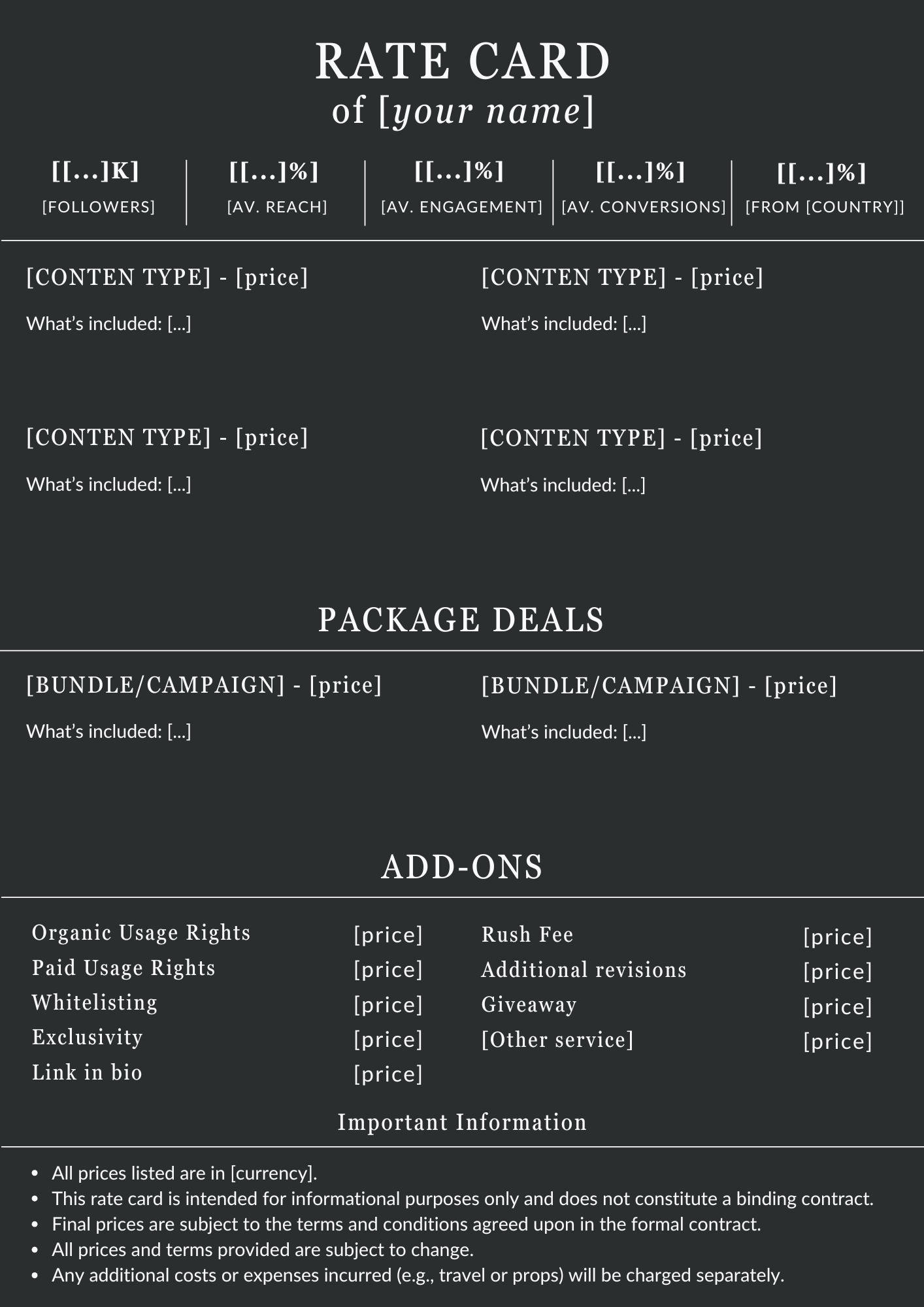
To make that conversation easier, many creators also attach their rate card when responding. Not as a take-it-or-leave-it demand, but as context: This is what I normally charge, and this is how I structure paid collaborations.
A rate card helps you:
Anchor the conversation around paid work
Show that gifted or hybrid deals are an exception, not your standard
Make your pricing feel normal and professional — not negotiable from scratch
💡 If you don’t have a rate card yet, I’ve created a free influencer rate card template you can use as a starting point — even if you’re still refining your pricing.
Simply subscribe to my newsletter and gain free access to my free legal library with the rate card template and more free resources!
Ready to Turn Gifted Collaborations Into Paid Deals?
If you want to work with brands professionally — even on small or hybrid deals — having the right agreement in place makes everything easier.
My lawyer-drafted Brand Collaboration Agreement is designed specifically for creators and influencers, like you, who want to protect themselves and get paid fairly.
It helps you:
Clearly define deliverables (so “one post” doesn’t turn into five)
Set usage rights and limits (no unpaid ads or endless reuse)
Structure paid, gifted, commission-based, or hybrid collaborations
Leave the door open for future paid work and upgrades
Avoid misunderstandings, pressure, and scope creep
Whether you’re charging a base fee, working with commissions, or carefully accepting a gifted collaboration for strategic reasons — this agreement gives you the structure to do it on your terms.
👉 Get the Brand Collaboration Agreement Template here
(Pre-written, creator-friendly, and easy to customize — no legal jargon.)
This post was all about how to turn a gifted collaboration into a paid collaboration — without the awkwardness.
Other posts you may like: