5 Things Every Life Coach Gets Wrong About Life Coaching Terms and Conditions (That Nobody Tells You)

Are you looking for life coaching terms and conditions? Here's what most coaches never find out until they've already chosen the wrong one.
I'm a business lawyer who works with coaches. And one of the most common things I see is a coach who has copy-pasted their terms and conditions straight from another coach's website.
They use ChatGPT to tweak the name, maybe change the fee, and call it done. And then a client disputes a payment, demands a refund, or pushes back on a missed session — and suddenly those T&Cs are worth exactly what they paid for them.
In this post, I'm walking you through the 5 things you need to know before you use life coaching terms and conditions — including the difference between a life coaching terms and conditions template and a life coaching agreement template, which version you actually need, and what yours must cover to hold up when it matters.
This post is all about life coaching terms and conditions — what they are, what to include, and how to choose the right one for your coaching business.
👉 Already know you just want it done? My 1-On-1 Coaching Agreement Template Bundle includes terms and conditions for both checkout pages and application forms — with niche-specific disclaimers and waivers specifically for online life coaches like you.
Best Life Coaching Terms and Conditions
Everything You Must Know — Before You Download a Life Coaching Agreement Template
1. Thinking a Coaching Agreement and Terms and Conditions Are the Same Thing
They're not — and using the wrong one for how you sign clients is one of the most common mistakes life coaches make.
A coaching agreement is a bilateral contract. You send it to your client, they sign it — digitally or physically — and both parties are bound by it from the moment of signature. A life coaching agreement template is the traditional format.
Terms and conditions work differently. Instead of being sent and signed, they're agreed to by the client's action — ticking a checkbox on an application form, or hitting the purchase button on a checkout page. The client doesn't sign anything. But with the right legal language, they're just as binding as a traditional contract.
Here's why the distinction matters:
A coaching agreement sent via DocuSign is not designed for a checkout page — you need specific legal wording that makes your T&Cs binding the moment a client hits that purchase button.
Terms and conditions for a checkout page are not designed for an application process. That requires different legal language, ensuring the contract is formed only after you confirm acceptance.
Using the wrong format may mean your contract isn't legally binding at all!
See how you could be stripped of all legal protections if you use the wrong contract for your setup?
So, before you grab any life coaching terms and conditions template, ask yourself: how do my clients actually sign up?
That answer determines which document you need.
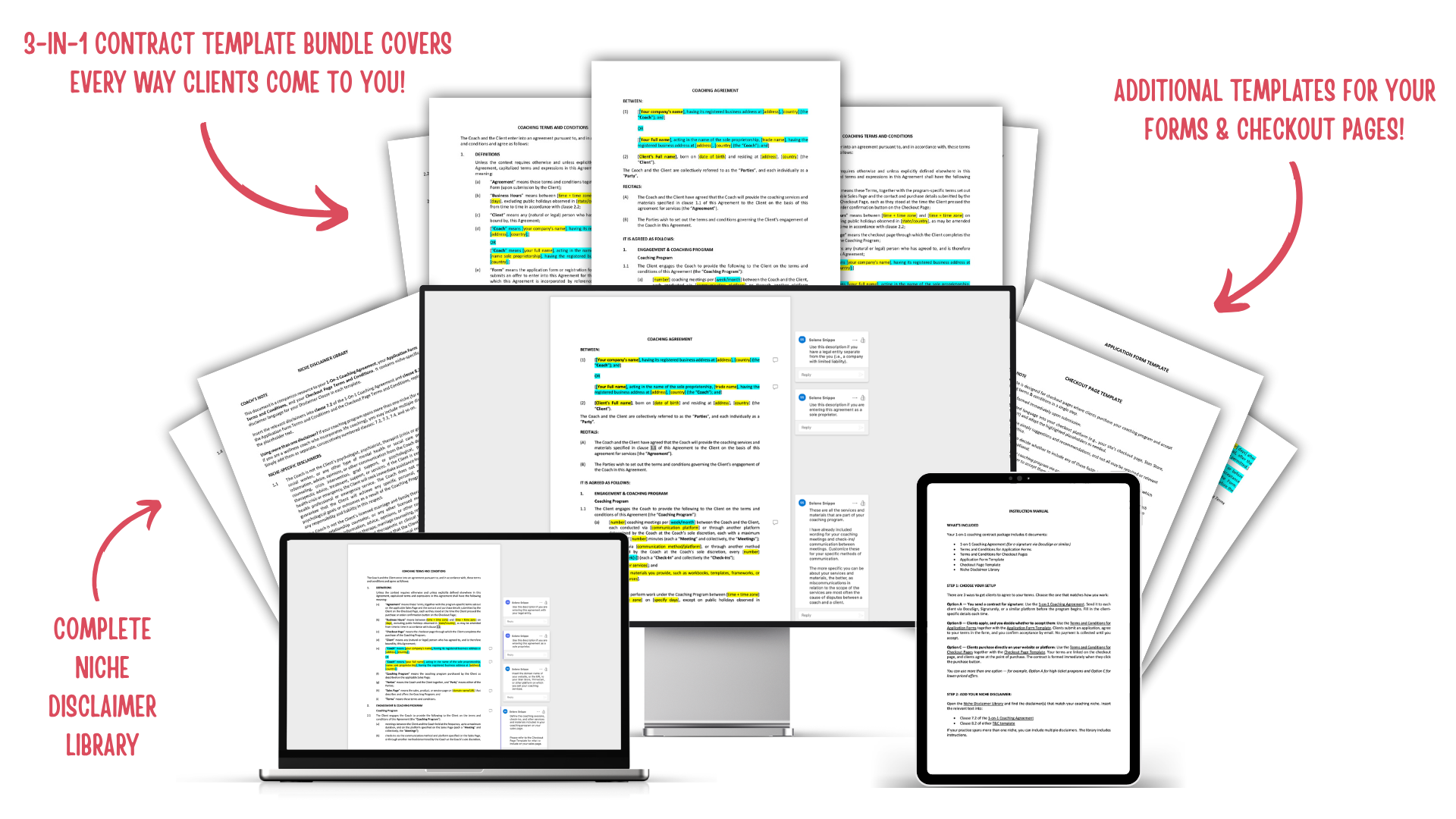
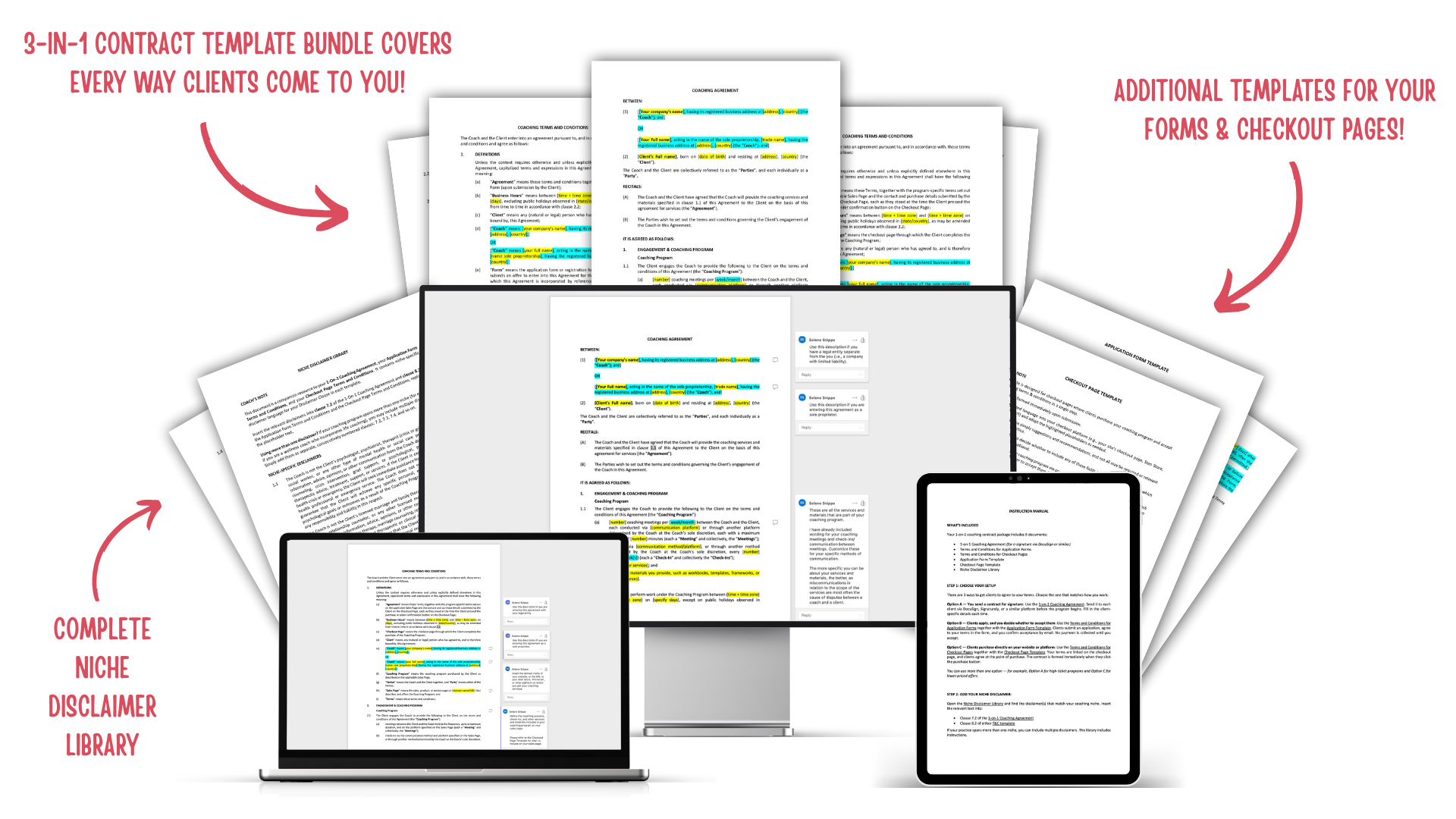
👉 My 1-On-1 Coaching Agreement Template Bundle includes all 3 formats: a traditional coaching agreement for digital signature, terms and conditions for checkout pages, and terms and conditions for application forms.
2. Copying T&Cs From Another Coach's Website
This is the one that makes me cringe the most — because it happens constantly.
A coach finds someone they admire, scrolls to the bottom of their sales page, copies their terms and conditions, swaps in their own name and fee, and calls it done.
The problem? You have no idea what those T&Cs actually cover. You don't know if they were written by a lawyer or by that coach's cousin who took a business law class in 2009. And you definitely don't know if they comply with the laws of your country or state.
And here's the part that might surprise you: even T&Cs drafted by a lawyer can be completely inadequate — if that lawyer doesn't understand the specific legal risks of life coaching. I've reviewed the T&Cs of some of the biggest names in the industry, including Tony Robbins, and I can tell you exactly what's missing.
Here's what you're risking when you copy someone else's T&Cs:
They may not be legally binding for your sales setup.
They may be missing crucial clauses, such as a mental health waiver, a "no influence" disclaimer beside the standard life coaching disclaimer, or a no-rollover clause.
They may not comply with the laws in your jurisdiction.
They may contradict what your sales page says.
And your sales page, checkout page, and application form all need to match your T&Cs — because inconsistency between documents is where client disputes are born.
👉 My 1-On-1 Coaching Agreement Template Bundle does not just include T&C Templates — it also includes a complete sales & checkout page template and an application form template that are designed to work together with your T&Cs.
3. Not Knowing What Your Life Coaching Terms and Conditions Must Actually Cover
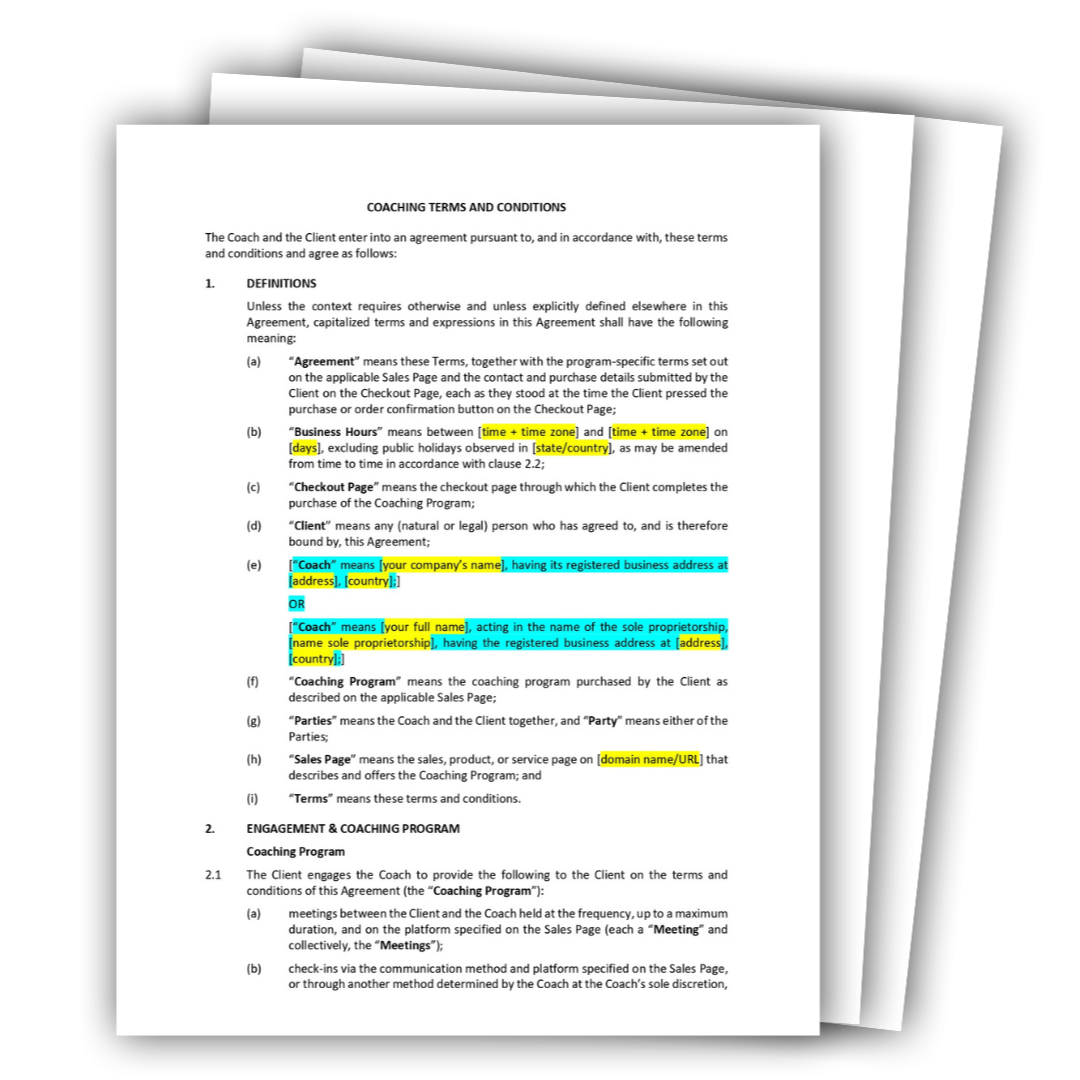
Most coaches assume that as long as they have something in place, they're covered, but unfortunately, not all templates are created equal.
A generic life coaching terms and conditions template might have basic terms in place, like:
Payment terms and fee structure
A basic refund policy
A termination clause
But what most life coaching terms and conditions templates miss are these extremely crucial terms:
A mental health waiver requiring clients to confirm they are not currently undergoing — and have not been advised to seek — therapy or counseling
A "no influence or agenda" disclaimer — so a client can't claim you pushed them into a major life decision
A controversial topics disclaimer — because life coaching gets personal, and clients can have strong emotional reactions
A no-rollover clause so unused sessions expire at the end of the term.
A chargeback protection clause (non-negotiable when you're selling online).
A digital materials clause that makes resources non-refundable once access is granted.
A communication boundaries clause that specifies exactly which platforms you're available on — and when.
A coach unavailability clause that gives you the right to take a break without issuing refunds.
A fool-proof lateness policy, so you're never stuck on Zoom wondering whether to start, wait, or give up.
Comprehensive IP protections for your frameworks, methods, and materials.
👉 Want to see a life coaching terms and conditions example that covers all of the above? My 1-On-1 Coaching Agreement Template Bundle includes everything — pre-written, niche-specific, and ready to customize.
4. Not Understanding That Life Coaching Has Specific Legal Risks Other Coaching Niches Don't
Life coaching sits in a uniquely complex legal space — and generic T&Cs written for coaches in general will never adequately cover it.
Life coaching touches on deeply personal areas — mindset, relationships, personal beliefs, emotional well-being, and major life decisions. That creates legal exposure that a business coach, a fitness coach, or a career coach simply doesn't face in the same way.
Here's what makes life coaching legally distinct — and what your T&Cs need to address specifically:
1. The therapy boundary
Life coaching and therapy can look similar from the outside. Clients dealing with grief, anxiety, relationship breakdowns, or identity crises may genuinely need a therapist — and may not realize that until they're already in your program.
Your T&Cs need two specific life coaching terms working together here:
A niche-specific disclaimer clearly stating you are not your client's therapist, psychologist, psychiatrist, or counselor — and that coaching is not a substitute for mental health treatment.
A mental health waiver requiring clients to actively confirm they don't currently need — and haven't been advised to seek — therapy or counseling before the program begins.
And if you are a licensed therapist or social worker in your other professional life, this becomes even more critical.
Your life coaching terms and conditions need to explicitly state that you are not acting in that licensed capacity during coaching. Otherwise, a client could argue you owed them a professional duty of care you never intended to provide.
2. The "you changed my life" problem
Life coaching can lead to major shifts — clients leave relationships, quit jobs, change their entire belief systems. If a client later regrets a decision and wants to blame someone, you need a “no influence or agenda” disclaimer making clear that any shifts in their views or behavior were the result of their own internal process — not your influence.
3. The emotional response risk
Sessions can get into politics, religion, deeply held values, and sensitive personal topics. Your T&Cs should make clear you are not responsible for how a client emotionally responds to the content of your sessions — including any harm, offense, or distress they may experience.
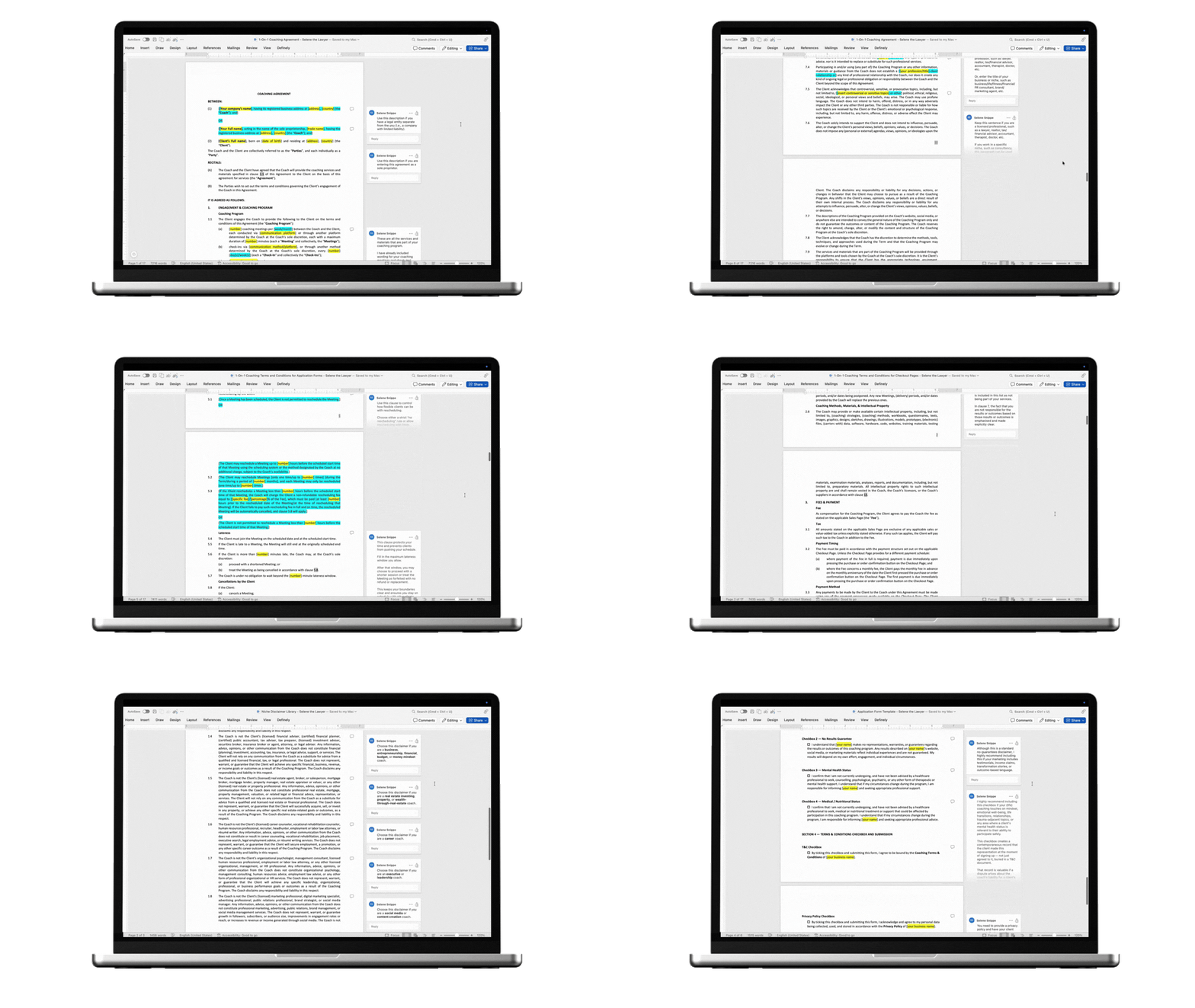
👉 All of these life coaching-specific protections are pre-written in my 1-On-1 Coaching Agreement Template Bundle — including niche-specific disclaimers and a mental health waiver built into every document.
5. Thinking a Free Life Coaching Terms and Conditions Template Is Good Enough
You generally get what you pay for, and the same goes for life coaching terms and conditions.
Free life coaching terms and conditions found on Google, downloaded from a random website, or generated by ChatGPT might seem comprehensive enough.
But there's a significant difference between T&Cs that look right and T&Cs that actually hold up when a client disputes a payment, demands a refund, or claims you crossed a professional boundary.
Here's what free life coaching terms and conditions templates almost always lack:
Life coaching-specific disclaimers and waivers — the ones we covered in sections 3 and 4
Jurisdiction-specific language — a template written for US coaches may not be legally compliant for coaches in the UK, Australia, or the EU.
The right format for your sales setup — free templates almost never come in three versions for three different client onboarding flows.
Customization guidance — no instructions, no explanation of optional clauses, no finalization checklist
Matching sales page and application form templates — so you're left patching documents together from different sources and hoping they don't contradict each other.
And perhaps most importantly: free templates are never reviewed or updated when laws change, platform terms shift, or new risks emerge in the coaching industry.
A proper life coaching terms and conditions template is an investment — but it's a one-time investment that protects every client relationship you'll ever have.
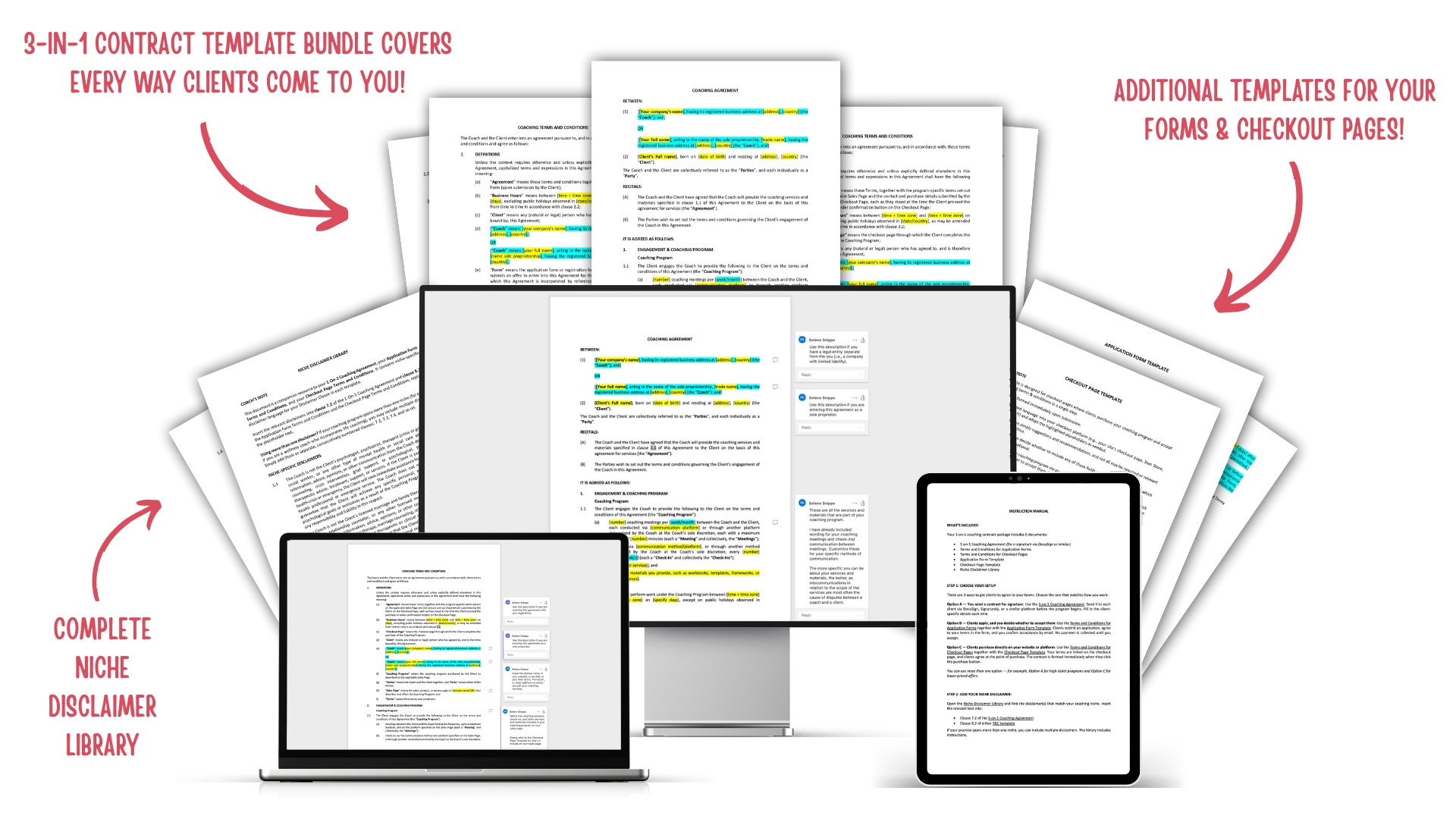
👉 My 1-On-1 Coaching Agreement Template Bundle was drafted by a lawyer who works specifically with coaches, covers all 3 onboarding formats, and gives you free access to every new update.
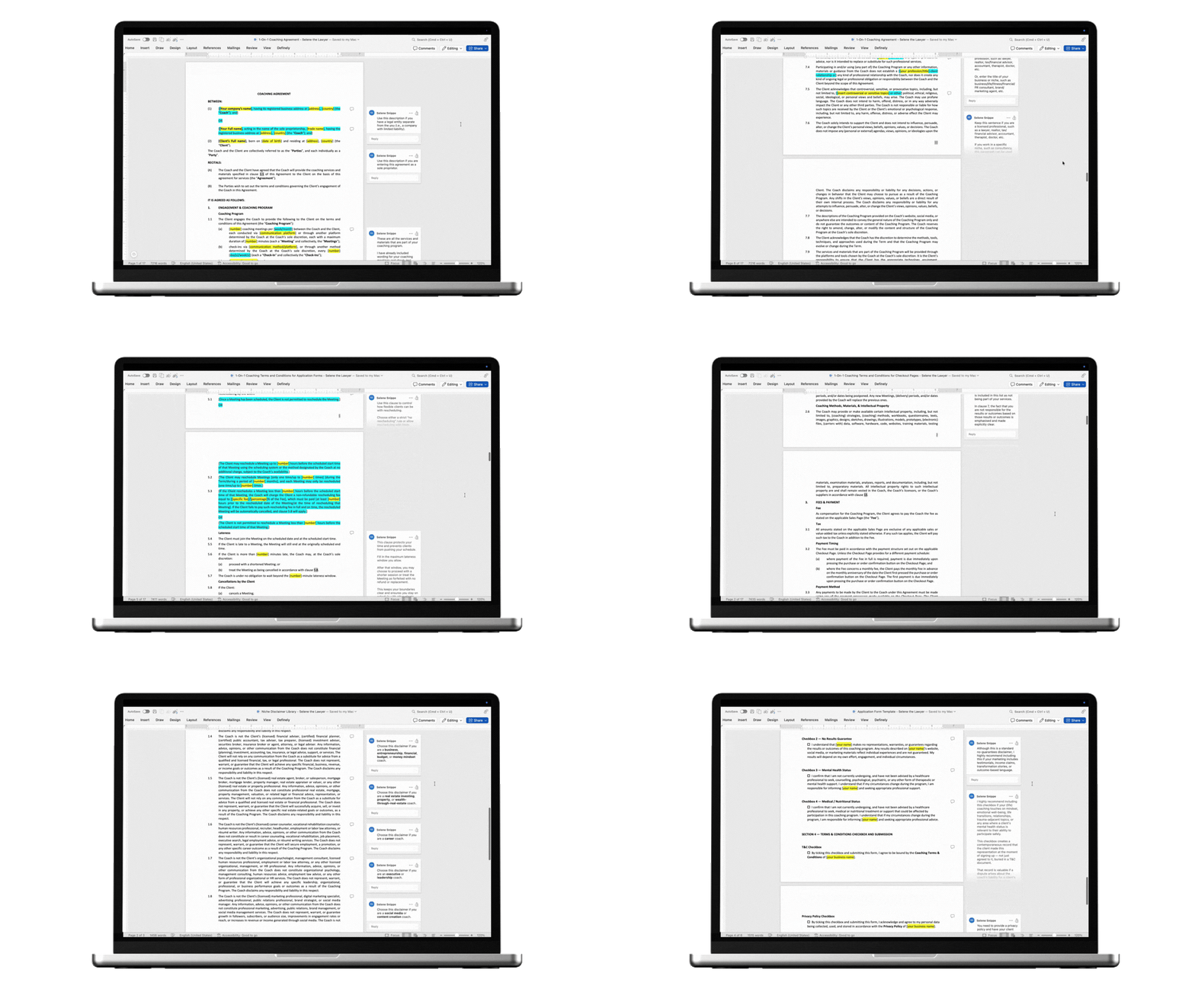
The Best Life Coaching Terms and Conditions Template
Choosing the wrong life coaching terms and conditions template — or copying one from someone else's website — is one of the easiest mistakes to make and one of the most expensive to fix.
So before you download anything, run it through these five checks:
Is it the right format for how you actually sign clients?
Was it written specifically for life coaching — not just “coaching” broadly (even if it says that it’s a life coaching terms and conditions template)?
Does it cover everything your business actually needs — not just the basics?
Does it address the specific legal risks that come with life coaching?
Was it actually drafted by a lawyer who understands the coaching industry?
👉 My 1-On-1 Coaching Agreement Template Bundle checks all five. Here's what's inside:
✅ A complete scope framework — what's included and what's not (sessions, check-ins, materials, and business hours)
✅ A customizable payment schedule for both fixed-term programs and ongoing month-to-month coaching
✅ A rescheduling policy with options ranging from no rescheduling to a tiered system with notice windows, fees, and limits
✅ A lateness policy — including exactly when you're entitled to treat a session as forfeited
✅ A cancellation policy that makes missed sessions non-refundable — including for personal circumstances, time zone errors, and tech issues on the client's side
✅ A no-rollover clause so unused sessions expire at the end of the term and can't be banked for later
✅ A check-in clause specifying when they start, how they're conducted, and that they expire with the term
✅ A solid refund policy with multiple options — including a legal waiver of statutory cooling-off and withdrawal rights
✅ A chargeback protection clause covering disputed payments, bank fees, and legal costs
✅ A full disclaimer suite for life coaches — mental health, no professional relationship, controversial topics, no influence or agenda, results and outcomes, and tech and platform
✅ A mental health waiver requiring clients to confirm they don't currently need — and haven't been advised to seek — therapy or counseling
✅ Client warranties confirming age, legal capacity, and mental and emotional suitability for coaching
✅ An airtight intellectual property clause protecting your frameworks, methods, workbooks, and materials
✅ A non-disparagement clause so a disgruntled client can't go on a social media rampage against you
✅ An ironclad limitation of liability clause capping what clients can ever claim against you
✅ A confidentiality clause covering both directions
✅ An unavailability clause giving you the right to temporarily adjourn the program without issuing refunds
✅ A governing law and jurisdiction clause that is customizable to your jurisdiction
This Post Was All About Life Coaching Terms and Conditions — and How to Choose the Right One for Your Coaching Business
You may also like: