5 Things to Look for in a Life Coaching Agreement Template (Before You Download the Wrong One)

What should you look for in a life coaching agreement template? The truth is, most of them are written for coaches from the Stone Age and have no idea how online life coaching actually works.
I’m a business lawyer who works with coaches. I’ve seen the clients who reschedule sessions non-stop and hijack their coach’s entire calendar.
The refund demands from clients who never even tried.
The liability nightmares that happen when a client who actually needed a therapist signed up for coaching instead.
Almost every time, it’s because they used a life coaching agreement template that was either too generic to hold up or so outdated it had no idea virtual coaching existed — let alone selling coaching programs through websites, Stan Stores, or Instagram, online schedulers, or Zoom sessions.
In this post, I’m walking you through the 5 things I’d check in any life coaching agreement template before downloading it — so you know exactly what to look for, what gaps to watch out for in a simple life coaching agreement template, and how to avoid the situations I just described.
This post is all about the 5 things to look for in a life coaching agreement template — so you can protect your coaching business and run it like a pro.
👉 Already know you just want it done? My 1-On-1 Coaching Agreement Template covers all five — and it was built specifically for online coaches like you.
Best Life Coaching Agreement Template
The 5 Things Every Simple Life Coaching Agreement Template Must Include
1. Does It Match How You Actually Sign Clients?
The average life coaching agreement template assumes you have a discovery call, then send a contract, your client signs it (physically or digitally), and then you request payment.
But that’s a cumbersome process that should be the exception, not the norm.
There are basically 3 ways you can sign clients:
You could do it the traditional, cumbersome way and send a contract for e-signature via DocuSign or a similar platform.
You could use an application form, review each client, and confirm acceptance by email.
You could sell directly through a checkout page, where the contract is formed the moment the client hits the purchase button.
Here’s why this matters legally: the way a contract is formed depends on how your client accepts it.
A standard e-signature agreement is not designed for a checkout page. And a checkout page version is not designed for an application process in which you decide whether to accept the client.
If you use the wrong contract or T&C format for your sales flow, your contract will not be legally binding.
A proper life coaching agreement template bundle should cover all 3 scenarios—or be crystal clear about which one it's built for.
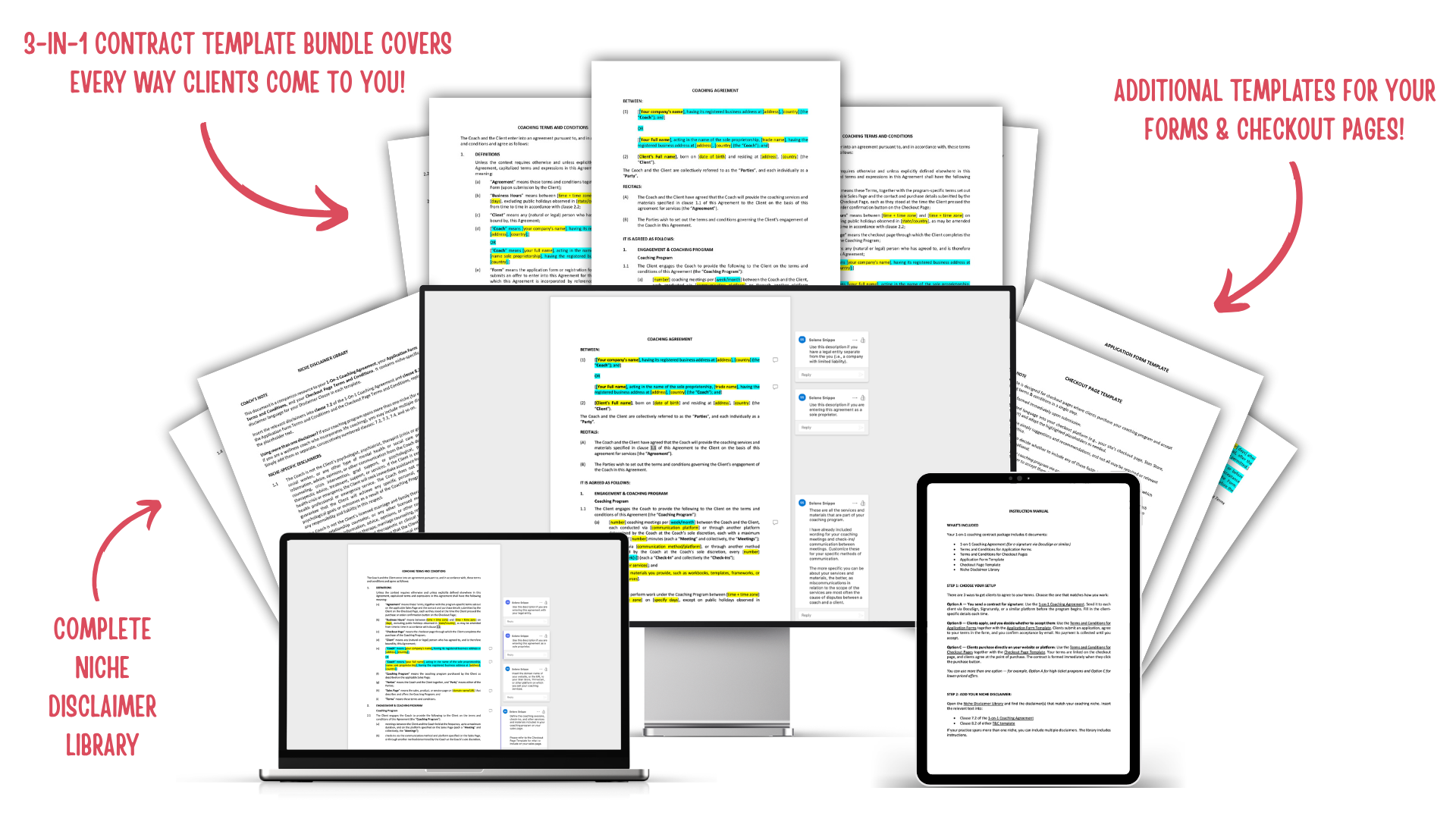
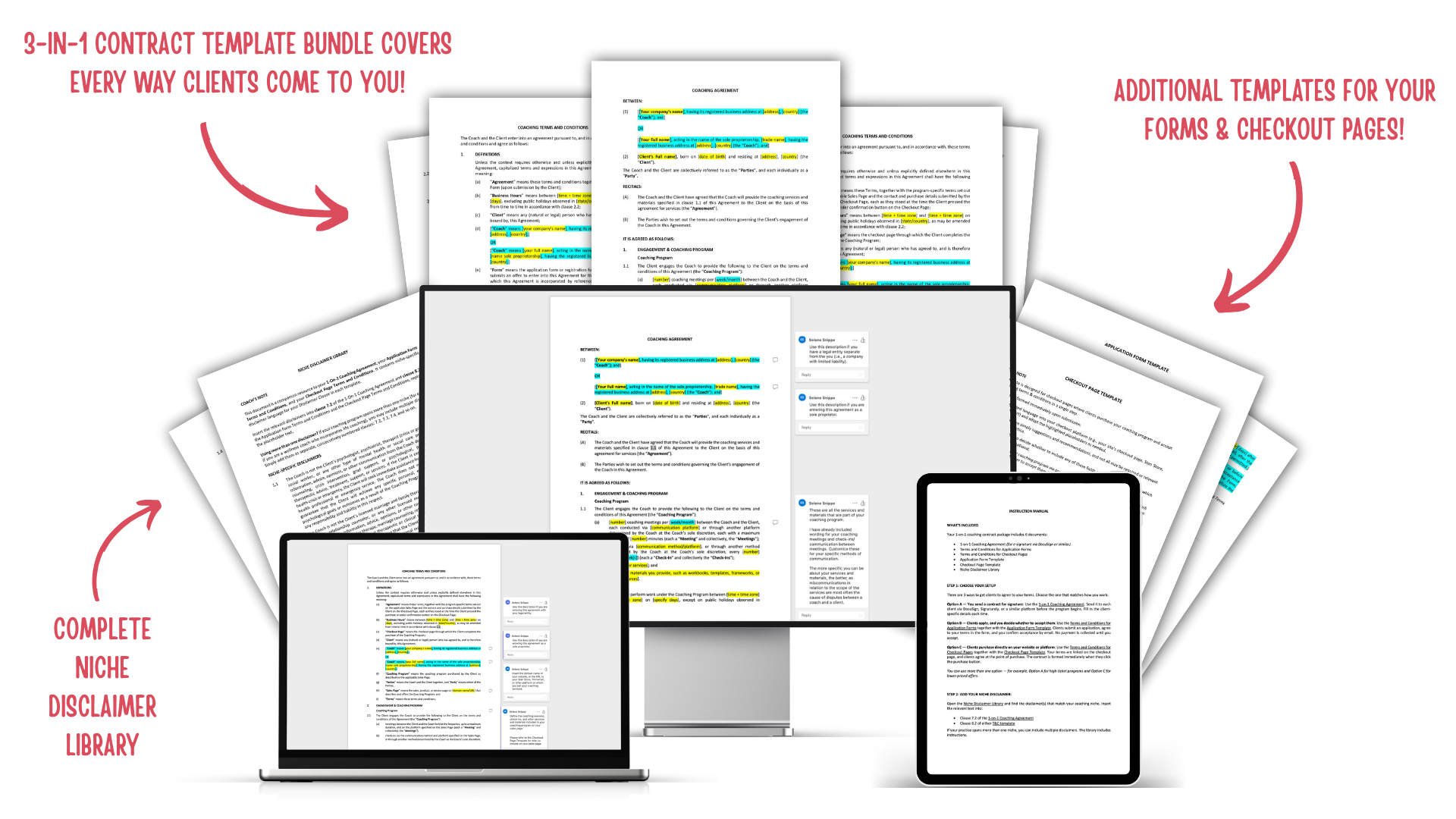
✅ My 1-On-1 Coaching Agreement Template Bundle comes with 3 separate documents:
A simple life coaching agreement template for e-signature
Terms & conditions for application forms, plus a complete application form template
Terms & conditions for checkout pages, plus a checkout and sales page template
So, you’re covered no matter how you sign clients.
2. Does It Have the Right Disclaimers for Life Coaching Specifically?
Whether you’re a mindset coach, a confidence coach, a spiritual coach, a grief coach, or a life coach working on relationships and personal growth, your work touches deeply on emotional areas. That creates legal exposure that a generic disclaimer won't cover.
Here's what a proper life coaching agreement template should include — and what most don't.
A niche-specific disclaimer
This clearly states that you are not your client's therapist, psychologist, psychiatrist, counselor, or any other mental health professional — and that your coaching is not a substitute for therapy or mental health treatment.
This matters even more if you are a licensed therapist, social worker, or psychologist in your other professional life. If that's you, your life coaching agreement template needs to explicitly state that you are not acting in that licensed capacity during coaching. Without that, a client could argue you owed them a professional duty of care you never intended to provide.
A "no professional relationship" disclaimer
Participating in your coaching program should not — legally — create any kind of professional relationship, fiduciary duty, or ongoing obligation beyond the coaching agreement itself.
A controversial topic and emotional response disclaimer
Life coaching can get into politics, religion, personal beliefs, and deeply held values. Clients may have strong emotional reactions. Your agreement should make clear that you are not responsible for how a client receives or emotionally responds to the content of your sessions — including any harm, offense, or distress they may experience.
A “no influence or agenda” disclaimer
This one surprises coaches. But if a client later claims you pushed them toward a decision — left a relationship, quit a job, changed their beliefs — you want a clause that makes clear you don't impose agendas, and that any shifts in their views or behavior are the result of their own internal process.
The average, simple life coaching agreement template doesn’t even include this.
A results & outcomes disclaimer
Your website, Instagram, and sales page describe your program in general terms. They do not guarantee outcomes. Your life coaching agreement template needs to explicitly state that — and make clear that your comments about results are expressions of opinion, not promises.
A "tech and platform" disclaimer
Your program runs on platforms you choose. If a client can't access Zoom, loses their workbook, or has connectivity issues, that's on them — not you. The average outdated life coaching agreement sample doesn’t even address this.
A mental health waiver (and this one is crucial)
This is different from the disclaimer above. The disclaimer defines your role. The mental health waiver requires the clientto confirm — before the program starts — that they are not currently undergoing, and have not been advised to seek, counseling, psychological, or therapeutic treatment or support.
Why does this matter so much? Because it shifts the responsibility onto the client to self-screen. If it later turns out they weren't honest about their mental health status, you have a contractual basis to terminate — and a clear record that they represented themselves as a fit for coaching, not therapy.
And it's not just in the main agreement. A good life coaching agreement template bundle should include this as an explicit checkbox in both the application form and the checkout page — so clients actively acknowledge it at the point of signing, not just buried in the T&Cs they don’t even read.
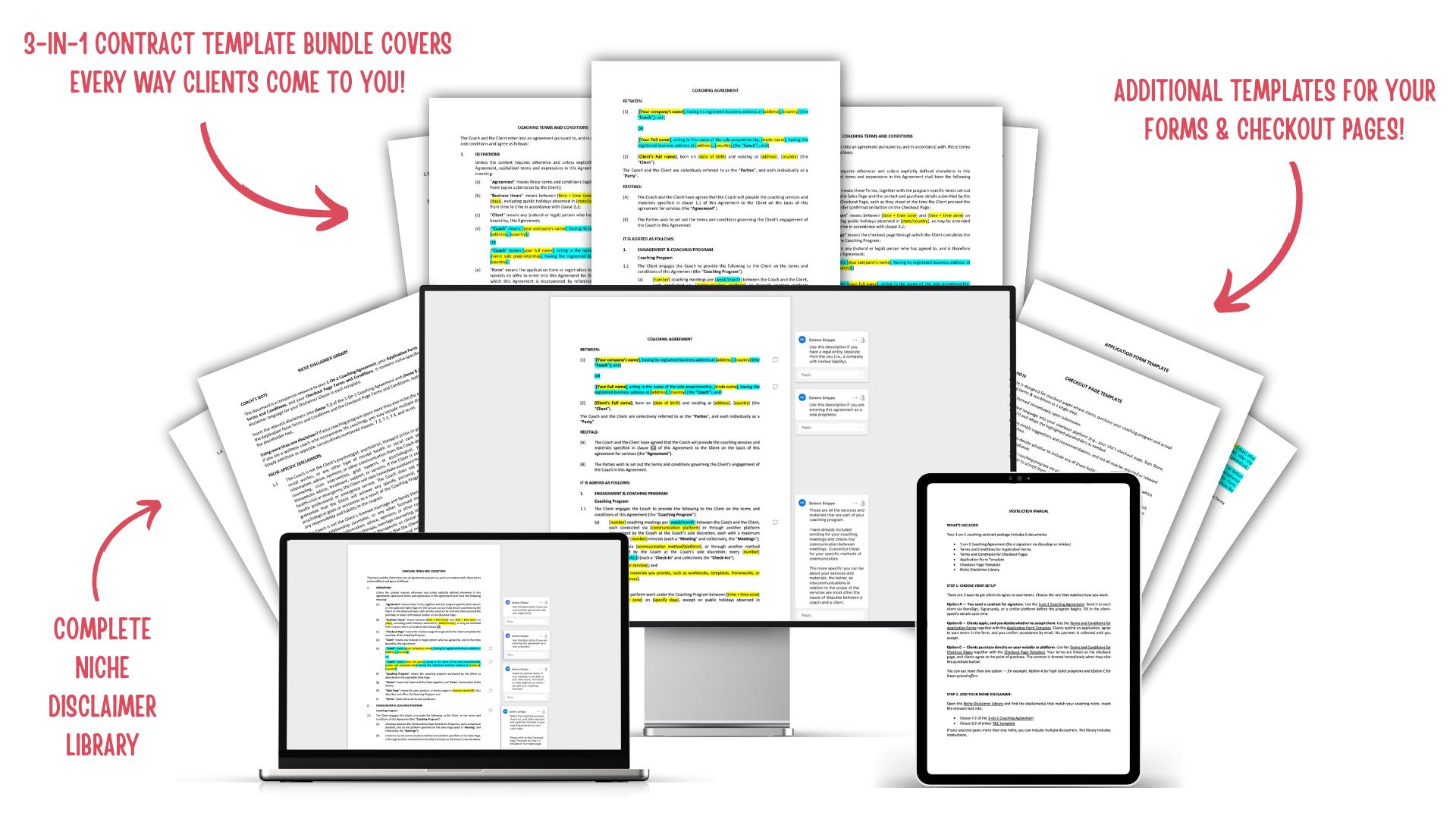
✅ My 1-On-1 Coaching Agreement Template includes all of the above — pre-written, niche-specific, and built into the agreement, the application form template, and the checkout page template, including explicit acknowledgment checkboxes for clients to confirm their mental health status and understand your scope of practice before they sign.
3. Does It Tell You What to Fill In, What’s Optional, and What to Delete?
A template with little or no guidance is almost as dangerous as no template at all.
The average (and even paid) life coaching agreement template hands you a wall of legal text and leaves you to figure out the rest.
They’ll provide very little or no instructions, no explanation of what the optional clauses actually do, and a completely blank space for you to describe your scope.
A good life coaching agreement template should make it obvious what to do with every single part of it. Here's what that looks like in my coaching agreement template bundle:
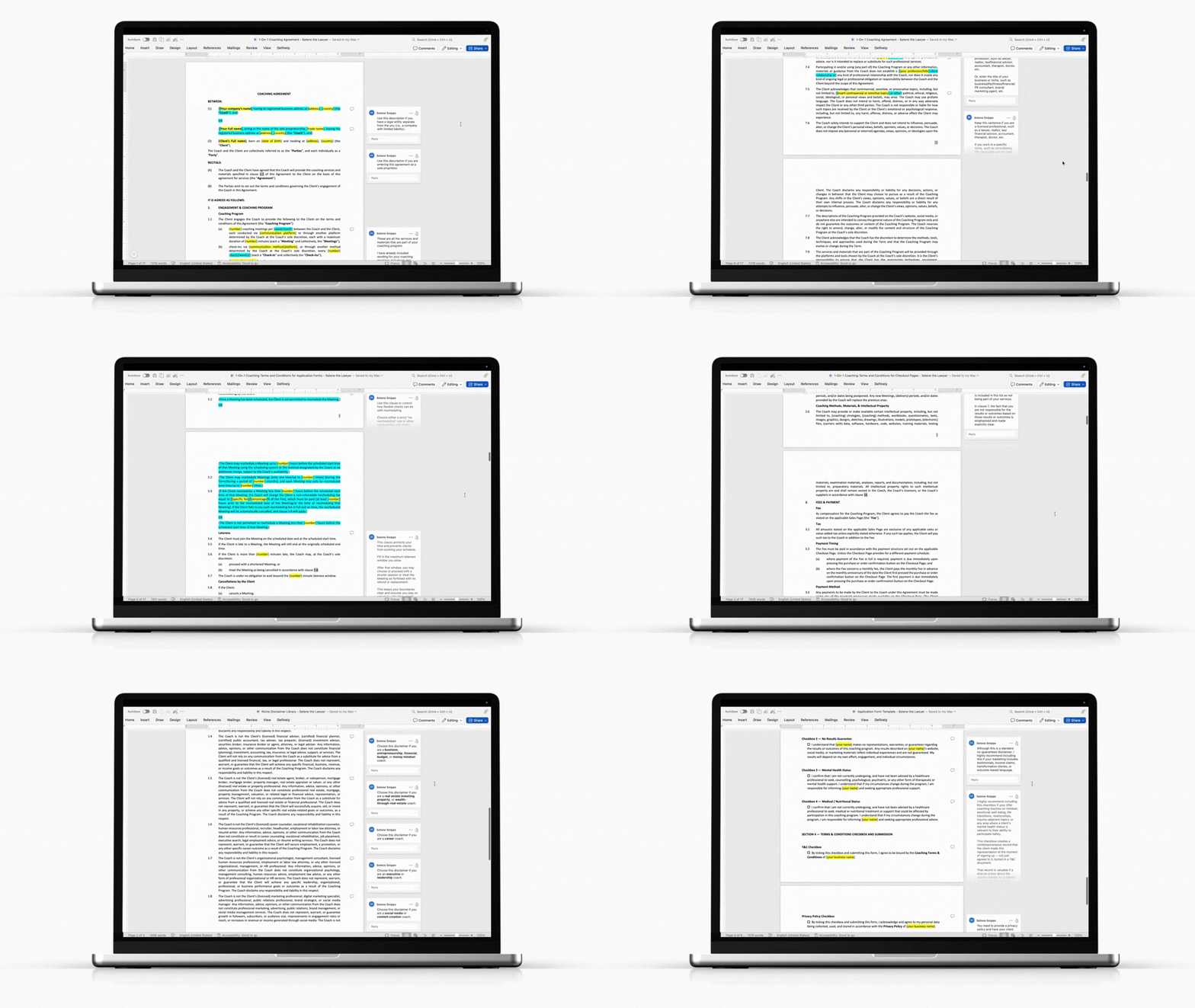
A clear set of instructions that walks you through the whole process — including choosing the right template format for your business
Fields you need to fill in (your name, fee, session frequency, governing law), with proper guidance on what to put there
Alternative clauses to choose from, so you can tailor it to your business model, refund policy, and cancellation rules
Practical guidance explaining what each important clause does and when to use it
Exact wording for your checkout page or application form — including how to present your refund policy and rescheduling rules to clients
✅ My 1-On-1 Coaching Agreement Template includes a full instruction manual that walks you through every step.
4. Does It Actually Cover How Online Coaching Works Today?
The average life coaching agreement template is written for a coach who meets clients in person, hands them a printed contract, and collects a check…
Today, online coaching faces a completely different set of situations that need to be covered.
Here's what a proper life coaching agreement template free of fluff should address:
Virtual-only sessions and tech responsibility
Your life coaching agreement template should include a scope clause for you to specify which platform your sessions run on — and make clear that if a client can't access Zoom, has connectivity issues, or joins from a broken laptop, that's on them. Not you.
Business hours and communication boundaries
In a digital age, clients can find you everywhere — Instagram DMs, text, WhatsApp, email, and the list goes on.
Your life coaching agreement template needs to set clear business hours and specify exactly which platforms you're available on—and which you're not. Without this, you're implicitly on call 24/7.
Session expiry and no rollovers
Unused sessions should expire at the end of the program term — automatically, with no extensions and no rollovers unless you explicitly agree by email.
Without this, clients will ask to "pause" their program indefinitely or bank unused sessions for later (whenever that may be).
No-shows, late cancellations, and lateness
If a client cancels at the last minute, doesn't show up, or joins 20 minutes late — what happens?
A proper life coaching agreement template should explicitly address all three scenarios, including what counts as a no-show and what happens to the forfeited session.
Check-ins
This is so bizarre to me, but the average simple life coaching agreement template doesn't even mention check-ins—and that is one of the reasons so many coaches struggle with clients texting and calling them nonstop.
Your agreement should at least specify when they start (after the first session), how they're conducted, and — crucially — that they expire at the end of the term.
Digital materials
If you share workbooks, templates, or other resources as part of your program, those should be non-refundable the moment access is granted — regardless of whether the client actually uses them.
Most outdated templates don't even mention digital materials and lack IP provisions that properly protect your copyrights for your digital products.
Coach unavailability
What happens when you need to take a break?
Your agreement should give you the right to temporarily adjourn the program without having to refund everything, with a clear mechanism for adjusting the term or fee.
Payment structure for online coaching programs
The payment structure in your agreement needs to match how you actually get paid, but most templates don’t.
First, you need the right version of the template for how payment is collected:
Checkout page or online store — payment happens at the point of purchase, so the contract is formed and payment is due simultaneously
Application form — payment is requested separately after you confirm acceptance by email
E-signature agreement — payment timing is set out directly in the contract itself
And within each version, your template should include alternative clauses for different payment structures:
A single upfront payment for a fixed-term coaching program
Monthly upfront payments for ongoing coaching — due before each new month begins, with automatic payment authorization
✅ My 1-On-1 Coaching Agreement Template covers all of the above — built specifically for online life coaches running virtual programs.
5. Does It Work as a Complete System — Not Just a Single Document?
Here's something I see all the time: a coach grabs a random life coaching agreement template, copies a refund and cancellation policy they liked from another coach's sales page, and pastes it onto their own sales page.
The problem? The refund and cancellation policy on the sales page says one thing. The refund clause in the contract says something slightly different.
And that’s how you’ll end up in a major argument with a client who’s relying on a random sales page and has never read the contract.
This is not a hypothetical. This is how refund disputes start.
Your sales page, checkout page, application form, and contract all need to say the same thing — especially regarding refunds, cancellations, session inclusions, and program duration. If there's any inconsistency between them, a client will find it.
That's why I’ve created a life coaching agreement template bundle that works as a complete ecosystem — where every document references the same core terms, there are no contradictions between them, and there’s no room for a client to play one document against another.
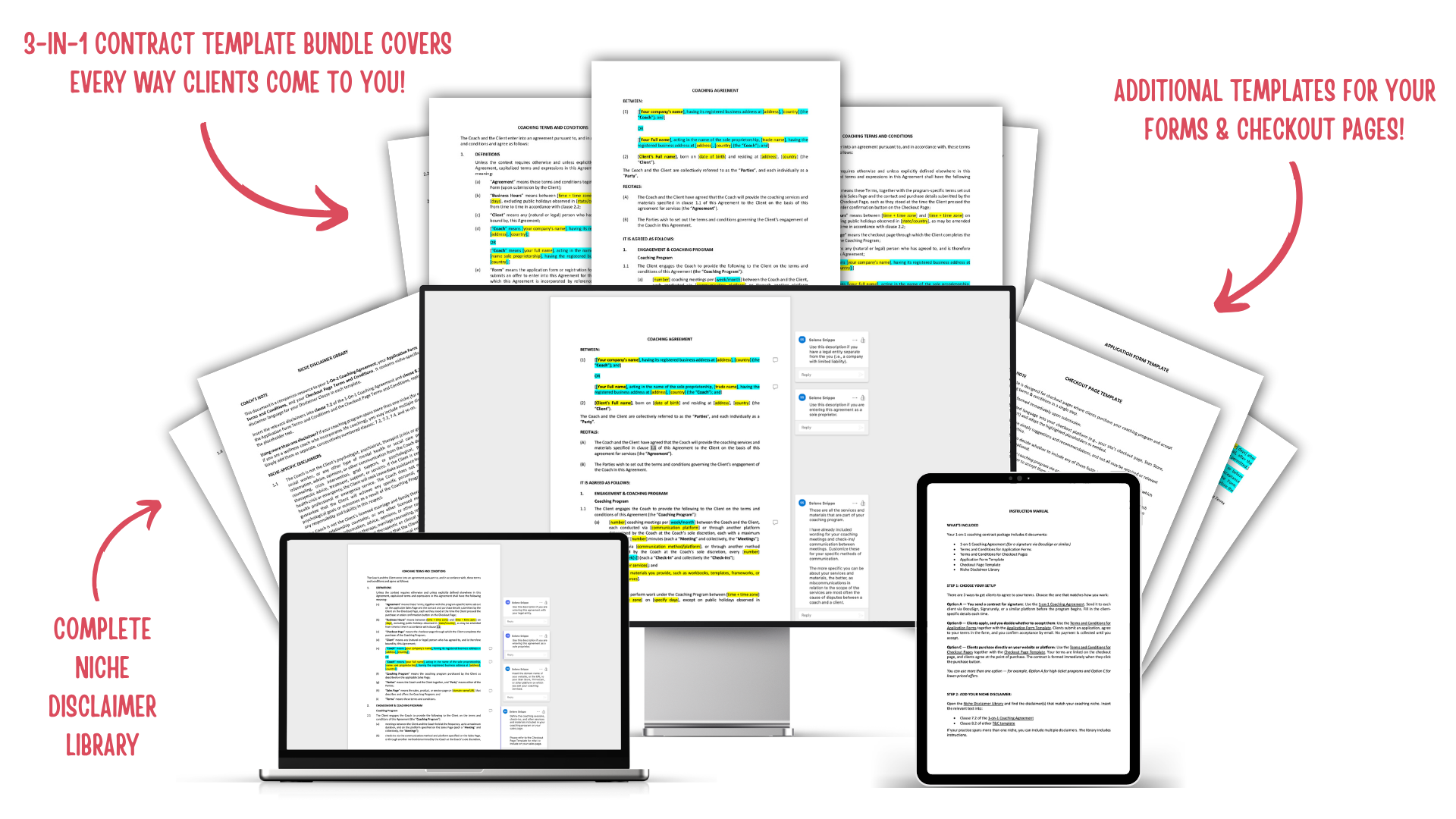
Here's what that complete ecosystem looks like:
A coaching agreement for e-signature
Terms & conditions for application forms — plus a complete application form template
Terms & conditions for checkout pages — plus a complete checkout and sales page template
A niche disclaimer library so every document uses the right language for your coaching niche
A full instruction manual so you know exactly how to put it all together
✅ My 1-On-1 Coaching Agreement Template is designed as exactly that — a complete bundle where every document works together, with no gaps, no contradictions, and no room for a client to play one document against another.
The Ultimate Life Coaching Agreement Template Free of Fluff — With Everything You Need
So before you download anything, run it through these five checks:
Does it match how you actually sign clients?
Does it have the right disclaimers for life coaching specifically?
Does it tell you what to fill in, what's optional, and what to delete — and explain why?
Does it actually cover how online coaching works today?
Does it work as a complete system — not just a single document?
👉 My 1-On-1 Coaching Agreement Template checks all five. Here's what’s inside:
A complete scope framework — what's included and what's not (sessions, check-ins, materials, and business hours)
A customizable payment schedule for both fixed-term programs and ongoing month-to-month coaching
A rescheduling policy with options ranging from no rescheduling to a tiered system with notice windows, fees, and limits
A lateness policy — including exactly when you're entitled to treat a session as forfeited
A cancellation policy that makes missed sessions non-refundable — including for personal circumstances, time zone errors, and tech issues on the client's side
A no-rollover clause so unused sessions expire at the end of the term and can't be banked for later
A check-in clause specifying when they start, how they're conducted, and that they expire with the term
A refund policy with multiple options — including a legal waiver of statutory cooling-off and withdrawal rights
A chargeback protection clause covering disputed payments, bank fees, and legal costs
A full disclaimer suite for life coaches — mental health, no professional relationship, controversial topics, no influence or agenda, results and outcomes, and tech and platform
A mental health waiver requiring clients to confirm they don't currently need — and haven't been advised to seek — therapy or counseling
Client warranties confirming age, legal capacity, and mental and emotional suitability for coaching
An intellectual property clause protecting your frameworks, methods, workbooks, and materials
A non-disparagement clause so a disgruntled client can't go on a social media rampage against you
A coach unavailability clause giving you the right to temporarily adjourn the program without issuing refunds
And so much more!
👉 Check out my 1-On-1 Coaching Agreement Template to learn more!
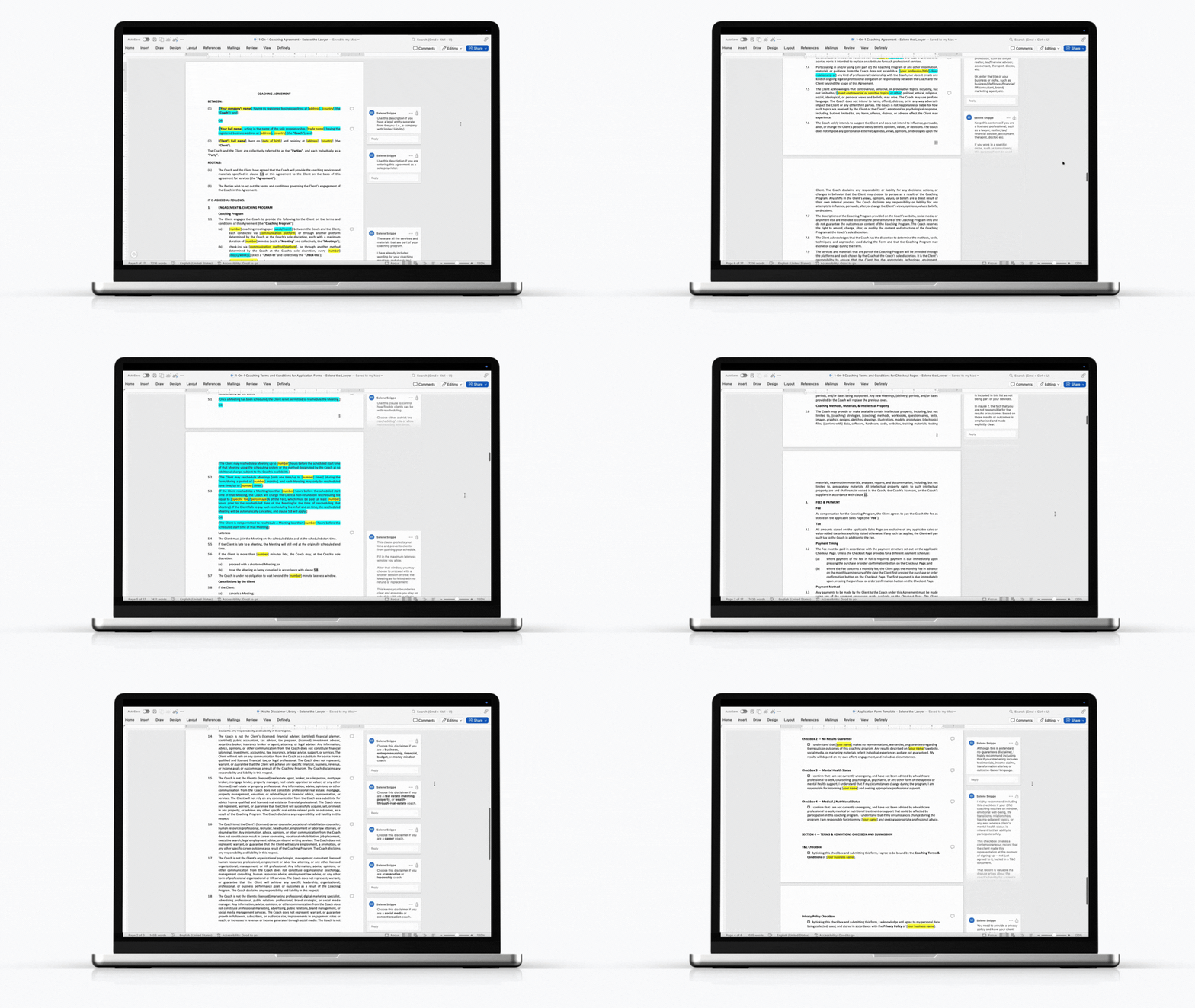
This post was all about what every life coach needs in a life coaching agreement template.
You may also like: