How to Start a Nutrition Coaching Business: 10 Crucial Steps Before You Take On a Single Client

Want to know how to start a nutrition coaching business — without crossing legal lines or losing money on avoidable mistakes? Without the right setup, you could find yourself with liability claims you weren’t prepared for, or no clients at all.
As a business lawyer for coaches, I’ve seen new nutrition coaches pour everything into launching — and still end up with boundary-crossing clients, refund disputes, and liability claims that could have been avoided entirely with the right foundation from the start.
In this post, I’m walking you through exactly how to start a nutrition coaching business in 10 crucial steps — from getting certified and understanding your legal boundaries, to designing your offer, setting up your contracts, and landing your first paying clients.
By the end, you’ll know how to start a nutrition coaching business online without overpaying for your setup or losing money with the wrong setup.
This post is all about how to start a nutrition coaching business — so you can launch legally and sign clients without the costly mistakes most new nutrition coaches make.
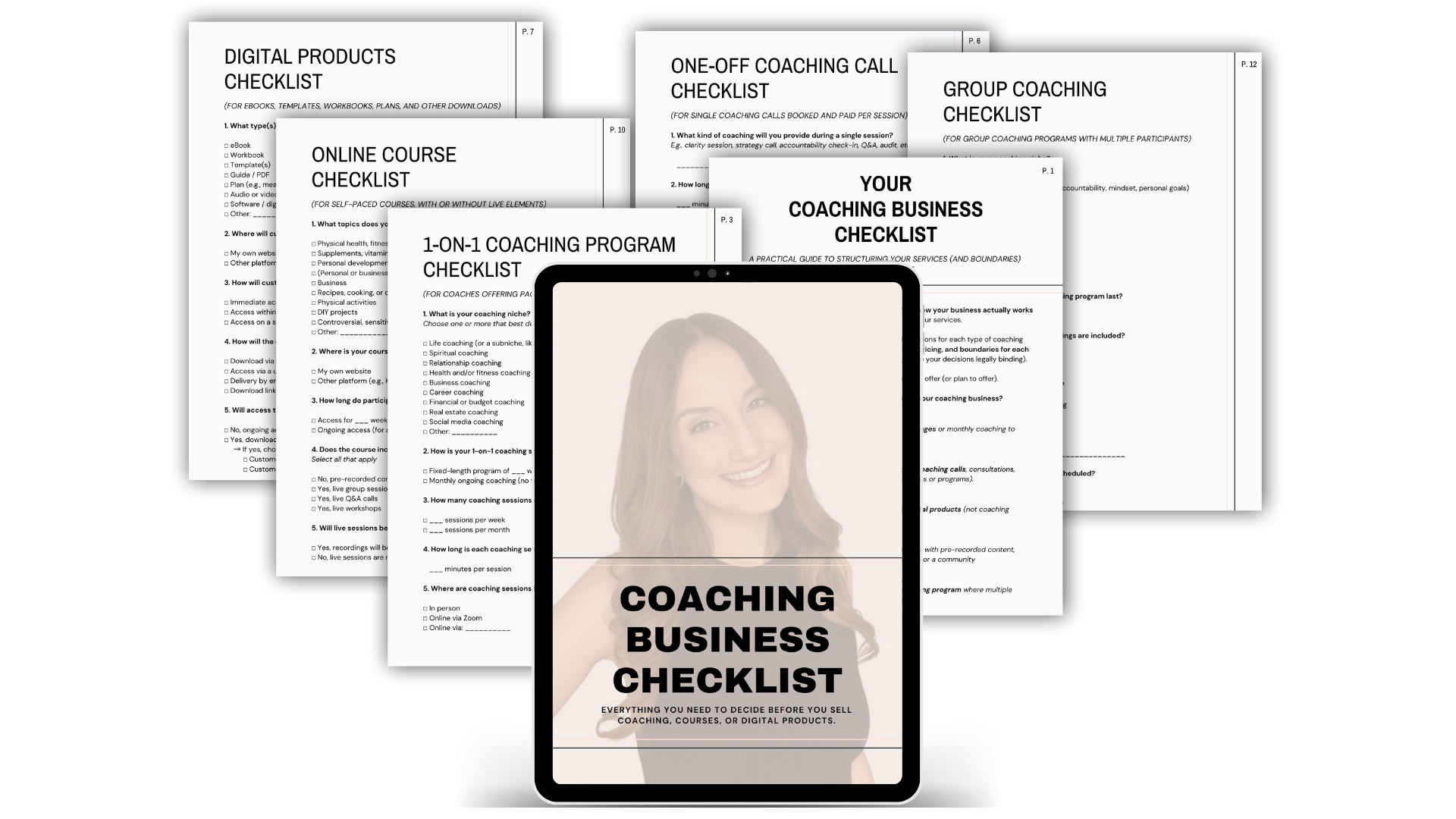
👉 Grab my free Coaching Business Checklist — it walks you through every decision you need to make for your coaching offers before you launch.
How to Start a Nutrition Coaching Business
How to Start a Nutrition Coaching Business Online in 10 Steps
Step 1: Get Clear on Your Nutrition Coaching Niche and Client Avatar
The first step in how to start a nutrition coaching business is defining your nutrition coaching niche and ideal client.
Nutrition coaching is a broad field, and you need to niche down by answering these 3 questions:
Who do you help? Define a specific type of person with a specific problem.
What transformation do you deliver? What shifts in your clients’ habits, relationship with food, or health outcomes?
What outcome do your clients walk away with? What will their life actually look like after working with you?
Here’s what that looks like in practice:
Gut health coaching for women with IBS and bloating who want to identify their triggers and finally eat without anxiety
Metabolic health coaching for men over 45 who travel constantly for work and want to lose weight without giving up every meal out
Hormone health coaching for women in perimenopause who want to feel like themselves again without going straight to medication
Prenatal nutrition coaching for first-time mothers who want to eat well during pregnancy without the overwhelm of conflicting advice
Plant-based nutrition coaching for people transitioning to a vegan diet who want to make sure they're actually getting everything they need
Each of these names a specific person, a specific problem, and a specific result.
Your niche shapes everything that follows — your offer, your pricing, your contracts, and how clients find you with their specific nutrition coach questions.
👉 Need help finding your direction? Check out my post on 31 Online Coaching Business Ideas to Start This Year.
Step 2: Get Certified — and Know Which Certifications Actually Matter

Before you figure out how to start a nutrition coaching business online, you need to know where you stand legally and professionally.
Do you actually need a certification to start a nutrition coaching business? In most places, nutrition coaching is largely unregulated, and there is no legal requirement to hold a certification before taking on clients.
That said, getting certified is still worth considering:
It adds credibility with potential clients who are comparing their options.
Some corporate wellness programs, platforms, and directories require it.
It gives you a clearer framework for what you can and cannot advise on, which directly affects your liability exposure.
If you do get certified, keep your ROI in mind. Nutrition coaching certifications range from a few hundred to tens of thousands of dollars — and the expensive ones aren't necessarily worth it right now.
Here’s the truth: your clients may ask if you're certified, but they won't care where you got it. Once you're earning consistently, a more advanced program may be worth the investment. But don't overspend on something your clients won’t notice and that won't necessarily make you a better coach than the cheaper alternative.
And here’s what most guides on how to become a nutrition coach won't tell you: a certification does not define your legal scope of practice — and it does not replace a proper contract. That's what Steps 3 and 7 are for.
Step 3: Understand What You Can and Cannot Do as a Nutrition Coach
This is the step that most guides on how to start a nutrition coaching business don’t address, but it’s actually one of the most important ones.
Nutrition coaching sits in a legally sensitive space, and it’s one of the riskiest because it concerns people’s physical well-being.
Without a clear understanding of your scope of practice, you could face serious liability claims, so you need to know what you can and can’t do
As a nutrition coach, you can:
Help clients set nutrition and lifestyle goals.
Provide general nutrition education and accountability.
Support clients in building sustainable habits around food, hydration, and meal planning.
Help clients implement guidance they've already received from a licensed professional.
But you cannot:
Diagnose a condition or disease.
Prescribe a specific diet to treat or manage a medical condition.
Recommend supplements to treat symptoms or a diagnosed condition.
Interpret lab results or medical tests.
Advise clients to change or stop medication.
The line matters — especially in this niche. Even if you are also a licensed dietitian, registered nutritionist, or medical professional, you can’t provide such services in your role as a nutrition coach.
A client who feels your advice made their health condition worse is far more likely to take legal action than a client who didn't like your business coaching.
Here's how to protect yourself:
A scope exclusion clause in your 1-on-1 Coaching Agreement that explicitly excludes medical and clinical nutrition advice
A medical disclaimer on your website and in your contract
An intake form with explicit waivers where clients confirm they are not undergoing — or advised to undergo — any medical or nutritional treatment
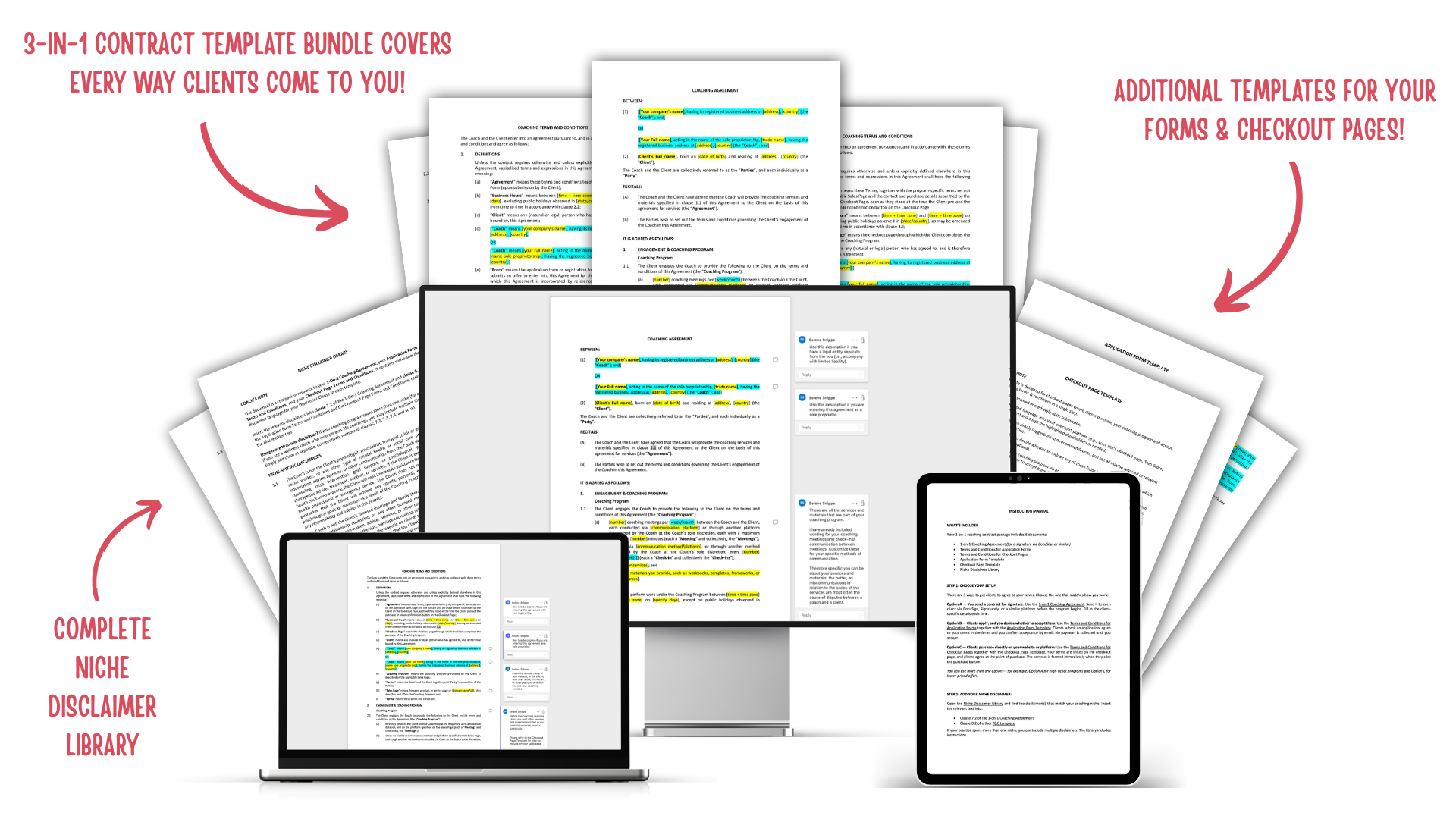
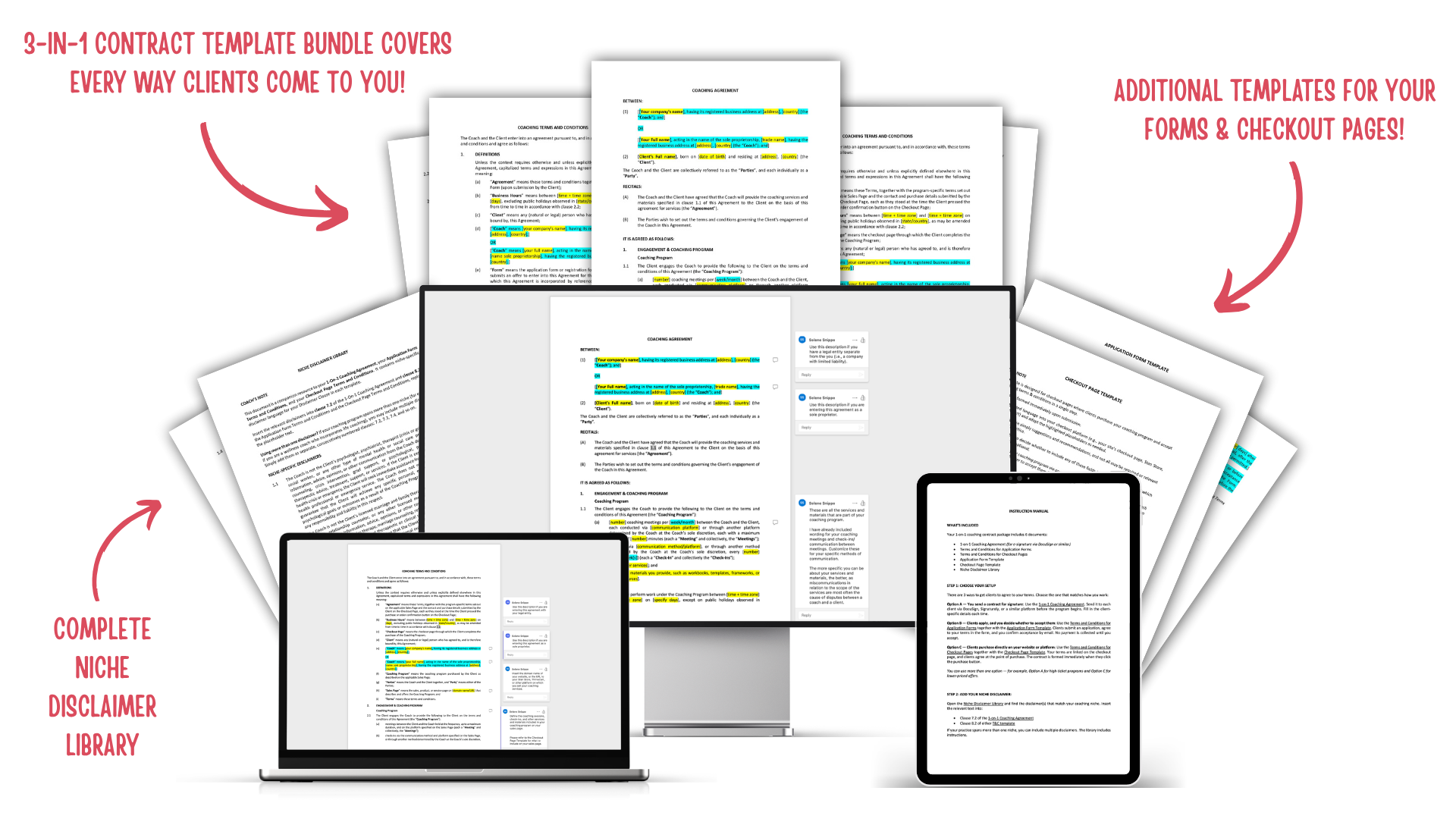
👉 My 1-on-1 Coaching Agreement and legal website bundle include all niche-specific disclaimers, client waivers, and protections specifically for nutrition and health coaches.
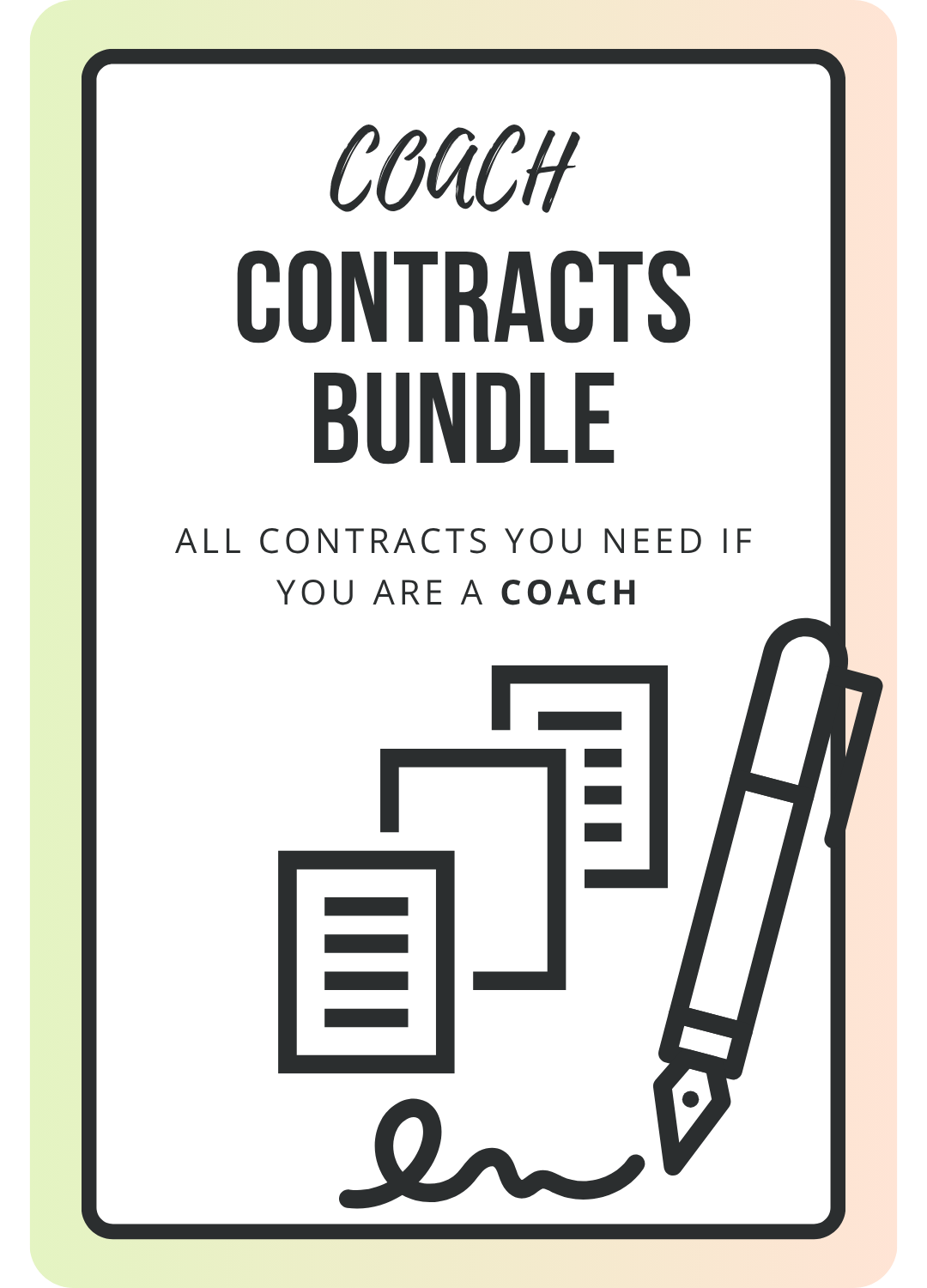
💡 My Coach Contracts Bundle includes all the legal documents you need for your website, 1-on-1 coaching sessions, one-off coaching calls, group coaching sessions, and more — for up to 34% off!
Step 4: Design Your Core Nutrition Coaching Offer
Once you know your niche and your legal boundaries, the next step in how to start a nutrition coaching business from home is deciding what you’re actually selling.
If you’re just starting out, you only need one core offer. Don’t try to set up everything at once, like a course, a group program, and a digital product all at once. Start with one.
That offer should be a structured 1:1 nutrition coaching program — with a defined length, a set number of sessions, and a clear outcome. For example:
A 12-week gut health reset with weekly 60-minute sessions and a custom meal planning framework
A 3-month metabolic health program for male executives with bi-weekly sessions and check-ins via Voxer
An 8-week prenatal nutrition program with weekly sessions and a trimester-by-trimester nutrition guide
You could also supplement that with one-off nutrition coaching calls that clients can book directly through your scheduler — but nothing more than that to start.
Once your 1:1 offer is consistently full, validated, and refined, you can expand into:
Group nutrition coaching programs with multiple participants.
A self-paced online course that clients can follow at their own pace.
Low-ticket digital products like meal planners, habit trackers, or recipe guides.
But don’t build any of that until your 1:1 offer has been running successfully for at least a year. Validate and refine your core offer first. Then expand into other coaching offers.
👉 Grab my free Coaching Business Checklist for this step — it walks you through every structural decision you need to make for each coaching offer before you sell it.
Step 5: Set Your Pricing and Payment Structure
The next obvious step in how to start your own nutrition coaching business is pricing your offer.
Don't price based on what an established nutrition coach with hundreds of testimonials charges. And don't listen to anyone on TikTok telling you to charge $5,000 from day one.
When you're just starting out, price based on the structure of your offer and your current level of demand (which is probably really low, if you’re just figuring out how to become a nutrition coach).
It’s also one of the most difficult nutrition coach questions to answer, because it also depends on your location and the demographic you serve.
But here are realistic starting price ranges for a new nutrition coach:
A one-time 60-minute call: $75–$150
A 4-8 week 1:1 nutrition coaching program: $600–$1,200
These are starting points, not ceilings. As your results, testimonials, and demand grow, so should your rates.
You also need to make a few key decisions on payment terms up front:
Do clients pay the full program fee up front, or a monthly fee up front for each month of a longer program?
Will you offer a payment plan? If so, how many installments — and will you charge a split-pay fee?
Are refunds available? Under what conditions, and up until when?
Make sure your pricing, payment structure, and refund policy are locked into a legally binding 1-on-1 Coaching Agreement before you take a single payment — so there's no room for dispute later.
👉 Grab my free Coaching Business Checklist — it guides you through every decision you need to make before you launch, including pricing, payment, and refund policy.
Step 6: Sort Out Your Business Structure and Legal Foundation
If you’re serious about how to start a nutrition coaching business, you need to make your business official before you take on your first client.
For most coaches in the U.S., that means sorting out 3 things:
1. Pick a business name and check availability. Before you commit to a name, check that it's available as a legal business name in your state via ZenBusiness and as a domain name for your website (via GoDaddy).
2. Form a legal entity. For most nutrition coaches in the U.S., a single-member LLC is the right starting point. It separates your personal assets from your business liabilities — so if a client ever makes a claim against you, your personal finances are protected.
I recommend ZenBusiness to set it up. Yes, this is an affiliate link, and I earn a commission. But I recommend it because I use it myself, it costs nothing beyond your state's filing fee, and it's faster and cheaper than hiring an overpriced lawyer for something this straightforward.
3. Open a separate business bank account. Do this the moment your LLC is formed. Running business income through your personal account puts your personal assets at risk, even if you have an LLC — a court could “pierce the corporate veil” and hold you personally liable for any business claims, which defeats the entire point of forming an LLC.
👉 For a full step-by-step breakdown, check out my post on How to Legally Start a Business in 9 Simple Steps.
Step 7: Get Your Contracts in Place Before Your First Client
Of course, as a lawyer for coaches, I have to tell you that starting a nutrition coaching business without the right contracts is a bad idea.
But seriously — without a legally binding agreement in place, you have no enforceable rules. And in a niche where clients are dealing with physical health, the stakes are higher than in most other coaching niches.
Here’s what can happen without the right contracts:
A client demands a full refund the day before your program starts — and has a legal right to it, because they never agreed to your refund policy in writing.
A client claims your nutrition guidance worsened their condition and threatens legal action.
A client ghosts halfway through the program and disputes the charge with their bank.
A client keeps canceling or rescheduling sessions at the last minute, costing you time you could have spent on another paying client.
And no, a refund or cancellation policy on your sales page or invoice is not legally binding.
If your client hasn’t explicitly agreed to your terms by signing a contract or checking a box at checkout, your rules will not hold up.
Here’s how to start a nutrition coaching business:
A 1-on-1 Coaching Agreement — covering session structure, scope exclusions, medical disclaimers, refund terms, and termination rights
A Virtual Meeting Policy for one-off coaching calls — with clear rules on cancellations, rescheduling, no-shows, and refunds
A Group Coaching Agreement for when you're ready to launch group programs
Terms and Conditions for Online Courses for any self-paced courses
Terms and Conditions for Digital Products for meal planners, habit trackers, recipe guides, or any other digital downloads
A Legal Website Bundle with a privacy policy, terms of use, and disclaimer page for your website
Or grab the Coach Contracts Bundle and get everything you need in one place — at a major discount of up to 34%.
Step 8: Build a Website That Does the Selling For You

The next best step in how to start a nutrition coaching business from home is building your website.
You don’t need anything fancy at this stage. Your website only needs 5 things:
A homepage that immediately communicates who you help and what you offer
A short About Me page that builds trust and speaks to your client avatar
A sales page for your 1:1 nutrition coaching program with a clear call to action
A sales page for one-off coaching calls linked to your online scheduler
Your 3 essential legal website pages — privacy policy, terms of use, and disclaimer
A lot of coaches claim you don’t need a website, and you can just use something like ThriveCart or Stan Store and link that in your Instagram bio.
The problem is that you don’t own those platforms. If those platforms shut down, your entire business disappears. Also, third-party platforms are way too overpriced.
I recommend building your website onSquarespace. Yes, this is an affiliate link, and I earn a small commission. But I use it myself, and here's why I recommend you should use it, too:
You can launch a professional-looking nutrition coaching website in a weekend — even if you're not tech-savvy at all (like me).
You can sell coaching programs, digital products, and online courses all in one place.
It's a lot cheaper than platforms like Stan Store or ThriveCart — and unlike those, you actually own your website.
👉 Make sure to grab my Legal Website Bundle to cover your privacy policy, terms of use, and disclaimer.
Step 9: Set Up Your Tools, Platforms, and Payment Processors
The next practical step in how to start a nutrition coaching business online is setting up your business tools.
Since you’re a beginner, I want to protect you from the shiny objects syndrome and overspending on software you don’t actually need. We want to keep your business as lean as possible.
All you need for your nutrition coaching business are these 4 tools:
1. A payment processor. If you build your website on Squarespace, use Squarespace's built-in payment processor for your coaching programs. It's cheaper than PayPal or Stripe, and you can send invoices with a payment link directly through it, which keeps everything in one place.
If you use an external scheduler like Calendly for one-off coaching calls, you'll need to connect a separate payment processor, such as Stripe or PayPal, to handle those bookings.
2. A business email address. Don't run your nutrition coaching business from your personal Gmail or iCloud account. Set up a professional email address that matches your domain — it takes 10 minutes and instantly makes your business look more credible.
3. A platform for client sessions. Zoom is the easiest option, and the one most clients are already familiar with. Set up a dedicated business account linked to your business email, and use it for all your sessions (to keep business and personal separate).
4. A communication platform for between-session contact. If your program includes check-ins or support between sessions, decide upfront which platform you'll use—and stick to it. Popular options are Voxer, WhatsApp, or Slack.
And set boundaries on coaching sessions and communication processes. Make sure your session length, scheduling rules, check-in process, response times, and availability are clearly stated in your 1-on-1 Coaching Agreement.
👉 And grab my free Coaching Business Checklist to guide you through all the practical decisions you need to make on platforms, sessions, and communication boundaries before you launch.
Step 10: Go Get Your First Paying Nutrition Coaching Clients

The last step in how to start a coaching business is finally getting your first paying clients!
And it’s actually never been easier to find clients than it is today from the comfort of your own home. But with all the options, like (online) networking events, TikTok, Instagram, Facebook groups, and blogging, it can feel quite overwhelming.
To simplify it for you, here’s what I’d recommend.
No matter your strategy, start with your existing network. Tell literally everyone you know that you’re starting a nutrition coaching business — your friends, your family, your former colleagues, your parents’ neighbors. If they don’t fit your client avatar, they might know someone who does perfectly.
Tell them exactly who you help, what you help with, and the outcome you help clients achieve (Step 1).
If you're starting with no money and zero followers, the fastest way to build social proof is a small beta phase. Sign 3–5 clients at a reduced rate in exchange for a strong testimonial. Your beta clients could be:
Friends, family, or former colleagues who already trust you
Followers who have been engaging with your content
People in relevant Facebook groups who are actively asking for help
Even during beta, use a proper 1-on-1 Coaching Agreement from day one — discounted rate or not.
Then, choose one strategy and stick to it for one year.
I’m an avid believer in the Rule of Five Ones, which is:
One target audience (as we defined in Step 1).
One specific problem you solve from them (which we also defined in Step 1).
One core offer (which we defined in Step 4).
One consistent channel to acquire clients (which we’re about to choose in this step).
One year of sticking to this strategy.
After that year, you can create other offers and focus on different channels, but choose just one channel to acquire clients for now.
There isn’t one right answer as to which channel to choose, but here’s basically what you could choose from:
Instagram and TikTok. Nutrition content performs really well on both platforms. Show up consistently, speak directly to your client avatar’s struggles, and make it easy for people to find your website.
Facebook groups. Find communities where your ideal nutrition-coaching client already hangs out, and show up as a genuinely helpful voice. It will take time to gain trust this way, but it can snowball really fast.
Blog and Pinterest. This is the long game, and the most sustainable one for my business. A well-optimized blog post can drive consistent traffic to your website for months without you having to show up on social media every single day. Nutrition and wellness content performs really well on Pinterest, too.
If you want to learn how to do this properly, I highly recommend Perfecting Blogging and Perfecting Pinterest by Sophia Lee. And no, these are not affiliate links — I genuinely have my own traffic to thank her for, so I think her courses are worth every penny.
Now You Know How to Start a Nutrition Coaching Business from Home — Here’s What To Do Next
Starting a nutrition coaching business is exciting. But in a niche where clients are dealing with their physical health, having the right contracts in place isn't optional — it's essential.
Here are the 3 basic contract templates you need before you take on your first client:
1-on-1 Coaching Agreement — covering session structure, scope exclusions, medical disclaimers, refund terms, and termination rights
Virtual Meeting Policy — for one-off coaching calls, with clear rules on cancellations, rescheduling, no-shows, and refunds
Legal Website Bundle — your privacy policy, terms of use, and disclaimer page
Or grab the Coach Contracts Bundle and get everything you need in one place — at up to 34% off.
This post was all about how to start a nutrition coaching business — so you can launch legally, protect yourself, and sign clients without the costly mistakes most new nutrition coaches make.
You might also like: