9 Key Steps to Starting a Life Coaching Business (That Most New Coaches Skip)
Thinking about starting a life coaching business? Without the right setup and offer structure, you'll spend the next few months dealing with boundary-crossing clients, refund demands, and last-minute cancellations.
As a business lawyer for coaches, I've seen coaches with genuinely great skills deal with schedules hijacked by clients who constantly reschedule, work creeping well outside their scope, money lost to no-shows, and ghosts. All because the business wasn’t set up properly from the start.
In this post, I’m walking you through the 9 key steps to starting a life coaching business — from finding your niche and designing your offer to pricing, setting your life coaching salary, securing legal protection, and landing your first paying clients.
By the end, you'll have a clear life coaching business plan with the exact steps to starting a life coaching business.
This post is all about starting a life coaching business so you can avoid the mistakes that cost most new coaches their first six months.
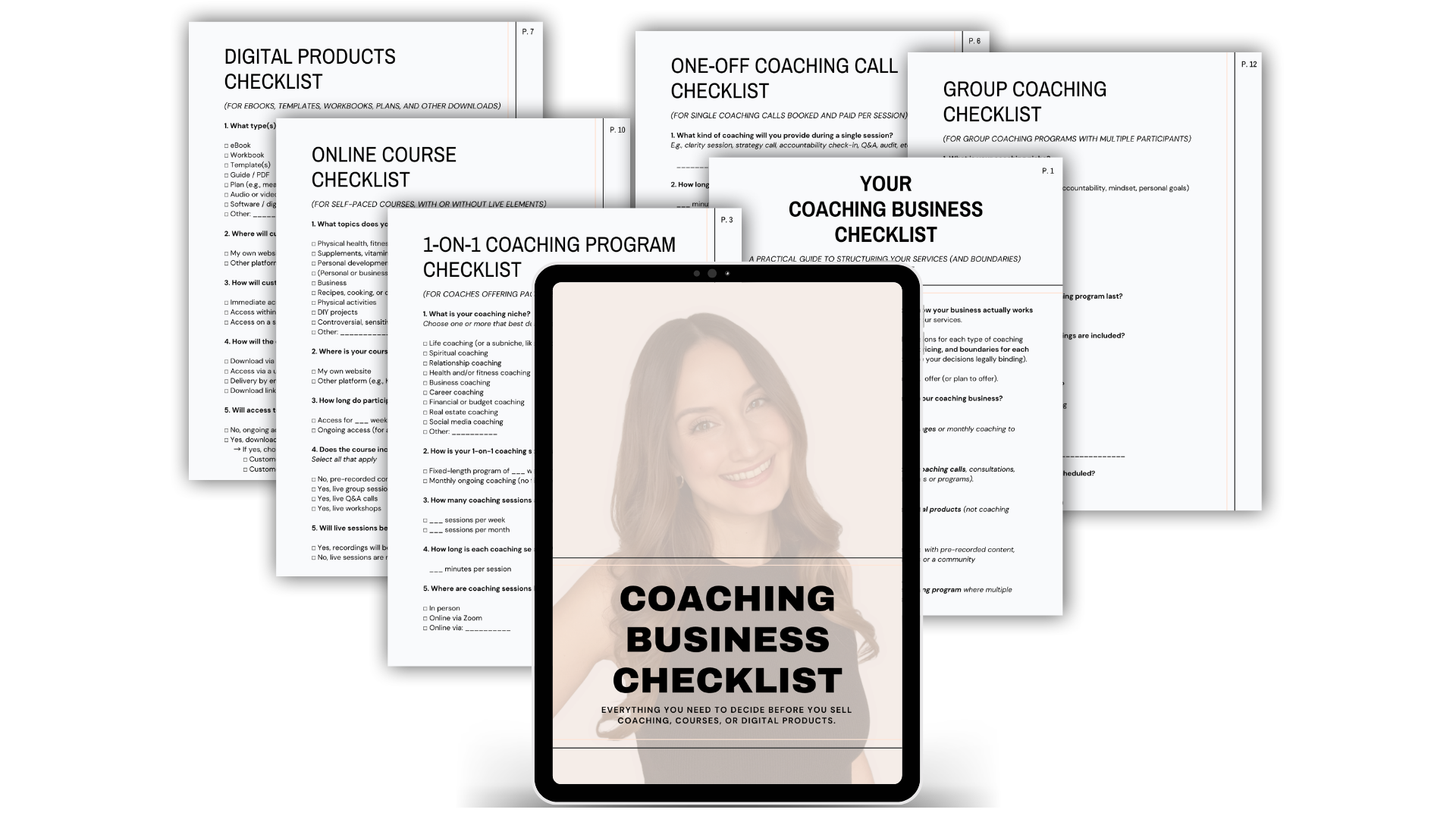
👉 Grab my free Coaching Business Checklist — it walks you through every decision you need to make for your offers, pricing, and legal setup before you launch.
Starting a Life Coaching Business the Right Way
The 9 Steps to Starting a Life Coaching Business from Home
Step 1: Get Super Specific About Who You Help (And What They Actually Walk Away With)

This is where most new coaches starting a life coaching business go wrong before they’ve even sold anything.
“Helping people live their best lives” is too vague and does not speak to anyone in particular.
You need to be crystal-clear on 3 core things:
Who you help: a specific type of person with a specific problem.
What transformation you deliver: what shifts in their mindset, situation, or habits.
What outcome they walk away with: what their life actually looks like after working with you.
Here’s what that looks like in practice:
Divorce transition coaching for women over 40 who want to rebuild their confidence and sense of identity after a long-term relationship ends
ADHD productivity coaching for self-employed creatives who keep starting new projects and never finishing any of them
Empty nest coaching for mothers in their 50s who have lost their sense of purpose now that their kids have left home
Perimenopause coaching for women in leadership roles who want to manage their symptoms without slowing down their career
Burnout recovery coaching for female attorneys in Big Law who want to transition out of corporate law without feeling like they're starting from zero (totally not something I suffered with)
Each of these names a specific person, a specific problem, and a specific result — not just a topic.
Your niche shapes everything that follows, including your offer, pricing, contracts, website, and how you market yourself.
👉 Not which life coaching niche you should focus on? Read my blog post on the 17 life coaching business ideas to start this year!
Step 2: Design the Coaching Offer You’d Actually Want to Buy
Once you know who you're helping and what transformation you deliver, the next step in starting a life coaching business is deciding what you're actually selling.
If you’re just starting a life coaching business from home, you only need one core offer. Not three. Not a course, and a group program, and 20 digital products. You’re starting with just one offer.
That offer should be a structured 1:1 life coaching program — with a defined length, a set number of sessions, and a clear outcome. For example:
A 12-week burnout recovery program with weekly 60-minute sessions
A 6-week divorce transition program with bi-weekly sessions and one check-in per week
A 3-month ADHD productivity program with weekly sessions and Voxer support between calls
You could also supplement that with one-time coaching calls that clients can book through your online scheduler, but nothing more.
Once your 1:1 offer is consistently full, you understand your clients' patterns, have tweaked your program, and validated it, you can expand into:
Group coaching programs and memberships with multiple participants
A self-paced online course that clients can follow at their own pace
Low-ticket digital products, such as eBooks, workbooks, habit trackers, templates, or journal prompts
But don’t build any of that until your 1:1 offer has been running successfully for at least a year. Validate first. Then expand.
👉 Grab my free Coaching Business Checklist — it walks you through every structural decision you need to make for each offer before you sell it.
Step 3: Set Your Pricing — And Don’t Under- or Overprice Yourself

When starting a life coaching business with no money, a lot of coaches either undercharge out of imposter syndrome or overprice before they have the results to back it up.
Don’t charge what an established coach with 500 testimonials charges. And certainly don’t listen to anyone on TikTok claiming you can charge clients $5,000 right away.
When you're just starting out, price based on the structure of your offer and your current level of demand. That can still differ dramatically depending on multiple factors, such as your state/country and the demographic of clients you serve.
But here are realistic starting price ranges for a new life coach:
A one-time 60-minute coaching call: $75–$150
A 4–6 week 1:1 life coaching program: $400–$900
A 3-month 1:1 life coaching program: $1,200–$2,500
These are starting points. This is not forever. It’s a simple supply and demand game. As your results, testimonials, and demand grow, so should your rates — and so will your life coach salary.
You also need to make a few key decisions on payment terms upfront:
Do clients pay the full program fee up front, or do they pay a monthly fee up front for each month of your long-term program?
Exactly how and when do they pay? Can anyone just purchase your program on your site and pay at checkout? Or do they apply to your program and pay once they're accepted? (More on this in Step 7.)
Will you offer refunds under certain conditions? If so, under what conditions, and up until when?
Make sure your pricing, payment structure, and refund policy are locked into a legally binding 1-on-1 Coaching Agreement before you take a single payment — so there's no room for dispute later.
👉 Grab my free Coaching Business Checklist — it guides you through every pricing, payment, and refund policy decision you need to make before you launch.
Step 4: Pick Your Business Structure Before You Get Paid a Single Dollar
If you’re officially starting a life coaching business, you need to sort out 3 things:
1. Pick a business name and check availability.
Choose a name that speaks to your niche and client avatar, or simply use your own name, or even better, a name that includes both your name and your client avatar or niche.
Before you commit, check that it’s available both as a legal business name in your state (via ZenBusiness) and as a domain name for your website (just type your name into GoDaddy).
2. Form a legal entity.
For most coaches in the U.S., a single-member LLC is the right starting point. It separates your personal assets from your business liabilities. So, if a client ever makes a claim against you, your personal finances are protected.
I recommend ZenBusiness to set it up. Yes, this is an affiliate link, and I earn a commission. But I recommend it because I use it myself to set up my own LLCs, it costs nothing beyond your state’s filing fee, and it's faster and cheaper than hiring an expensive lawyer (who’s slower) for something this straightforward.
3. Open a separate business bank account.
Do this the moment your LLC is formed, and have your business transaction run through that account.
Running business income through your personal account puts your LLC protection at risk — a court could “pierce the corporate veil,” meaning you can be held personally liable for any business claims, even though you have an LLC. That defeats the entire point of forming an LLC in the first place.
👉 For a full step-by-step breakdown, check out my post on How to Legally Start a Business in 9 Simple Steps.
Step 5: Get Your Legal Documents in Place (Yes, Before Your First Client)
Of course, I’ll be the one to tell you that starting a life coaching business without contracts is a bad idea.
But, seriously, not having an ironclad, legally binding agreement between you and your clients will cost you — and not just financially.
A lot of coaches assume that getting paid up front means they're covered. But without a legally binding contract in place, you have no enforceable rules. And when a difficult situation arises — and it will — you’ll have nothing to stand on.
Here’s what can happen without the right contracts:
A client demands a full refund the day before your program starts — and has a legal right to it, because they never agreed to your refund policy in writing.
A client claims you gave them mental health advice without a license and threatens legal action.
A client ghosts halfway through the program and disputes the charge with their bank or PayPal.
A client keeps canceling or rescheduling booked sessions at the last minute, costing you so much time you could have spent on another paying client.
And no, a refund or cancellation policy on your sales page or invoice is not legally binding. If your client hasn't explicitly agreed to your terms by signing a contract or checking a box at checkout, your rules will not hold up.
Here’s what you need for each offer when starting a life coaching business:
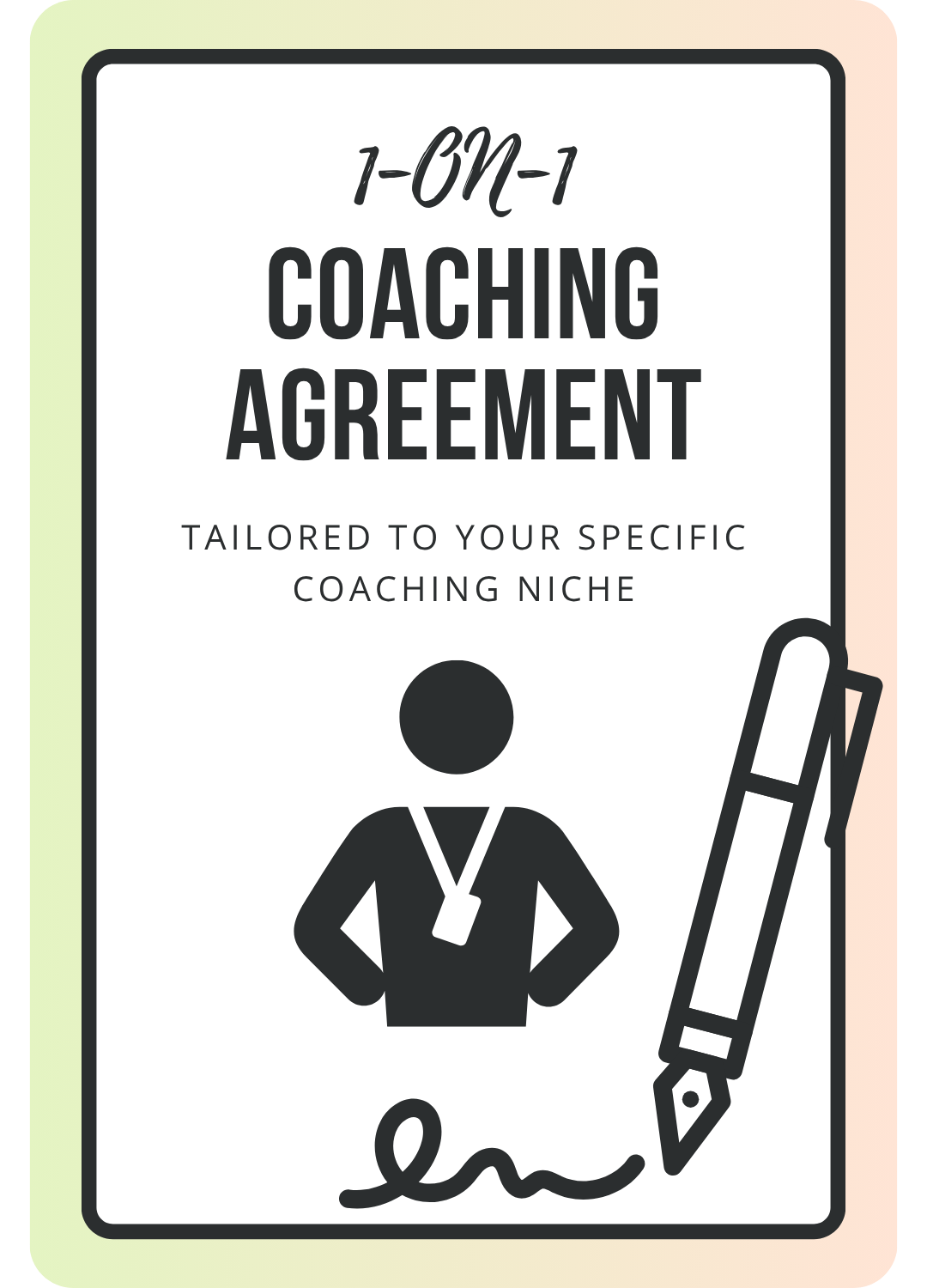
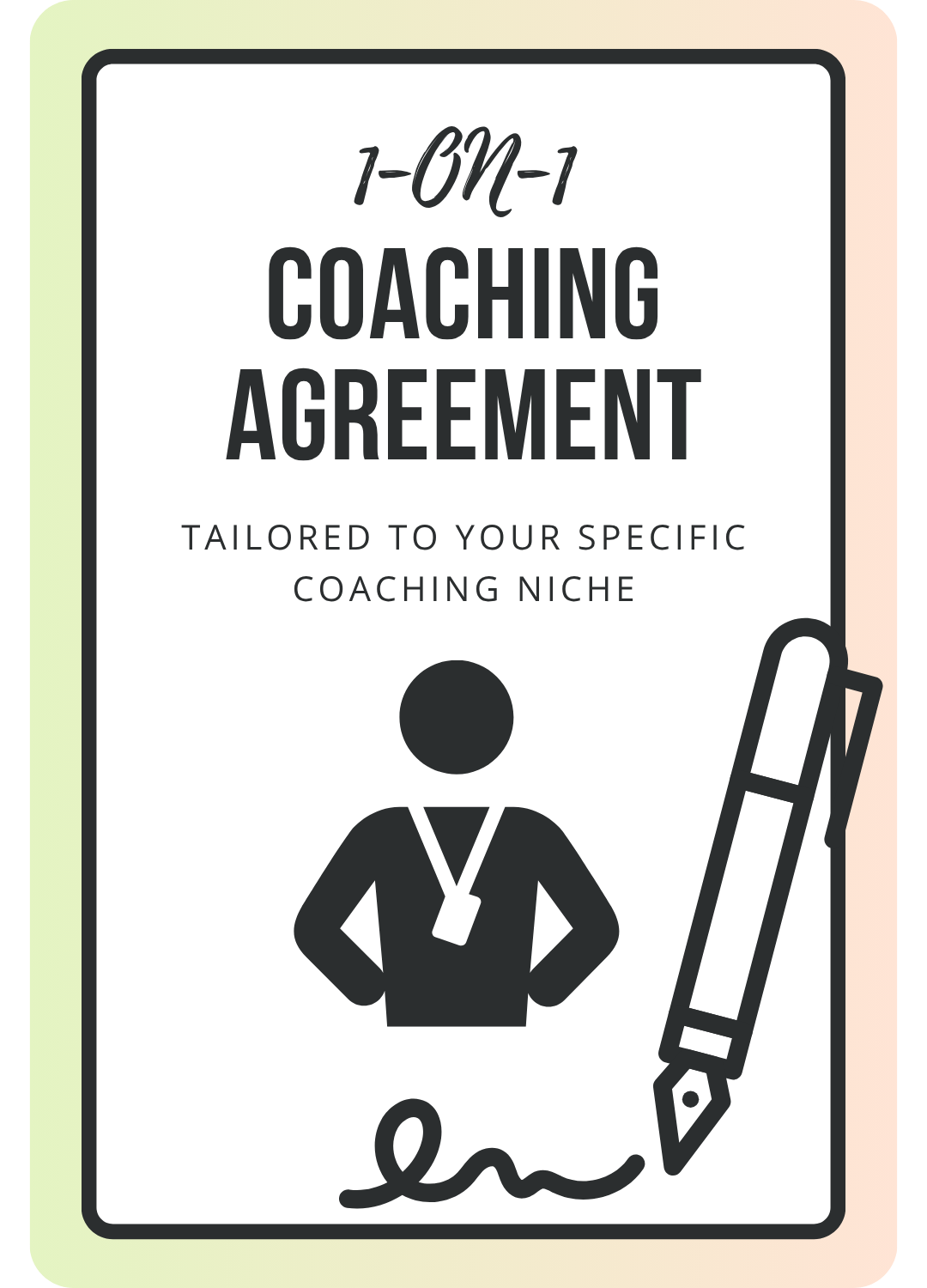
A 1-on-1 Coaching Agreement for your 1:1 program — covering session structure, scope exclusions, mental health disclaimers, refund terms, and termination rights.
A Virtual Meeting Policy for one-off coaching calls — setting clear rules on cancellations, rescheduling, no-shows, and refunds.
A Group Coaching Agreement for when you're ready to launch group programs — covering confidentiality, participation standards, and recording rules.
Terms and Conditions for Online Courses for any self-paced courses that could include live workshops or access to an exclusive Facebook group.
Terms and Conditions for Digital Products for eBooks, workbooks, templates, journal prompts, or any other digital downloads.
A Legal Website Bundle with a privacy policy, terms of use, and disclaimer page for your website.
Or grab the Coach Contracts Bundle and get everything you need in one place — at a major discount.
Step 6: Build a Website That Does the Selling For You
When you're starting a life coaching business from home, your website is your most important sales tool. It works while you sleep, while you're coaching, and while you're not on social media.
You don't need anything fancy at this stage. Your website only needs 5 things:
A homepage that immediately communicates who you help and what you offer
A short About Me page that builds trust and speaks to your client avatar
A sales page for your 1:1 program with a clear call to action
A booking page for one-off coaching calls linked to your online scheduler
Your three legal website pages — privacy policy, terms of use, and disclaimer
I recommend building your website on Squarespace. Yes, this is an affiliate link, and I earn a small commission. But here's why I recommend it over anything else:
You can launch a professional-looking coaching website in a weekend — even if you're not tech-savvy at all.
You can sell coaching programs, digital products, and online courses all in one place.
It's a lot cheaper than platforms like Stan Store or ThriveCart — and unlike those, you actually own your website.
👉 Make sure your website has the right legal pages from day one — grab my Legal Website Bundle to cover your privacy policy, terms of use, and disclaimer.
Step 7: Create Your Onboarding Process Before You Actually Need It

Most new coaches figure out their onboarding process after they find their first client and scramble to figure out a cumbersome process to vet the client, get a contract signed, and then get paid.
Setting it up before you need it means you're never scrambling when someone actually says yes.
You have 3 main options for how to onboard clients:
Option 1: Send a contract manually via DocuSign.
You send your coaching agreement by email or through DocuSign, wait for it to be signed, and then send a separate payment link.
This is the traditional way, and many new coaches just starting a life coaching business start out this way.
But it's an unnecessarily slow process — and it creates multiple opportunities for a potential client to lose interest and drop off before they’ve paid.
Option 2: Sell through a checkout page with terms and conditions.
Clients purchase directly on your website and agree to your coaching terms and conditions at checkout by ticking a box.
It’s a clean, efficient process with minimal friction. But for life coaching specifically, where you're often working with people in vulnerable situations, you may want more control over who enters your program before they pay.
Option 3: A structured application and registration form.
This is the approach I recommend for most life coaches. You build one structured form that includes:
Intake questions to determine whether the client is a good fit
Explicit waivers, including confirmation that coaching is not therapy
A checkbox agreeing to your coaching terms and conditions
A checkbox agreeing to your privacy policy
The client submits the form, and enrollment is only confirmed upon your written acceptance. This gives you full control over who enters your program — and protects both you and your client from the start.
My 1-on-1 Coaching Agreement includes contract language that's compatible with all 3 onboarding options, so whichever process you choose for your business model, you're legally covered.
Step 8: Set Up All Your Platforms, Payment Processors, and Coaching Tools
Now, for the practical side of starting a life coaching business.
Before you take on your first client, you need 4 things in place:
1. A payment processor.
If you build your website on Squarespace, use Squarespace's built-in payment processor for your coaching programs. It's cheaper than PayPal or Stripe, and you can also send invoices with a payment link directly through it, which keeps everything in one place.
But if you use an external scheduler like Calendly for one-off coaching calls, you'll still need to connect a separate payment processor, such as Stripe or PayPal, to handle those bookings.
2. A platform for client sessions.
There are multiple options, such as Zoom, Google Meet, and Microsoft Teams. But Zoom is the easiest option and the one most clients are already familiar with.
Another option would be to just call or FaceTime (if your clients are in the same country and timezone), but that makes it really easy for clients to call you anytime outside of their sessions — which you might come to regret.
3. A communication platform for between-session contact.
If your program includes check-ins or support between sessions, decide upfront which platform you'll use, and stick to one. Popular options are Voxer, Slack, WhatsApp (with international clients), or just text (for clients within the country).
The platform matters less than the boundary you set around it, so make sure your response times and availability are clearly stated in your 1-on-1 Coaching Agreement.
4. A business email address.
Don't run your coaching business from your personal Gmail or iCloud account. Set up a professional email address that matches your domain — it takes 10 minutes and instantly makes your business look more credible.
👉 Grab my free Coaching Business Checklist — it guides you through the practical platform decisions, communication boundaries you need to set, and other key decisions you need to make before you launch.
Step 9: Go Get Your First Paying Clients

You don't need a massive following, a viral TikTok, or a fully built-out funnel. You need a clear offer, a working website, and a way for people to find you.
Here's where to start:
Your existing network.
Don't underestimate the people you already know and tell literally everyone you know, including your parents’ neighbors, that you’re starting a life coaching business. If they don’t fit your client avatar, they might know someone who fits your client avatar perfectly.
Tell them exactly who you help, what you help with, and the outcome you help clients achieve (like you specified in Step 1).
If you're starting a life coaching business with no money and zero followers, the fastest way to build social proof is a small beta phase. Sign 3–5 clients at a reduced rate in exchange for a strong testimonial.
Your beta clients could be:
Friends, family, or former colleagues who already trust you
Followers who have been engaging with your content
People in relevant Facebook groups who are actively asking for help
Even during beta, treat it like a real program. Use a proper 1-on-1 Coaching Agreement from day one, even if you’re working at a discounted rate.
Once you’ve helped those few people, they’ll tell others about their incredible results. Word of mouth remains one of the most effective ways to get paying clients.
Instagram and TikTok.
Short-form content works well in the life coaching space. Show up consistently, speak directly to your client avatar's struggles, and make it easy for people to find your website.
Facebook groups.
Find communities where your ideal client already hangs out and show up as a genuinely helpful voice. Don't pitch. Just be useful — and clients will find you.
Blog and Pinterest.
This is the long game, and the most sustainable one. A search engine-optimized (SEO) blog post can drive consistent traffic to your website for months without you having to show up on social media every single day.
Life coaching content performs exceptionally well on Pinterest, too.
If you want to learn how to do this properly, I highly recommend Perfecting Blogging and Perfecting Pinterest by Sophia Lee. And, no, these are not affiliate links — I genuinely have my own traffic to thank her for, so I think her courses are worth every penny.
Now, You Have Your Life Coaching Business Plan — Here’s What to Do Next
Starting a life coaching business is exciting. But without the right contracts in place, one difficult client situation can cost you more than just money (as you’ve learned in Step 5).
Here are the exact contract templates you need before you take on your first client:
1-on-1 Coaching Agreement — your most important document as a life coach, covering session structure, scope exclusions, mental health disclaimers, refund terms, and termination rights
Virtual Meeting Policy — for one-off coaching calls, with clear rules on cancellations, rescheduling, no-shows, and refunds
Group Coaching Agreement — for when you're ready to scale into group programs
Terms and Conditions for Online Courses — for any self-paced courses you launch
Terms and Conditions for Digital Products — for eBooks, workbooks, templates, and other digital downloads
Legal Website Bundle — your privacy policy, terms of use, and disclaimer page
Or grab the Coach Contracts Bundle and get everything you need in one place — at a major discount.
This post was all about starting a life coaching business — so you can go from idea to first paying client without the costly mistakes most new coaches make.
You might also like: