How to Start an Online Life Coaching Business in 10 Simple Steps (And Actually Get Clients)

Want to know how to start an online life coaching business — and actually build one that gets consistent clients?
Without a proper setup, you could end up with refund claims, constant reschedulings, last-minute cancellations, or worse, no client at all.
As a business lawyer for coaches, I’ve seen what separates the online life coaches who have built entire empires from the ones who struggle to get their first paying client. And it almost never comes down to coaching skills — it comes down to legal foundations, the right offer structure, and a clear strategy.
In this post, I'll walk you through exactly how to start an online life coaching business in 10 simple steps — from choosing your niche and pricing your offers, to understanding the coaching-therapy boundary, getting the right contracts in place, and landing your first clients.
By the end, you'll have a complete step-by-step life coaching business plan template — and you’ll know exactly how to start a life coaching business from home without wasting money on things you don't need.
This post is all about how to start an online life coaching business in 10 simple steps — so you can launch with the right legal foundation, a proper coaching offer, and your first paying clients lined up.
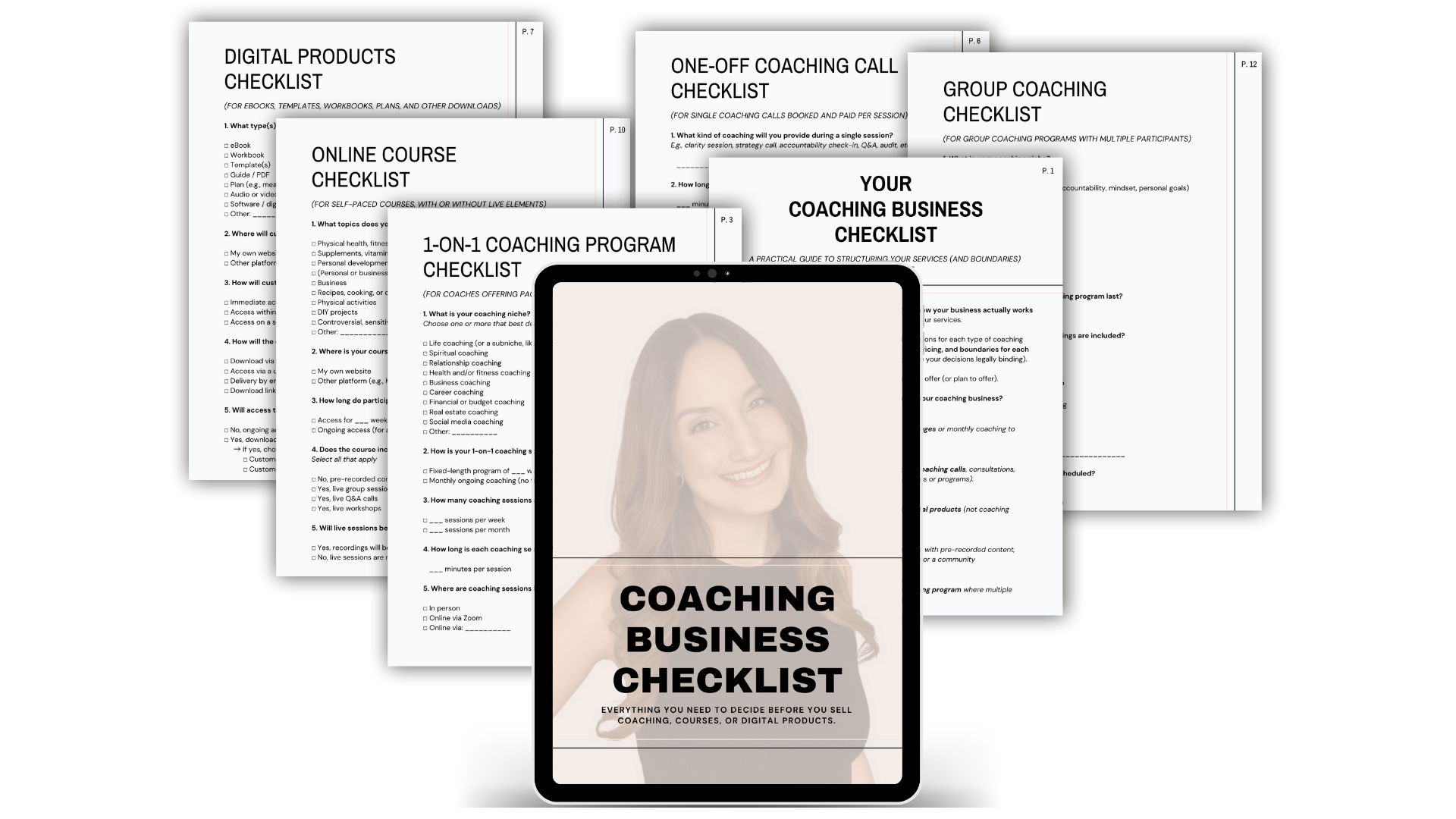
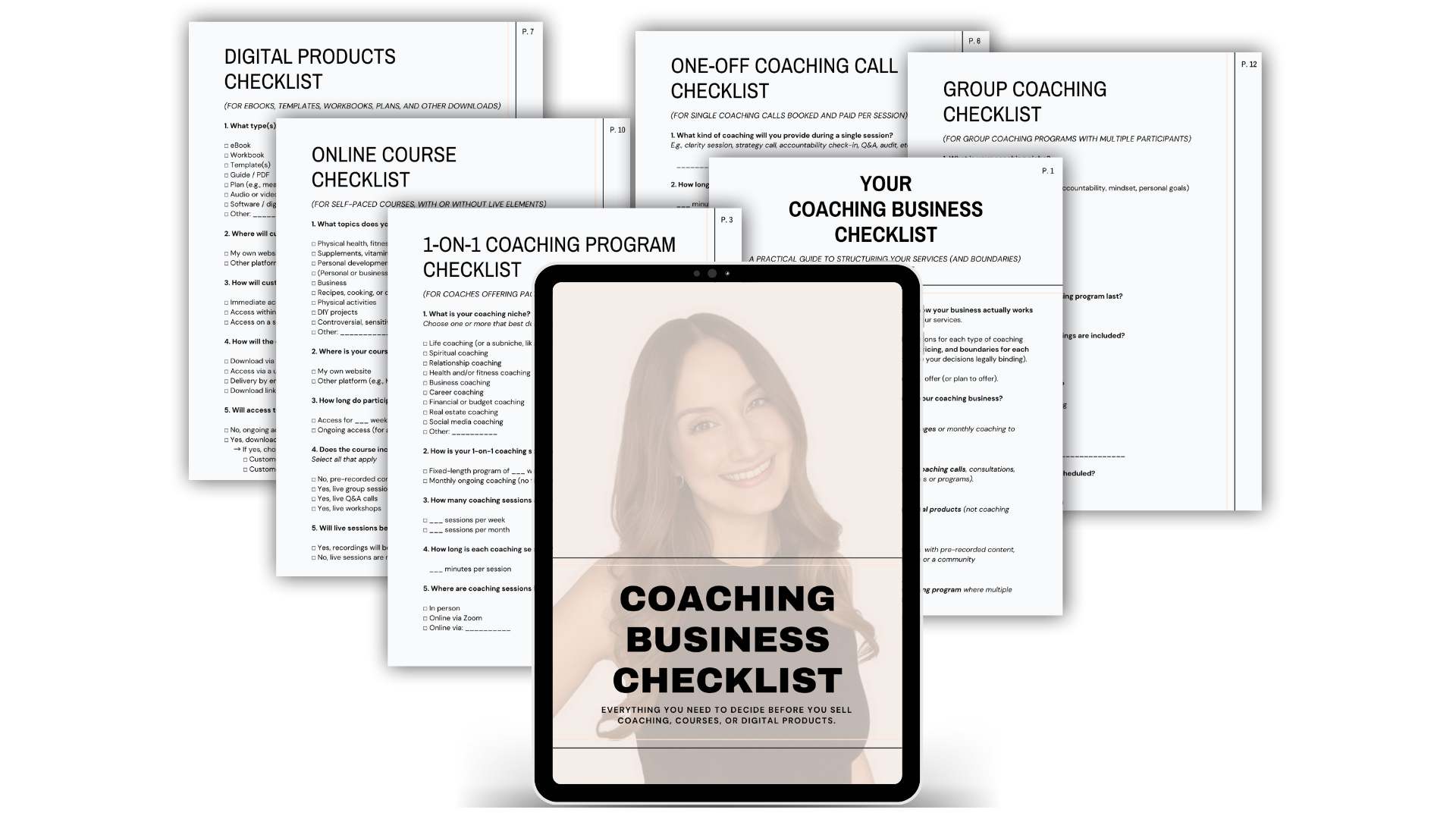
👉 Before you dive in, download my free Coaching Business Checklist to make the right decisions about your offers, pricing, boundaries, and terms before you launch.
How to Start an Online Life Coaching Business
How to Start an Online Life Coaching Business from Home In 10 Steps
Step 1: Decide on Your Life Coaching Niche and Client Avatar

If you want to know how to start an online life coaching business that actually attracts clients. You probably already have an idea, but you need to be crystal-clear on:
who you help, and
what problem you solve.
Successful online life coaches own a specific subniche and a specific client avatar. Here are a few examples:
ADHD coaching for late-diagnosed adults
Burnout recovery coaching for high-performing executives and managers or small business owners
Divorce transition coaching for women over 40
Friendship coaching for male adults who are 35+
Perimenopause coaching for women in the workforce after a career break
See how each of these describes a specific person with a specific problem and not just a topic?
Your subniche and client avatar will shape everything that follows — your offers, pricing, intake process, and how you market yourself online.
👉 Check out my post on life coaching business ideas for more inspiration on finding your direction.
Step 2: Focus on creating one core offer
Once you know who you’re helping and what problem you're solving, the next step in how to start an online life coaching business is deciding what you're actually selling.
If you’re just starting out, all you should focus on is one core offer and maybe one supporting offer:
Your first core offer should be a structured 1:1 life coaching program — for example, a 12-week burnout recovery program with weekly sessions, or a 6-week divorce transition program with bi-weekly check-ins.
One-off coaching calls or strategy sessions — a 90-minute clarity call or a goal-setting session that clients can book and pay for directly through your scheduler.
Once your 1:1 offer is generating consistent revenue and you truly understand your clients’ patterns and needs, you can expand into:
Group life coaching programs — for example, a 30-day accountability group or a confidence-building cohort
Online courses — a structured program that clients can follow at their own pace
Digital products — workbooks, habit trackers, journal prompts — low-ticket products that bring new clients into your world and can eventually convert them into your higher-ticket coaching program
But don't build any of that until your 1:1 offer has been working for at least 1 year. Start with one solid offer. Validate it. Then expand into creating other offers.
👉 Download my free Coaching Business Checklist to set the rules and boundaries for each offer before you sell!
Step 3: Price Your Offers Realistically
Pricing is where a lot of new life coaches either undersell themselves out of imposter syndrome or overprice before they have the results to back it up.
Here’s how to start a life coaching business from home the right way: price based on your offer’s structure and your current level of demand.
Don’t price based on what other (more experienced) online life coaches charge or what someone on TikTok says.
How you should price yourself is, of course, dependent on your specific subniche and where you live, but here’s a realistic price range for someone who is just starting out:
A 60-minute one-off coaching call: $75–$150
A 4–6 week 1:1 life coaching program: $400–$900
A 3-month 1:1 life coaching program: $1,200–$2,500
These are starting points, not ceilings. It’s a supply and demand game. As your testimonials, results, and demand grow, so should your rates.
Also, you need to make some important decisions about your payment structure, such as whether clients pay the full program fee upfront (for a fixed program of several weeks) or a monthly fee in advance (for an ongoing, rolling monthly program).
Also, will you offer refunds under certain conditions? Like, if a client cancels at least X hours before the first session? Or will no refunds be offered once a client has been accepted into the program?
👉 My free Coaching Business Checklist guides you through these decisions and other important decisions you need to make for each of your offers before you sell.
And make sure that your pricing, payment structure, and refund policy are clearly stated in a legally binding coaching agreement before you take a single payment.
Step 4: Legal Protections for the Coaching-Therapy Boundary
Most people teaching how to start an online life coaching business never talk about this — but it’s one of the most important steps in this entire guide.
As a life coach, you could face serious liability claims simply for drifting into therapeutic territory — even unintentionally.
A client could accuse you of diagnosing or treating a mental health condition, and because life coaching is completely unregulated, there is no professional body standing between you and that lawsuit.
Here’s what you need to protect yourself:
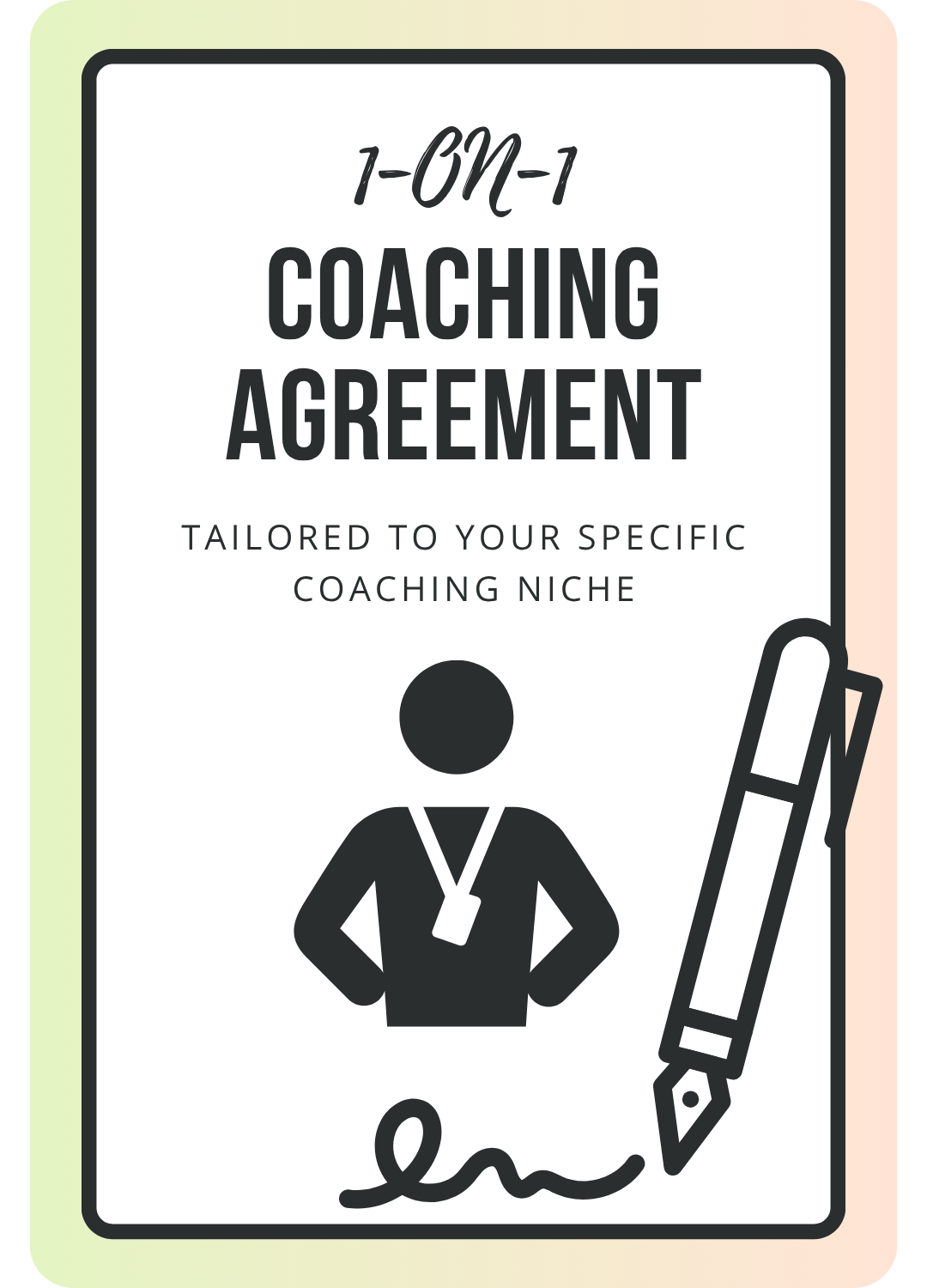
A scope exclusion clause in your 1-on-1 Coaching Agreement that makes clear your services are not therapy or mental health treatment
A mental health disclaimer on both your website and in your coaching contract or T&Cs
A written mental health waiver in your contract and intake form where the client explicitly confirms they are not currently undergoing — or advised to undergo — any form of psychological or therapeutic treatment
👉 Grab my 1-on-1 Coaching Agreement — it includes the scope exclusions, disclaimers, and waivers life coaches specifically need.
Step 5: Set the Rules for Your Offers Before You Start Selling
Knowing what you’re selling is one thing. Knowing exactly how it works — and what happens when things don't go to plan — is another.
Before you take your first payment, you need to make every operational decision for your 1:1 life coaching program. This needs to be in your life coaching business plan template.
If you don’t set clear rules and boundaries with your clients, you will deal with:
Clients who keep rescheduling 5 minutes before their booked sessions
Clients canceling sessions at the last minute and still wanting their money back
Waiting in sessions for over 30 minutes for clients who are always late or just don’t show up
Clients who are constantly texting you day and night
That’s why you need to set boundaries. Here are the decisions you need to make:
How long is your program, and how is it structured — fixed weeks or rolling monthly?
How often do you meet, and for how long per session?
Do you offer any support between sessions—and if so, through which channel and with what limitations?
What are your coaching hours, and when are you available?
What is your rescheduling policy — and how much notice does a client need to give?
How long can a client be late before the session is forfeited?
What is your refund policy — and under exactly what conditions does it apply?
The goal is to ensure that when a difficult situation arises — and it will — your rules are already documented, agreed to, and legally enforceable.
👉 Download my free Coaching Business Checklist — it walks you through every rule and boundary you need to set for each offer, with all the possible options laid out for you.
Then, set those boundaries in your coaching contract so they’re actually enforceable.
Step 6: Set Up Your Legal and Business Foundation
I’ll tell you exactly how to start an online life coaching business from home with very little investment.
There are 3 things you need to sort out:
Pick a business name and check availability.
Choose a name that speaks to your niche and client avatar, or just use your own name. But before you make a final decision, check that it’s actually available. You need to verify availability both as a legal business name in your state (through ZenBusiness) and as a domain name for your website (by entering it at GoDaddy or another domain registration site).
Form a legal entity.
For most coaches in the U.S., a single-member LLC is the proper starting point. It separates your personal assets from your business and provides you with a proper legal foundation to operate.
I recommend ZenBusiness for this, too. Yes, this is an affiliate link, and I earn a commission. But I recommend it because (1) I use it myself to set up my own LLCs, (2) it costs nothing beyond your state’s filing fee, and (3) it's faster and cheaper than hiring an overpriced lawyer to do something this straightforward.
Open a separate business bank account.
Don’t wait to set up your account. Do this the moment your LLC is formed. Running business income through your personal account puts your LLC protection at risk. A court could pierce the corporate veil and hold you personally liable for any business claims, which defeats the entire point of forming an LLC.
Step 7: Get the Right Contracts in Place Before You Take Your First Payment
Getting the right contracts in place is how to start an online life coaching business the right way — and most guides skip this entirely.
A lot of beginner coaches think that as long as they get paid up front, they have nothing to lose. But here’s what can happen without a proper contract in place:
A client decides at the last minute they don’t want to participate and demands a refund(which they’re entitled to, since they never received anything in return for their payment).
A client steals your coaching program, eBooks, templates, and workbooks, and resells them (and you have no legal recourse).
A client shares another participant’s personal struggles from your group program publicly (and ruins your reputation).
A client keeps rescheduling and canceling sessions at the last minute(completely hijacking your calendar).
A client holds you responsible for their outcomes and makes claims against you for providing mental health advice without a license (so you’re either forced to refund them or go to court).
And no, a refund policy or cancellation policy on your sales page or invoice is not legally binding.
If your client has not explicitly agreed to your terms by signing a contract or checking a box at checkout, your rules simply don’t hold up.
Here’s what you need for each offer:
A 1-on-1 Coaching Agreement for your 1:1 life coaching program — covering session structure, check-in limits, scope exclusions, mental health disclaimers, refund terms, and termination rights
A Virtual Meeting Policy for one-off coaching calls — setting clear rules on cancellations, rescheduling, no-shows, and refunds
A Group Coaching Agreement, when you’re ready to launch group programs — covering confidentiality, participation standards, and recording rules
Terms and Conditions for Online Courses for your self-paced courses
Terms and Conditions for Digital Products for workbooks, journal prompts, or any other digital downloads
A Legal Website Bundle with a privacy policy, terms of use, and disclaimer page for your site
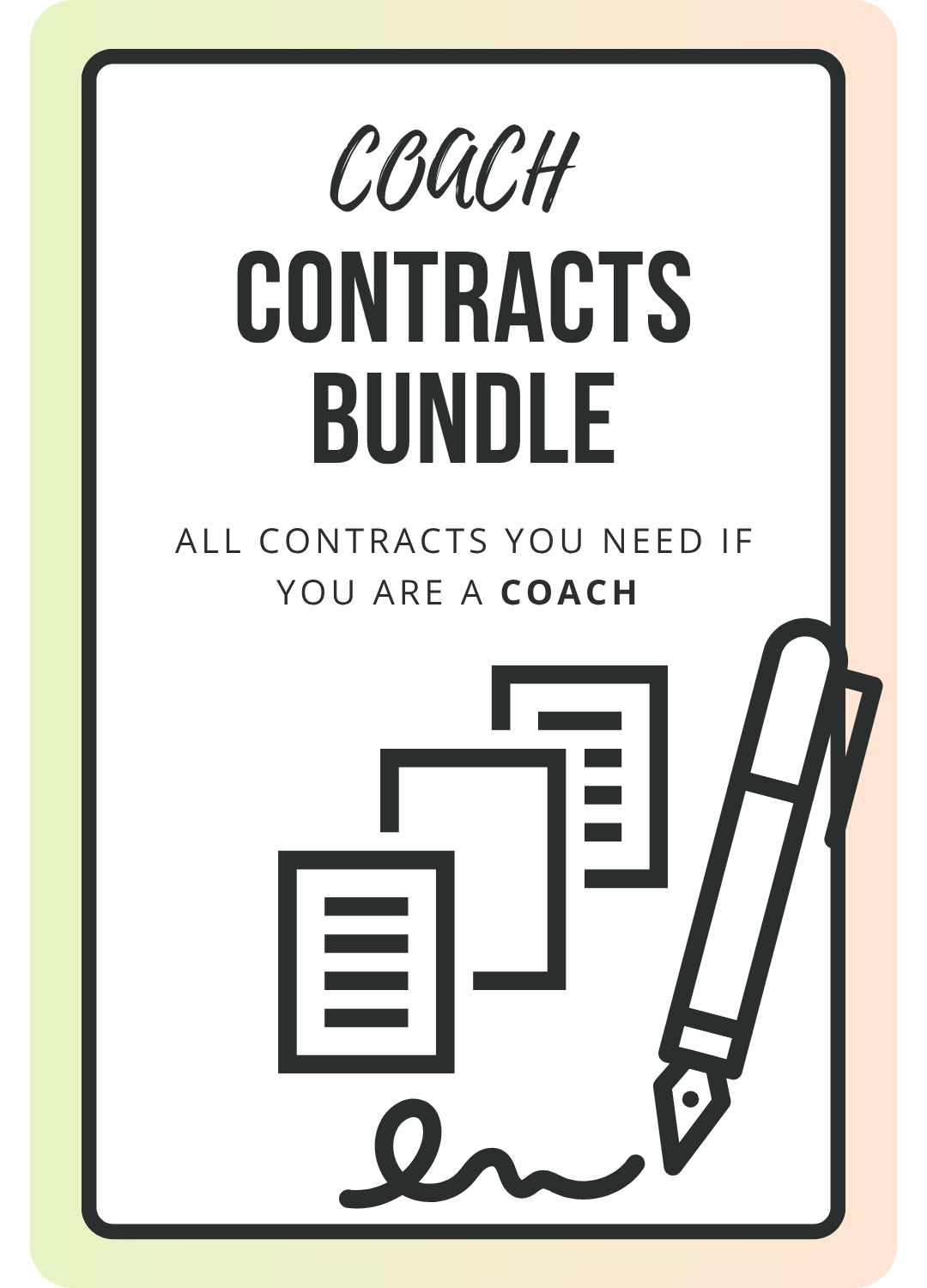
Or grab the Coach Contracts Bundle and get everything you need in one place — at up to 40% off.
Step 8: Build Your Online Life Coaching Website and Make It Easy to Buy
The next step in how to start an online coaching business is setting up your website.
I urge you not to overspend on something like Stan Store or ThriveCart. Because you won’t even own those platforms. They could shut down, and you’d be left with nothing and need to start from scratch again.
I recommend building your website on Squarespace.
Yes, this is an affiliate link, and I earn a small commission from it, but here’s why I recommend Squarespace over any other website builder:
You can launch a professional-looking life coaching website in a weekend (even if, like me, you're not tech-savvy at all).
You can sell coaching services, digital products, and online courses all in one place, with very low transaction fees.
It’s actually a lot cheaper than a platform like Stan Store or ThriveCart.
At this stage, your website only needs five things:
A homepage that clearly explains who you help and what you offer
A short About Me page
A sales page for your 1:1 life coaching program
A sales page linking to your scheduler for one-off calls
Your three legal website pages — privacy policy, terms of use, and disclaimer
Step 9: Get Your First Online Life Coaching Clients

The next step in how to start a life coaching business is the fun part: actually getting paying clients!
Optional: Start with a beta phase.
If you're starting from zero, the fastest way to build social proof is a small beta phase. Sign 3–5 clients at a reduced rate in exchange for a strong testimonial. Your beta clients could be:
Friends, family, or former colleagues who already trust you
Followers who have been engaging with your content
People in relevant Facebook groups or online communities who are actively asking for help
Even during beta, treat it like a real program. Define the length, the number of sessions, what's included, and the price — even if discounted. And use a proper 1-on-1 Coaching Agreement from day one.
Where to find your first online life coaching clients
Beyond beta, here's where online life coaches tend to find early traction:
Instagram and TikTok — short-form content works incredibly well in the life coaching space. Show up consistently, speak directly to your client avatar's struggles, and make it easy for people to find your website.
Facebook groups — find communities where your ideal client already hangs out and show up as a genuinely helpful voice. Don't pitch. Just be useful, and clients will eventually find you when they need you.
Your existing network — don't underestimate it. Tell people what you do and who you help. Word of mouth works really well and remains one of the main ways service-based entrepreneurs get clients.
Blog and Pinterest — the long game, and the strategy that has worked really well for my business. My blog has driven consistent traffic to my website without you having to show up on social media every single day. I use Pinterest only to drive blog traffic, and I spend just one morning on it every 2 weeks. And life coaching content performs exceptionally well on Pinterest, too. If you want to learn how to do it properly, I highly recommend Perfecting Blogging and Perfecting Pinterest by Sophia Lee. Not an affiliate. Just genuinely grateful for her strategies.
Step 10: Set Up a Safe and Structured Onboarding Process

The last step in how to start an online life coaching business is the best part: signing up your clients and getting paid.
But this is where a lot of beginners overcomplicate things unnecessarily.
You basically have 3 options:
Option 1: Send a Contract Manually via DocuSign
You send your coaching agreement by email or through DocuSign, wait for it to be signed, and then send a separate payment link.
It’s the traditional way, and it works. But it's slow, cumbersome, and invites unnecessary back-and-forth questions about your contract. It also creates multiple opportunities for a potential client to lose interest and drop off before they've paid.
Option 2: Sell Through a Checkout Page with Terms and Conditions
Clients purchase directly on your website and agree to your coaching terms and conditions at checkout by ticking a box.
This is clean, efficient, and works well for many coaching niches.
But for life coaching specifically — where you're often dealing with vulnerable, personal situations — I usually don't recommend this as a standalone solution.
You might want more control over who actually enters your program before they pay, especially for high-ticket offers.
Option 3: A Structured Application Form
Instead of separating screening, contracting, and payment into multiple steps, you build one structured registration form that includes:
All intake questions to determine whether the client is a good fit
Identity and contact information
Explicit confirmation that coaching is not therapy
Highlighted disclaimers that must be actively acknowledged by the client
A checkbox agreeing to your coaching terms and conditions
A checkbox agreeing to your privacy policy
This can be set up on your website, in a CRM like Dubsado, or even in a structured Google Form.
The client submits the form, and enrollment is only confirmed upon your written acceptance.
For life coaches, making client onboarding subject to approval often makes the most sense. It gives you the ability to review each application and decline clients who may need therapeutic or medical support rather than coaching — which protects both of you.
My 1-on-1 Coaching Agreement includes contract language compatible with all three onboarding options, so whichever process you choose, you’re legally covered.
Now You Know How to Start a Life Coaching Business from Home — Here’s What to Do Next
As you’ve learned in this guide on how to start a life coaching business from home:
Starting a life coaching business is easy, but actually keeping it without getting into legal or financial trouble is a lot harder — at least, if you don’t have the right contracts in place.
Here are the exact contract templates you need to launch your online life coaching business:
1-on-1 Coaching Agreement — your most important document as a life coach, compatible with all three onboarding options
Virtual Meeting Policy — for one-off coaching calls
Group Coaching Agreement — for when you’re ready to scale into group programs
Terms and Conditions for Online Courses — for self-paced courses
Terms and Conditions for Digital Products — for workbooks, journal prompts, and other digital downloads
Legal Website Bundle — your privacy policy, terms of use, and disclaimer page
Or grab the Coach Contracts Bundle and save up to 40%.
This post was all about how to start an online life coaching business in 10 simple steps — so you can launch with the right legal foundation, a proper coaching offer, and your first paying clients lined up.
You might also like: