How to Start a Coaching Business: 7 Decisions You Must Make Before Selling Anything
Wondering how to start a coaching business without wasting time, money, or setting it up wrong?
Without the proper business setup from the start, you could face refund disputes, scope creep, unhappy clients, and unnecessary legal stress later.
As a lawyer for coaches, I’ve seen too many people jump straight into branding, Instagram, or grab a random contract template. They skip thinking through how to start a coaching business properly first. The result? Problems that could have been avoided with the right structure upfront.
In this step-by-step guide, you’ll learn how to start a coaching business by focusing on 7 core decisions that shape the success of your coaching business—from turning your coaching business ideas into real offers, to pricing, payments, refunds, and contracts.
By the end, you’ll know how to start a coaching business with no money (or very little of it) before you sell anything — so you don’t have to undo mistakes later.
This post is all about how to start a coaching business by making the right decisions before selling anything.
👉 Want to make sure you don’t miss a step? Download my free Coaching Business Checklist—it walks you through each decision in the right order and shows what to set up before you take your first client.
How to Start a Coaching Business (Properly)
How to start a coaching business for beginners
1. Set Up Your Coaching Business Properly (Before You Sell Anything)

Okay, I know what you’re thinking: “Here comes the lawyer trying to sell me business setup services.”
Actually, I’m urging you not to have a lawyer set up your coaching business. Those services are way too overpriced (and we’re talking about how to start a coaching business on a budget here).
Honestly, it’s way too easy to set up your business the right way yourself with an online service like ZenBusiness (full transparency: yes, this is an affiliate link, so, yeah, I am trying to make a little money off of you here, haha!).
But with an online service like ZenBusiness, you can set up your business for basically free. You only pay the required state filing fee.
For most coaches who are just starting out, a single-member LLC is usually the most practical option:
it separates your personal and business liability,
it’s still reported on your personal return, so your tax filings won’t be overcomplicated, and
it’s cheap because it’s not overly complicated, with minimal compliance and accounting costs.
There is one important BUT: When you set up your LLC, you’ll be asked to describe your business's purpose. That wording matters more than people realize.
A poorly formulated or too narrow purpose description can create major issues in contract disputes and insurance coverage. So, you need to make sure your business purpose is properly formulated.
Read this blog post for a step-by-step guide on how to set up your LLC, including the exact description you need for the purpose of your coaching business, if you want to go deeper.
A quick note for international readers: Setting up an LLC or a similar entity may not make sense in your country. In the US, it’s cheap, but in countries like the Netherlands, a sole proprietorship often makes more sense in the early stages, especially if you’re not close to six figures yet.
2. Open a Business Bank Account (Yes, This Matters Early)
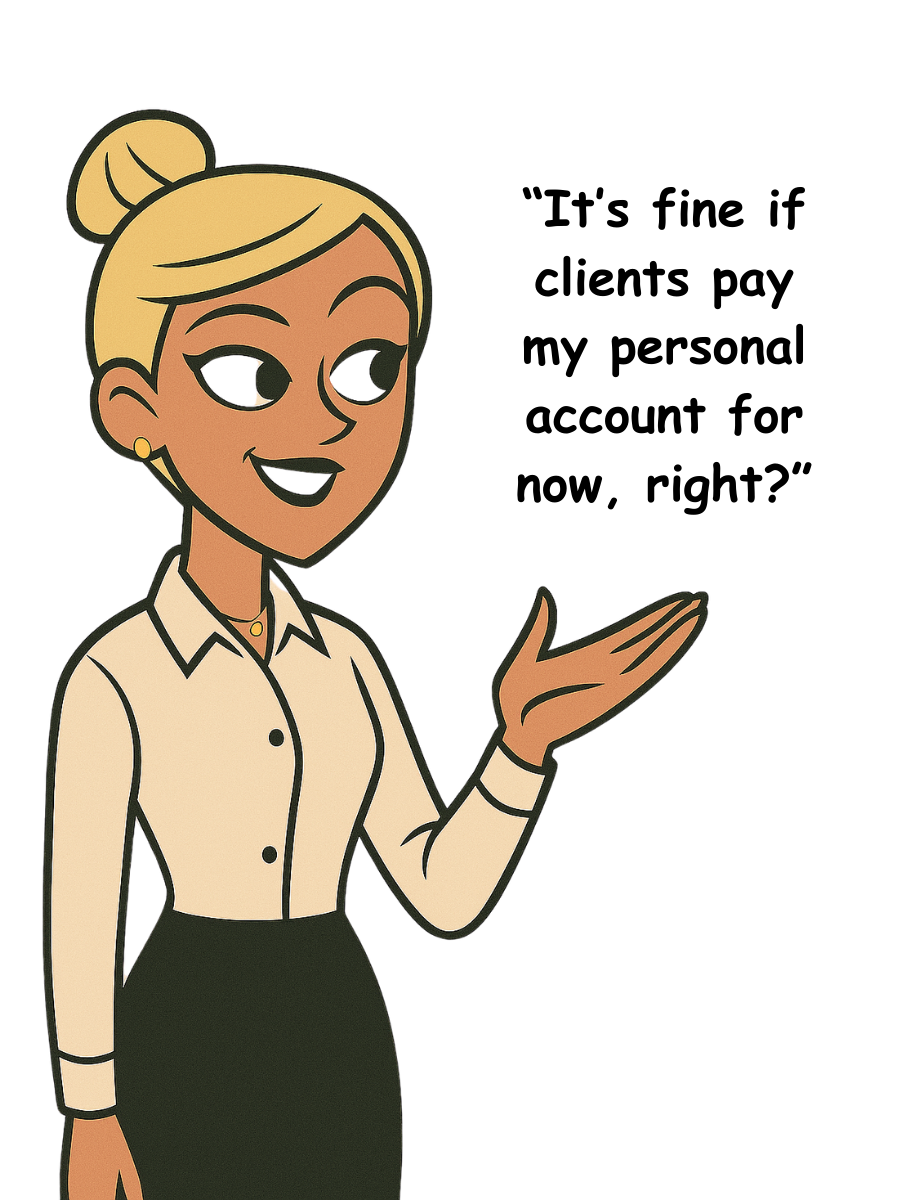
Once you’ve set up your LLC, you need a separate business bank account for your entity.
Do not EVER use your personal account for any business transactions, no matter how small or insignificant they may seem at the beginning.
Mixing personal and business money creates problems fast and affects:
refunds and chargebacks,
tracking what clients actually paid for,
bookkeeping and taxes later on,
how professional your business looks to clients and platforms,
and, most importantly, the legal distinction between you and your business entity.
If client payments go into your personal account, it becomes harder to argue that the client was dealing with the company, not you personally. That can weaken the separation you set up and expose your personal assets to risk.
And, just like setting up an LLC, it’s super easy and fast to set up a bank account. Even business formation platforms, like ZenBusiness, are affiliated with banks like Bank of America and help you get started with a bank account as part of the process.
That’s how to start a coaching business properly.
3. Decide Which Coaching Offers You’ll Sell

Next, you need to decide which coaching offers you’re actually selling.
As a coach, there are so many possible ways to offer coaching. There are so many income streams to choose from, which is exciting. But it also means you need to make deliberate choices right from the start when starting a coaching business.
You could sell:
1-on-1 coaching, like a 6-week package or an ongoing monthly program,
paid one-off calls or strategy sessions that people can book through your scheduler (we’ll get to booking tools and software in step 5),
group coaching programs, which may be too soon right now, but might be something you want to offer once you grow,
online courses, whether fully self-paced or combined with live Q&A sessions or workshops, or
digital products such as eBooks, plans, or templates.
Figuring out which services and products you want to offer matters because each works differently in practice.
The way clients book, pay, access your services, cancel, or ask for refunds depends on the type of offer you’re selling. Treating all offers the same is where problems usually start.
A 1-on-1 coaching package creates very different expectations than a one-off call or an online course. Group programs come with different access, boundaries, and client responsibilities altogether.
We’ll get into some of the different decisions you’ll need to make for different offers in the next steps to ensure you understand how to start a coaching business properly.
But make sure to subscribe to my newsletter to get access to my free Coaching Business Checklist, which includes complete decision checklists for different types of offers, so you can structure each one properly before you sell any of your coaching business ideas.
4. Decide How You’ll Price Your Coaching

Once you know which offers you’re selling, you need to decide how to price them.
In the business of coaching, there are many different pricing models for many different offers. Your pricing model directly affects cancellations, refunds, access, and client expectations.
Here are some examples:
1-on-1 coaching programs:
You could (1) charge one fixed fee upfront for a 6- or 12-week program, or (2) charge a fixed monthly fee upfront for ongoing coaching (always charge upfront).Single calls or sessions:
Clients typically pay upfront when booking the session, not after the session takes place. This is usually handled through your scheduling tool.Online courses:
You could (1) charge the full course fee upfront, or (2) offer a payment plan where part is paid upfront and the rest in instalments, especially for higher-priced courses.Group coaching programs:
These are often priced as either a full fee upfront or through a payment plan.Digital products:
These are usually paid in full at checkout.
Each of these works differently in practice:
A fixed-price package usually comes with a clear start and end.
Monthly pricing raises questions about notice periods and when clients can cancel.
One-off calls are often treated as (1) completely non-refundable or (2) non-refundable if cancelled within a certain time window.
Access-based pricing affects what happens when access ends or is cut off.
Where coaches run into trouble is choosing a pricing model without thinking through what it means operationally.
Before you sell anything, you should be clear on:
whether your pricing is tied to time, sessions, or access,
when payments are due, and
what happens if a client wants to stop early.
💡 My Coaching Business Checklist includes separate pricing decision checklists for different types of offers, so you can choose a pricing model that actually fits how each offer works before you sell.
5. Decide How Clients Book, Pay, and Access Your Services

Before you offer coaching, you need to decide how clients actually move through your business—from booking, to payment, to accessing what they’ve paid for.
This means choosing the tools and systems you’ll use for each part of your services.
For example:
How do clients in your 1-on-1 coaching program book their sessions? Through an online scheduler like Calendly, or by email?
How can clients book one-off calls? Via Calendly, Google Calendar, or Acuity?
How do clients pay you for 1-on-1 and group coaching services? Through a sales page on your website, or via payment links using a tool like QuickBooks?
On which platform will you host your online course? Teachable, Thinkific, or Kajabi?
Where can people buy your digital products? Directly on your website or through a Stan Store?
Making these decisions upfront will make how you will run your coaching business crystal clear. That's how to start a coaching business practically.
💡 The Coaching Business Checklist walks you through booking, payment, and access tools for different parts of your offers, so you can actually implement your coaching business ideas without patching things together as you go.
Subscribe for instant access to my Coaching Business Checklist:
6. Decide Your Refund and Cancellation Rules Before Selling

Before you sell anything, you need to decide what your refund and cancellation policy actually is for each offer.
There is no single “right” refund policy for coaching. What matters is choosing one that fits your offer, pricing model, and how access is granted—and then applying it consistently.
Common options include:
No refunds at all once payment is made, or once materials, portals, or recordings are accessed. This makes sense especially for digital products, since customers download them at checkout (you can’t “return” a digital product).
Limited refunds. For example, only before the first session or before access is granted.
Refunds with cut-off points. such as refunds being unavailable after a certain date or milestone.
Cancellation notice periods, where clients must cancel within a set number of hours or days to avoid losing their payment.
Conditional refunds (”satisfaction guarantees”), where clients only get a refund if they can prove they meet certain criteria that you’ve set (for example, they completed all course modules but still weren’t satisfied).
Each option has different consequences. For example:
A strict no-refund policy offers clarity but may deter some buyers from high-ticket offers.
A limited refund policy requires very clear rules around timing and access.
Conditional refunds can work, but only if the conditions are objective and measurable.
One important point many coaches miss: stating your refund policy on a sales page is not enough.
If you want your refund and cancellation rules to be legally enforceable, clients need to actively agree to them—usually through your contract or terms and conditions at checkout.
💡 My coaching contract templates are designed to make these refund and cancellation rules enforceable, so clients agree to them before paying—rather than arguing about them later.
7. Put the Right Contracts in Place for Each Offer

By this point, you’ve made all the important decisions on how to start a coaching business:
how your business is set up,
how clients pay and access your services,
how pricing works, and
what your refund and cancellation rules are.
Now, those decisions need to be legally locked in.
This is where contracts do their job:
they set boundaries around access, refunds, cancellations, and behaviour, and
they make sure clients agree to those rules before paying, so they’re legally binding and enforceable.
My coaching contract templates are fully customisable, so you can align them with the decisions you’ve already made and apply them across a multi-offer coaching business.
Check out my contract templates for each coaching offer you sell:
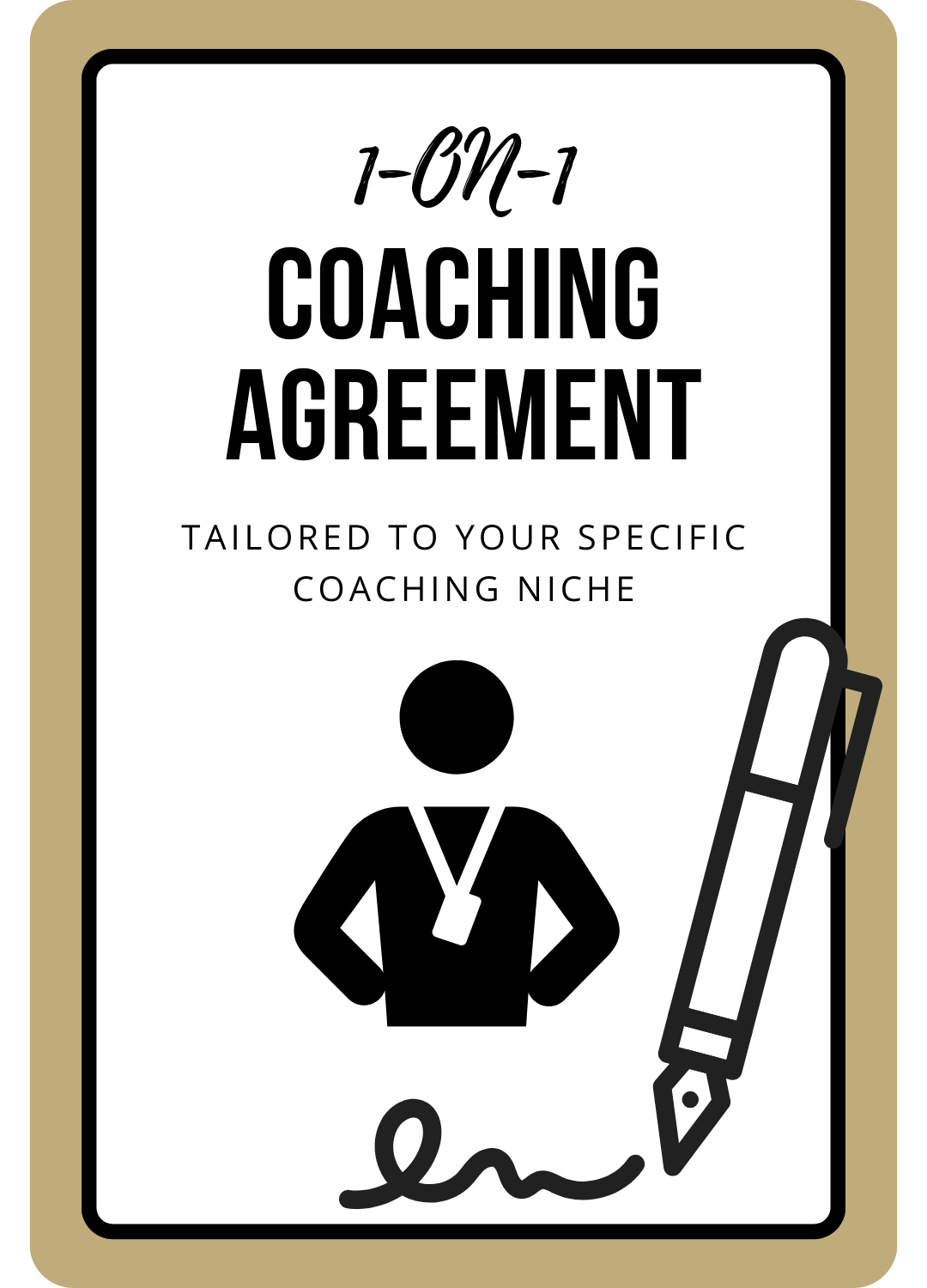
1-on-1 coaching: 1-On-1 Coaching Contract Template!
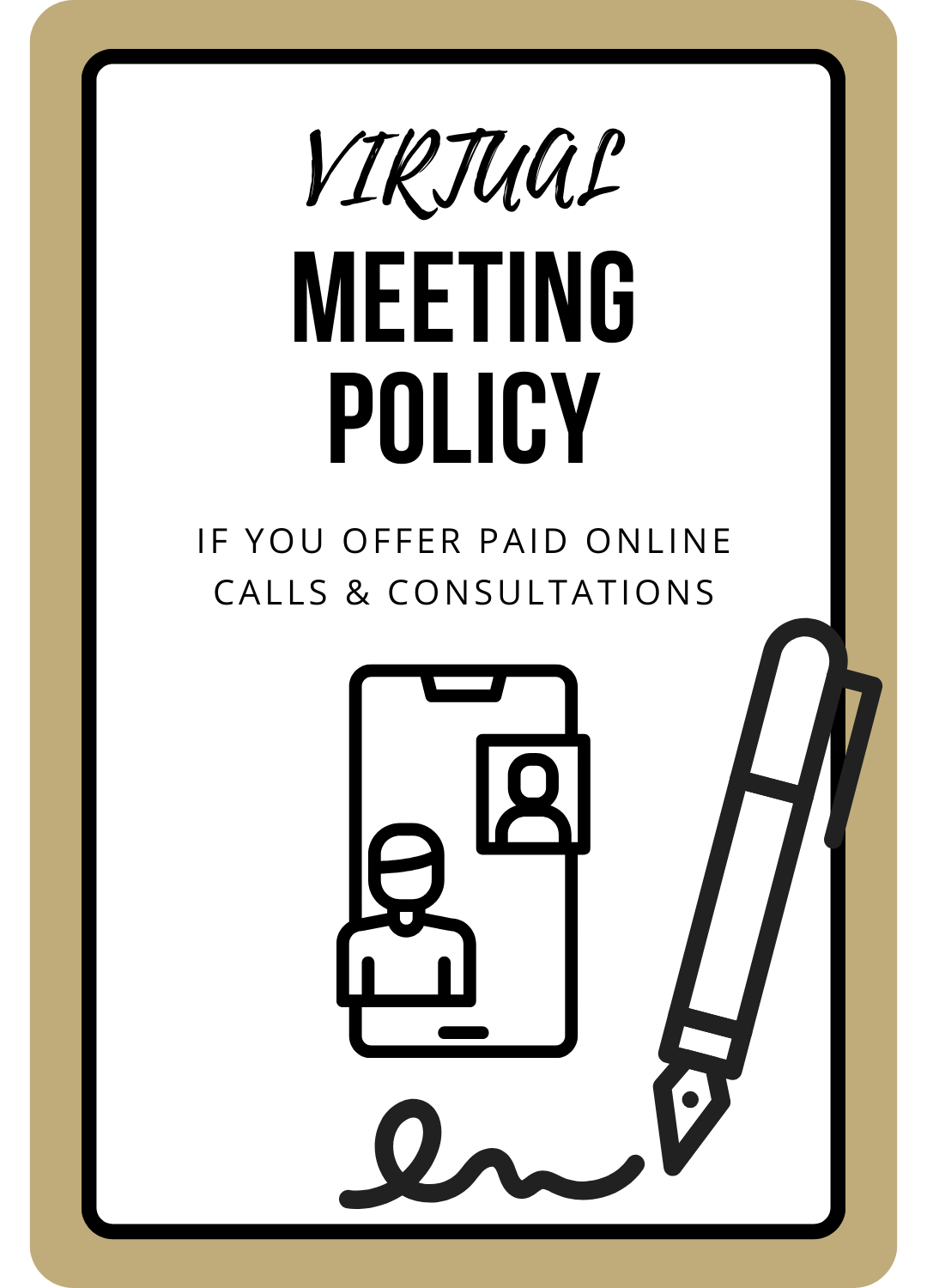
One-off coaching calls: check out my Virtual Meeting Policy!
Group coaching: Group Coaching Contract Template!
Online courses: Terms and Conditions for Online Courses!
Digital products: Terms and Conditions for Digital Products!
The ULTIMATE Coaching Business Checklist (a guide on how to start a coaching business from home)
Starting a coaching business that actually becomes successful requires making the right decisions at the start.
And you definitely don’t need to overcomplicate it either!
All you need to do is (recap):
set up your LLC (or the proper business type if you’re in a different country,
open a business bank account for your coaching business,
choose which service(s) you want to offer:
1-on-1 coaching
one-off coaching calls,
group coaching,
online courses, and/or
digital products,
make the crucial decisions for each offer using the specific checklist for each offer inside my Coaching Business Checklist, and
use the proper contract template for each offer to make those decisions legally enforceable!
👉 Get instant access to my Coaching Business Checklist for free.
This starting a coaching business checklist walks you through every crucial step covered in this post, with clear decision prompts for different offers—so you can set up your coaching business properly before you sell anything.
If you’re serious about building a coaching business that actually works long-term, start with the checklist and use it as your foundation.
This post was all about how to start a coaching business the right way for success.
Other posts you may like: