7 Things Every Coach Needs in Their Terms and Conditions for Coaching Services (That Most Templates Don't Cover)
Looking for terms and conditions for coaching services? Here’s the thing most coaches don’t realize: having T&Cs isn’t enough — having the right ones for your coaching niche and your sales setup is what actually protects you.
I’m a business lawyer who creates contract templates for coaches across every niche — life, health, business, relationship, career coaches, and everything in between.
And the most common thing I see?
Coaches who have terms and conditions in place — maybe even paid good money for them — and have absolutely no idea they're using the wrong format, missing crucial disclaimers, or leaving themselves wide open to refund disputes, chargebacks, and boundary issues.
Here's what most templates get wrong:
They’re built for the wrong sales setup — a traditional e-signature flow that most online coaches don’t even use.
They’re completely rigid — no customization for your program, your pricing model, or your scheduling policy.
They’re missing crucial protections — against session rollovers, IP theft, refund disputes, and the right niche-specific coaching disclaimer for your type of coaching.
In this post, I'm walking you through the 7 things every coach needs in their terms and conditions for coaching services — the exact format to use, every clause your T&Cs must cover, the coaching disclaimer for your niche, and every coaching waiver your template needs.
This post is all about terms and conditions for coaching services — so you can protect your coaching business, your IP, and your income, no matter which niche you're in.
👉 Already know you just want it done? My 1-On-1 Coaching Agreement Template Bundle includes terms and conditions for checkout pages and application forms, a niche disclaimer library covering 10+ coaching niches, and everything you need to get it right — built specifically for online coaches.
Best Terms and Conditions for Coaching Services
Everything You Need in Your T&C — From Your Coaching Disclaimer to Your Coaching Waiver
1. Most Templates Are Built for a Sales Process Nobody Uses Anymore
Let me paint you a picture.
You hop on a discovery call. You like the client. They seem great. So you open your contract template, manually fill in their name, the fee, the dates, and every other detail.
Then you send it via DocuSign.
Then you wait.
Then they come back with questions about clause 7. Or they ghost you for four days. Or they sign but forget to pay. Or they pay but forget to sign.
And that’s before the program has even started.
This is the reality of the traditional e-signature coaching agreement — and it's the format that 99% of coaching contract templates are built for.
It works, but it's slow, manual, and frankly a bit of a hassle for a high-volume coaching business.
There are actually 3 ways to sign clients — and each requires a completely different document.
Option 1 — The traditional e-signature agreement
You send a contract, your client signs it, and the contract is formed at the moment of signature.
It’s a lot more hassle, but it still works well for high-ticket programs where you want a formal, signed document on file.
Option 2 — T&Cs for application forms
Your client applies via a form and ticks a checkbox to agree to your T&Cs. You review the application and confirm acceptance by email. The contract is formed only when you send that acceptance — not when they submit the form.
This format requires specific legal language to ensure the contract isn't formed until you've said yes.
Option 3 — T&Cs for checkout pages
Your client purchases directly through your website, Stan Store, ThriveCart, SamCart, or Paperbell. They agree to your T&Cs by ticking a checkbox at checkout. The contract is formed the moment they hit the purchase button.
This format also requires specific legal language to ensure the contract is binding at that exact moment.
Using the wrong format means your T&Cs may not be legally binding at all — no matter how well-written the rest of the document is.
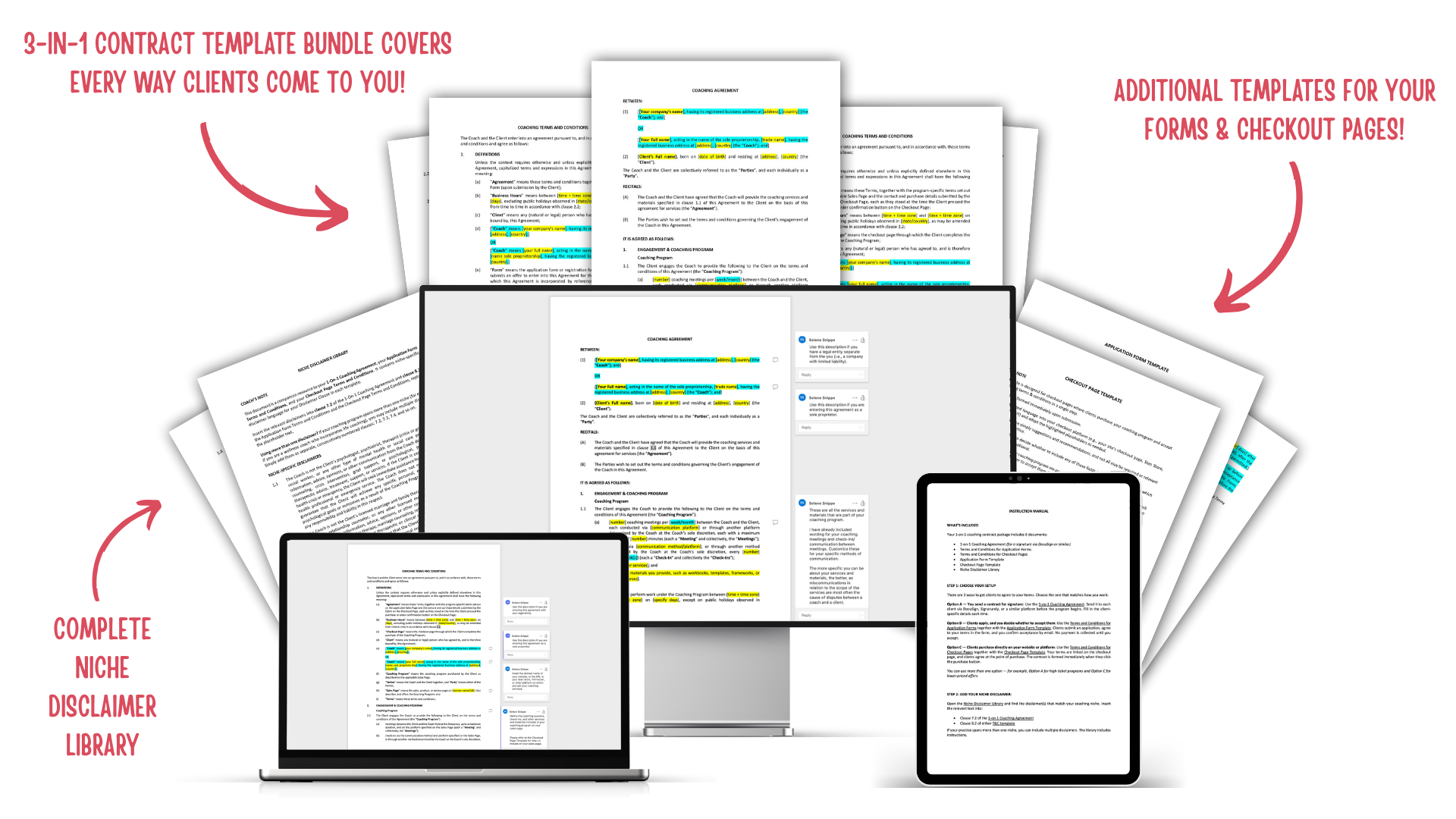
👉 My 1-On-1 Coaching Agreement Template Bundle includes all 3 formats — plus a complete application form template and a checkout and sales page template designed to work together with your T&Cs.
2. The Core Clauses Every Set of T&Cs Must Actually Cover
Here’s where most templates fall flat.
A generic terms and conditions for coaching services template will give you the basics — a payment clause, a vague refund policy, maybe a termination clause.
And coaches look at that and think: great, I'm covered.
But the basics barely scratch the surface of what can — and does — go wrong in an online coaching business.
Here's what your T&Cs must cover if you want to be actually protected:
Scope — what's included and what's not
Your T&Cs should define exactly what's included in your program, including your sessions, check-ins, and coaching materials, such as workbooks and templates. And just as importantly, what's not included.
Without clear boundaries on your scope, your clients will assume more is included and keep pushing for more.
Business hours and availability
When does your coaching day start and end? Which days do you work? What time zone?
If your T&Cs don't spell this out, clients will assume access whenever it suits them — including evenings, weekends, and public holidays.
Communication boundaries
Which platforms are you available on — and which ones are you not?
Your T&Cs should specify the exact communication methods you use and make clear that anything outside of those (Instagram DMs, WhatsApp, text messages) is off-limits unless you've explicitly agreed to it.
Payment structure
Not just the fee, but when it's due, how it's collected, and what happens if a payment fails or is late.
Your coaching terms and conditions template should cover both a single upfront payment for fixed-term programs and monthly upfront payments for ongoing coaching.
Suspension for non-payment
Most templates only allow termination if a client stops paying. But you usually don't want to end the relationship right away if their payment failed once — but you should have the right to pause your coaching services until they pay.
Your T&Cs should give you the right to suspend sessions, cancel upcoming meetings, and pause access to materials the moment a payment fails — without having to terminate the entire agreement.
Rescheduling policy
Your terms and conditions for coaching services template should be customizable for you to define:
Through what scheduler sessions may be booked
Up to how many hours before a booked session clients can reschedule sessions (24, 48, or 72 hours?)
The limit on the number of reschedulings (so clients don’t keep rebooking you over and over again
Lateness policy
Your terms and conditions for coaching services should define exactly:
What happens if a client shows up 20 minutes late
That the session will still end on time (no extension rights)
After how many minutes you get to treat the session as a no-show (and stop wasting your precious time)
Cancellation policy
Missed sessions should be non-refundable by default — including for personal circumstances, scheduling conflicts, incorrect time zone conversions, and tech issues on the client's side.
Because clients will use every single one of those excuses.
No-rollover clause
Unused sessions expire at the end of the term — automatically, with no extensions and no rollovers.
Without this clause, clients will ask to “pause” their program indefinitely or bank unused sessions for whenever they feel like it.
Check-in clause
Your T&Cs should specify when check-ins start (after the first session), how they're conducted, and — crucially — that they expire at the end of the term.
Check-ins should not become an ongoing, unlimited service.
Refund policy
Your template should have multiple options — from fully non-refundable to a partial refund window before the first session — including a legal waiver of statutory cooling-off and withdrawal rights.
Because in some jurisdictions, clients have a legal right to a refund unless they explicitly waive it.
Chargeback protection clause
Non-negotiable when you're selling your coaching services online.
If a client disputes a payment with their bank, PayPal, or Stripe, your T&Cs need to require them to reimburse you for the full amount charged back, plus any bank fees and legal costs.
Digital materials clause
Any workbooks, templates, or other resources you share should be non-refundable the moment access is granted — regardless of whether the client actually uses them.
No results & outcomes disclaimer
This one applies to every coaching niche.
Your T&Cs should make clear that results are not guaranteed, that any feedback or guidance is opinion-based and not a promise of outcomes, and that responsibility for results lies entirely with the client.
A vague “results may vary” line doesn't cut it legally and doesn't hold up when a disappointed client wants their money back.
Termination rights
Both parties need clear rules for ending the agreement — including notice periods, what happens to the fee, and when termination can happen immediately and without notice.
Immediate termination should be available for serious breaches: non-payment, harassment, fraud, or any behavior that makes continuing the program unsafe or unreasonable for you.
IP protections
Your coaching frameworks, methods, workbooks, and materials stay yours. Clients cannot copy, share, or use them to coach others.
Non-disparagement clause
A disgruntled client cannot go on a social media rampage against you without legal consequences.
Limitation of liability
This caps what a client can ever claim against you — so one difficult coaching relationship can never threaten your entire business.
Confidentiality
Both directions: your client's information stays private, and everything they learn about how you work does too.
Coach unavailability
You have the right to temporarily adjourn the program — for a holiday, an emergency, or a planned break — without having to refund everything.
Governing law and jurisdiction
Customizable to your country or state — with options for court resolution or arbitration, depending on what makes sense for your situation.
✅ Every single one of these clauses is included in my 1-On-1 Coaching Agreement Template Bundle — pre-written, customizable, and built for online coaches.
3. A Niche-Specific Coaching Disclaimer for Your Type of Coaching
Every coach needs a disclaimer. But the right disclaimer depends entirely on what you actually coach.
A generic “I’m not your therapist” disclaimer might work for a life coach — but it does nothing for a health coach, a financial coach, or a real estate coach whose work touches on completely different areas of professional liability.
Here's the full library of niche-specific disclaimers you should have in your terms and conditions for coaching services template — and what each one covers.
Life, mindset, spiritual, accountability, and goal coaching
Your disclaimer should state that you are not your client's psychologist, psychiatrist, therapist, counselor, or social worker — and that your coaching does not constitute or replace mental health treatment or support.
It should also include a crisis clause: if a client is experiencing a mental health crisis or emergency, they are responsible for seeking immediate assistance from a qualified professional.
Relationship and dating coaching
Your coaching disclaimer should state that you are not a licensed marriage and family therapist, couples therapist, sex therapist, or relationship counselor — and that your coaching does not constitute couples therapy, marriage counseling, or any other form of clinical relationship services.
Health, fitness, and nutrition coaching
Your disclaimer should state that you are not a doctor, physician, surgeon, dietitian, licensed nutritionist, physical therapist, or any other healthcare professional — and that your coaching does not constitute medical, dietary, or clinical advice, diagnosis, or treatment.
This one also needs a specific instruction: clients should consult a qualified healthcare professional before making any changes to their diet, exercise routine, supplementation, or healthcare regimen.
Business, budget, and financial coaching
Your disclaimer should state that you are not a licensed financial adviser, certified financial planner, accountant, tax adviser, investment adviser, or legal adviser — and that your coaching does not constitute financial, investment, tax, insurance, or legal advice.
Real estate coaching
Your coaching disclaimer should state that you are not a licensed real estate agent, broker, mortgage broker, property manager, or appraiser — and that your coaching does not constitute professional real estate, mortgage, or property advice, representation, or services.
Career coaching
Your disclaimer should state that you are not a licensed career counselor, vocational rehabilitation counselor, HR professional, recruiter, or employment attorney — and that your coaching does not constitute career counseling, job placement, or legal employment advice.
Leadership and executive coaching
Your coaching disclaimer should state that you are not an organizational psychologist, management consultant, licensed HR professional, or employment attorney — and that your coaching does not constitute organizational psychology, management consulting, or HR services.
Social media and content coaching
Your disclaimer should state that you are not a licensed marketing professional, digital marketing specialist, PR professional, or social media manager — and that your coaching does not constitute professional marketing, advertising, or social media management services.
It should also include a platform disclaimer stating that you are not responsible for changes to social media algorithms, platform policies, or account restrictions that occur during or after the program.
Parenting coaching
Your disclaimer should state that you are not a child psychologist, child psychiatrist, developmental pediatrician, family therapist, or social worker — and that your coaching does not constitute child psychology, developmental assessment, or family therapy.
This one also needs a crisis clause: if a client is concerned about their child's mental, physical, or developmental health, or is experiencing a family emergency, they are responsible for seeking immediate assistance from a qualified professional.
Writing and publishing coaching
Your coaching disclaimer should state that you are not a professional editor, copy editor, proofreader, ghostwriter, literary agent, or publisher — and that your coaching does not constitute professional editing, ghostwriting, literary representation, or publishing services.
It should also clarify that any feedback on the client's work is for informational and educational purposes only — not a legal clearance or review of the client's work for intellectual property purposes.
What if your coaching spans more than one niche?
You can include multiple disclaimers. A wellness coach who also incorporates mindset coaching, for example, would include both the health and life coaching disclaimers.
And if you hold a professional license in your other professional life — as a therapist, doctor, financial adviser, or otherwise — your T&Cs need an additional clause explicitly stating that you are not acting in that licensed capacity during coaching.
Without that, a client could argue you owed them a professional duty of care you never intended to provide.
✅ My 1-On-1 Coaching Agreement Template Bundle includes the full Niche Disclaimer Library — all 10 pre-written disclaimers covering 33 coaching niches, ready to insert directly into your terms and conditions for coaching services.
4. The Coaching Waivers Your T&Cs Need (And Most Templates Don't Have)
A disclaimer tells clients what you are not. A coaching waiver requires clients to actively confirm something about themselves before the program begins.
They work together — but they're not the same thing, and most terms and conditions for coaching services templates only include one or the other.
Here are the coaching waivers every coach needs.
The mental health waiver
This is the one most coaches have never even heard of — and the one that matters most.
A mental health waiver requires clients to confirm, before signing up, that they are not currently undergoing — and have not been advised to seek — counseling, psychological, psychiatric, or any other form of therapeutic or mental health support.
Here's why it's so important: the disclaimer defines your role. The coaching waiver places responsibility on the client to confirm they are a good fit for coaching—not therapy.
If it later turns out a client wasn't honest about their mental health status, you have a clear contractual basis to terminate — and a written record that they represented themselves as suitable for coaching.
The medical and nutritional status waiver
Essential for health, fitness, and nutrition coaches.
This coaching waiver requires clients to confirm they are not currently undergoing — and have not been advised to seek — medical or nutritional treatment that could be affected by participation in your program.
Same logic as the mental health waiver: it shifts the responsibility onto the client to self-screen before they sign up.
The no results guarantee waiver
The disclaimer states that results aren't guaranteed. The waiver requires clients to actively acknowledge that — including that any results described on your website or social media reflect individual experiences, are not guaranteed, and that their results will depend entirely on their own effort and engagement.
Getting clients to tick a checkbox confirming this is a very different thing from burying it in your T&Cs.
Where these waivers should appear
This is where most templates fall short — even the ones that include the waiver language.
Burying a waiver in your T&Cs isn’t really enough. Clients should actively acknowledge these points when they sign up.
That means explicit checkboxes:
On your application form, before submission
On your checkout page, before purchase
In your coaching agreement, as part of the client warranties
A client who has ticked a checkbox confirming their mental health status has actively acknowledged it. A client who just agreed to a wall of T&Cs they didn't read? That's a much weaker legal position.
✅ My 1-On-1 Coaching Agreement Template Bundle includes all three plus other niche-specific waivers — check out my sample terms and conditions for coaching services, which you can download for free.
5. What Your Sales Page and Checkout Page Need to Say
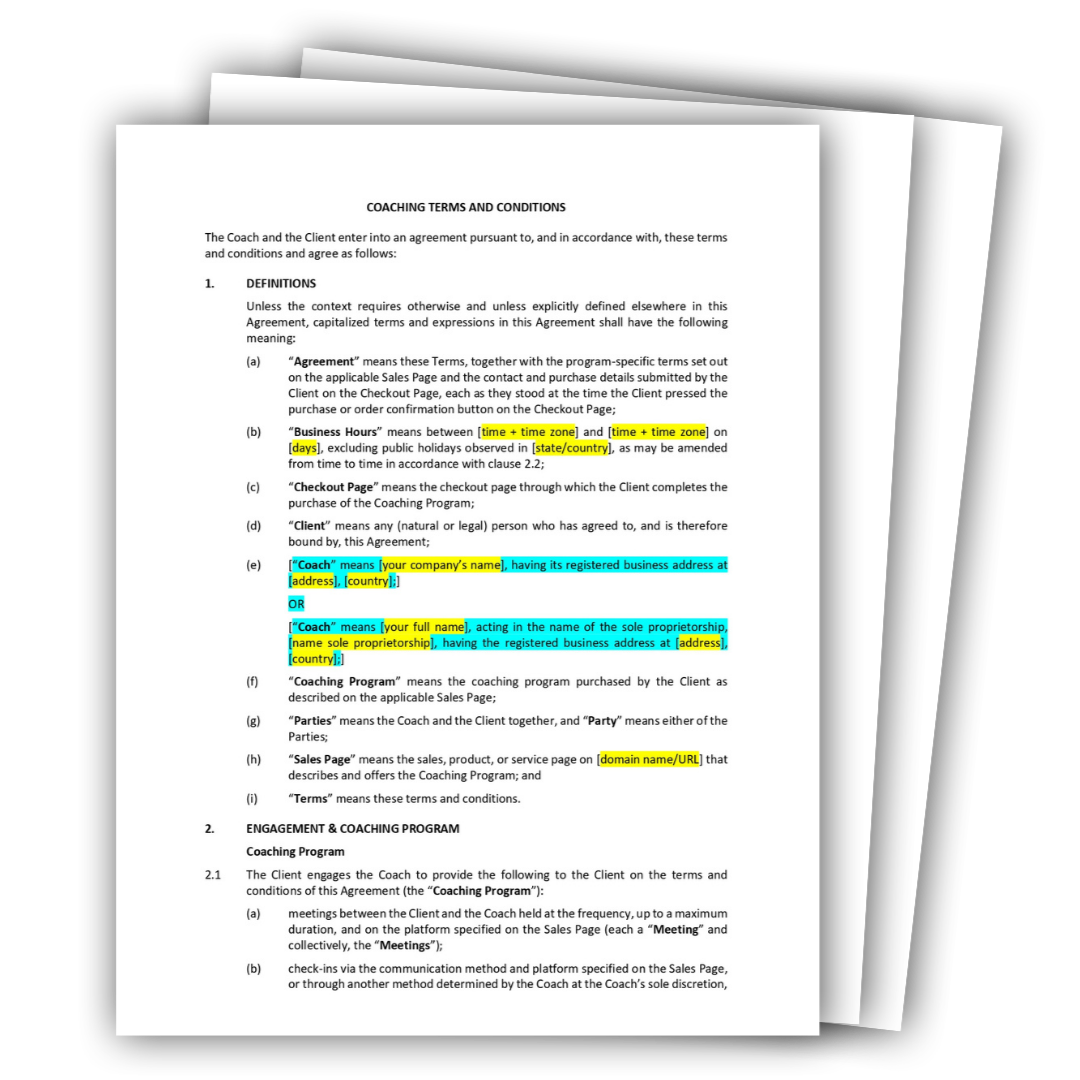
Most coaches put a lot of effort into their terms and conditions for coaching services — and then completely forget about what their clients actually read.
Because here’s the reality: most clients won’t read your T&Cs in full. What they will read is your sales page. Your checkout page. Your application form.
And if those documents say something different from your T&Cs — even slightly — you have a problem.
Let me tell you about a coach who came to me after a client dispute that had taken over her life for two solid weeks.
She had solid T&Cs for her checkout page. Three-month minimum commitment. Clear payment terms. No refunds after onboarding. All of it.
But her sales page said: "Cancel anytime."
Two words. No asterisk. No clarification. No "subject to terms and conditions."
When month one didn't go the way her client hoped, that client canceled. Pointed to the sales page. Filed a chargeback.
The contract was technically on her side. But that didn't stop the dispute from landing in her Stripe dashboard at 9pm on a Thursday. It didn't stop the emails. It didn't stop her from spending her Sunday writing formal responses with screenshots attached.
Those two weeks? Gone.
The problem wasn't her terms and conditions for coaching services. The problem was that her T&Cs and sales page told two completely different stories.
Here's what your sales page and checkout page must clearly state before any client signs up:
Your refund policy — in plain language
Not just a link to your T&Cs. The actual policy, in simple terms, visible before purchase.
Is it fully non-refundable? Is there a window for a partial refund before the first session? Your sales page and checkout page need to say so explicitly — and your T&Cs need to say exactly the same thing.
Your rescheduling and cancellation policy — summarized
Clients need to know upfront that missed sessions are forfeited, that rescheduling has limits, and that sessions expire at the end of the term.
A brief, plain-language summary before they buy removes any room for "I didn't know."
The acknowledgment checkboxes
Beyond just agreeing to your T&Cs, clients should actively tick separate checkboxes confirming:
They understand your scope of practice and that your coaching is not a substitute for professional services — with niche-specific wording depending on your type of coaching (mental health professionals for life coaches, medical professionals for health coaches, financial professionals for business coaches, and so on)
They understand no results are guaranteed.
They confirm their mental health status if your coaching touches on emotional or psychological areas — or their medical and nutritional status if you're a health or fitness coach.
The T&Cs prevail clause
Your sales page is marketing. Your T&Cs are the contract.
If there's any inconsistency between them — even something minor — your T&Cs should explicitly state that they prevail. Without that clause, a client can point to your sales page language and argue it formed part of the agreement.
Two words on a sales page. That's all it takes.
✅ My 1-On-1 Coaching Agreement Template Bundle includes a complete sales and checkout page template plus an application form template if you use application forms for onboarding.
They both include the exact refund policy wording, rescheduling summary, and niche-specific acknowledgment checkboxes built in, designed to align perfectly with your T&Cs.
(P.S., just download my terms and conditions for coaching services example to see them yourself.)
6. Does It Actually Work for Your Sales and Coaching Platforms?
Many coaches assume that if they're using a sales or coaching platform, their legal bases are covered.
They're not.
Platforms like Paperbell, Stan Store, ThriveCart, SamCart, and Kajabi handle scheduling, payments, and delivery. They do not provide legally binding terms and conditions for coaching services.
Their built-in T&Cs — where they exist at all — protect the platform. Not you.
Here's what that means in practice.
Paperbell has its own terms of service. Those terms govern your relationship with Paperbell as a platform. They say nothing about your rescheduling policy, your refund terms, your no-rollover clause, or your IP protections.
Stan Store processes your payments. It doesn't draft your coaching contract.
ThriveCart handles your checkout. It doesn't include a mental health waiver.
You need your own T&Cs — regardless of which platform you use.
And those T&Cs need to be set up correctly for how your platform works.
If you sell through a checkout page on any of these platforms, you need terms and conditions designed for a checkout flow — with the right legal language to make the contract binding at the moment of purchase.
If you use an application form — whether on Typeform, Google Forms, Jotform, or a custom form on your website — you need T&Cs designed for that flow, with language that ensures the contract is only formed once you confirm acceptance.
Once your T&Cs are set up correctly for your platform, they work on autopilot.
No need to worry about sending contracts, waiting for signatures, or chasing clients to sign before the first session.
Your client purchases or applies, ticks the checkbox, and the contract is formed — automatically, with every protection in place.
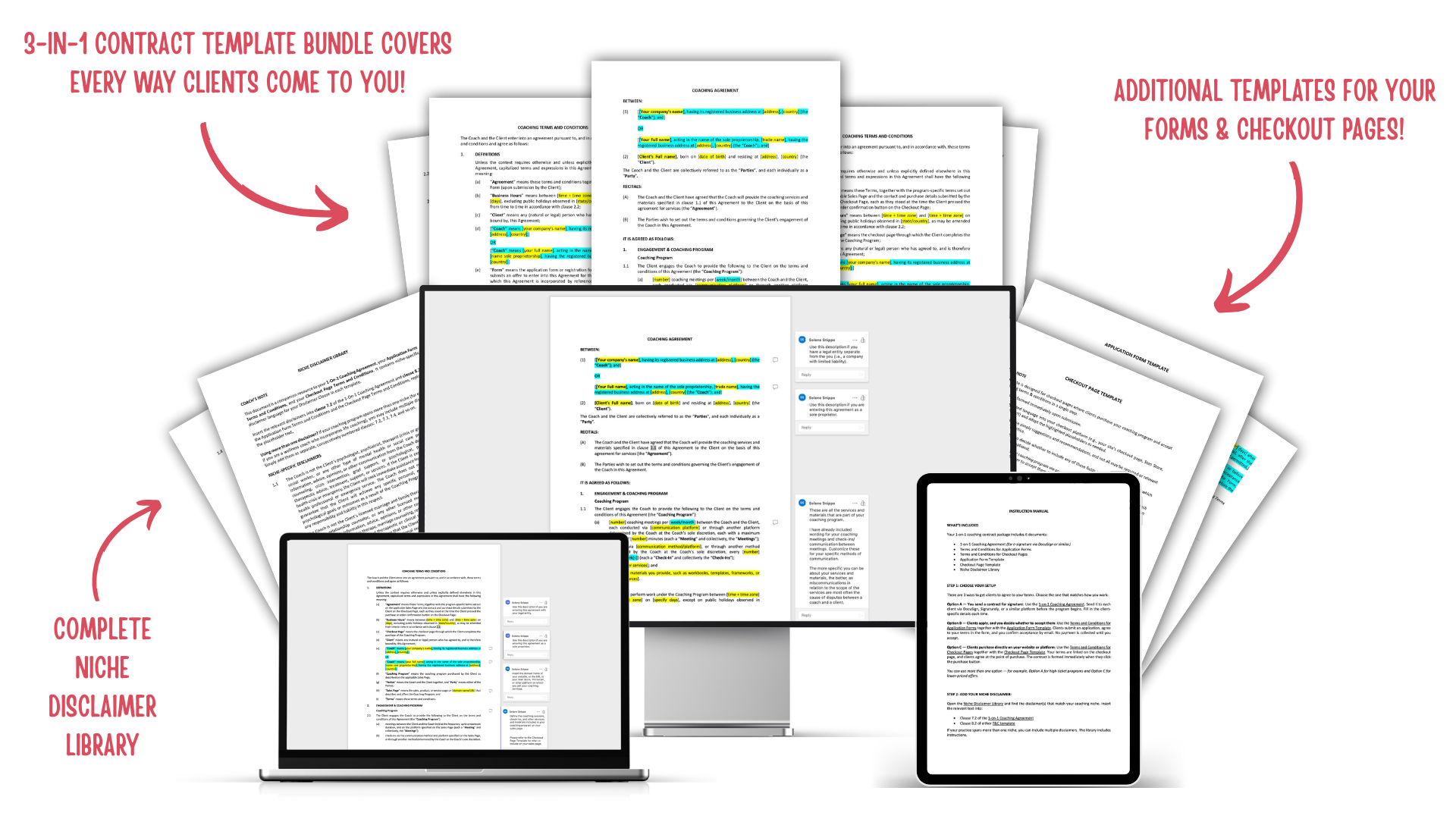
✅ My 1-On-1 Coaching Agreement Template Bundle works for every major coaching platform — including Paperbell, Stan Store, ThriveCart, SamCart, Kajabi, and your own website — and offers three delivery-method formats so you can set it up correctly for however you sell.
7. Does It Come With Guidance So You Can Actually Customize It Correctly?
A template is only as useful as your ability to customize it without breaking it.
And most coaches — even the legally savvy ones — don't know what they're looking at when they open a legal document for the first time.
Which clause is mandatory? Which is optional? What should you fill in, and what should you delete? What happens if you accidentally remove something that was actually protecting you?
Without guidance built into the template, these are genuinely hard questions.
A well-built terms and conditions for coaching services template should make all of this obvious — so you're not guessing.
Here's what good customization guidance looks like:
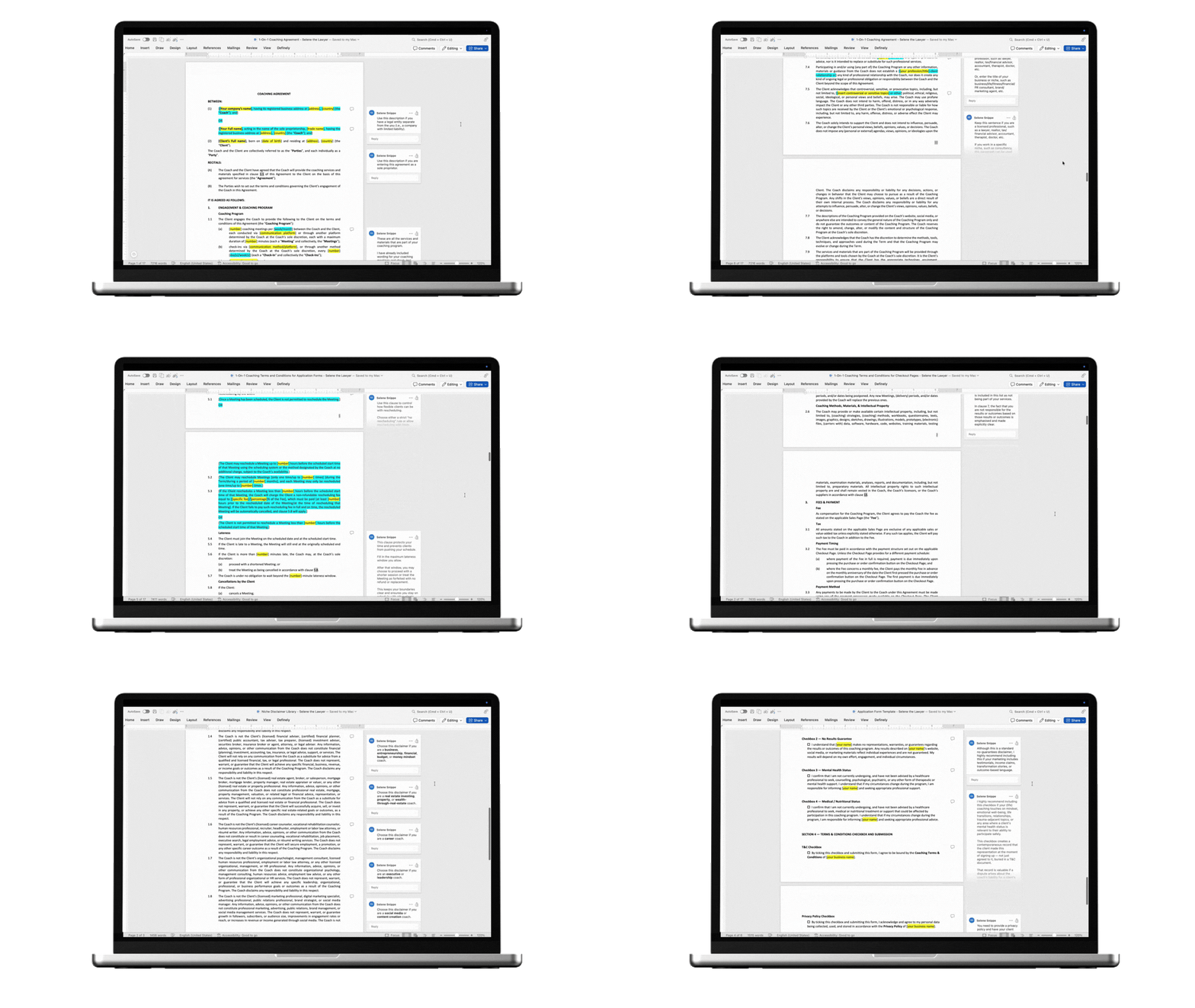
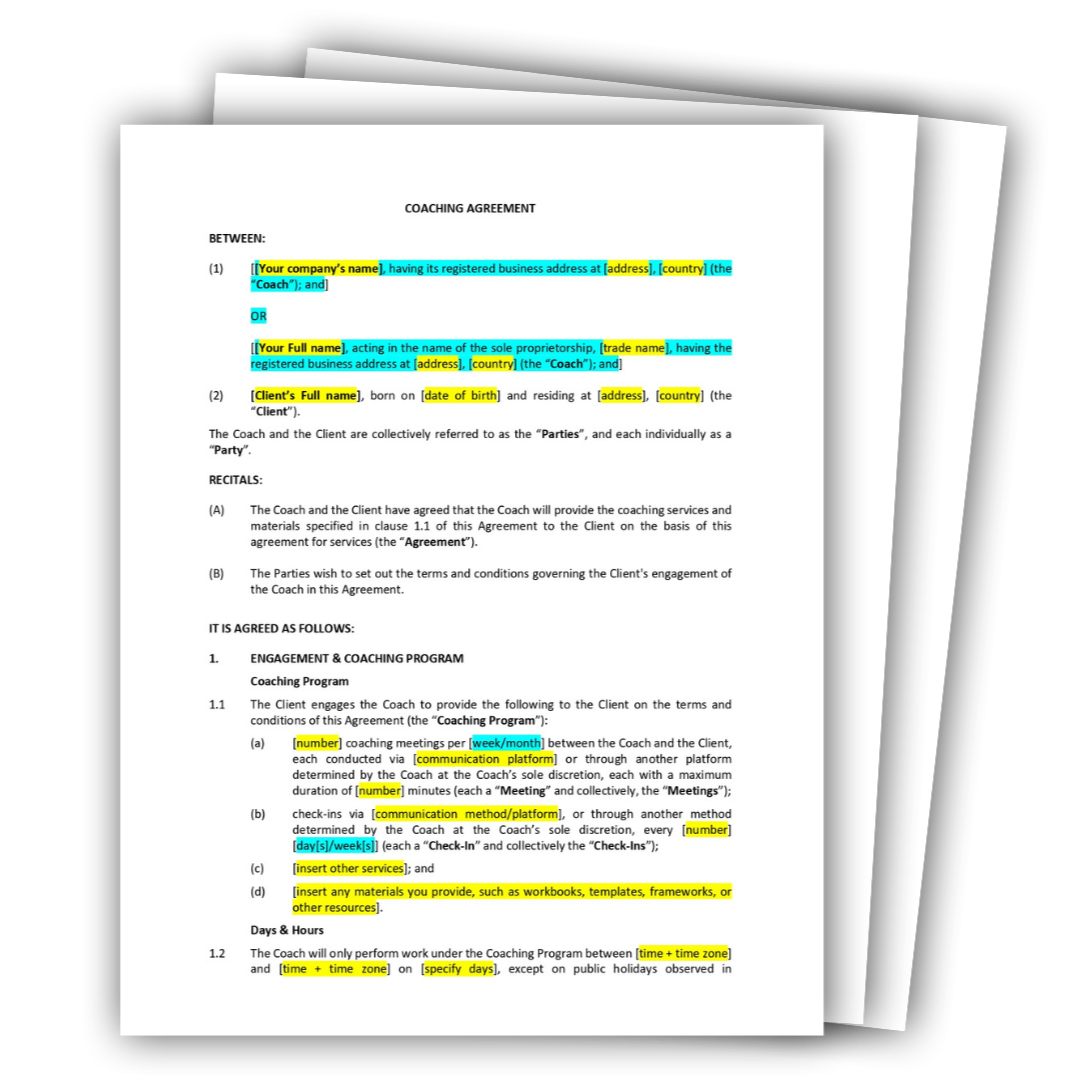
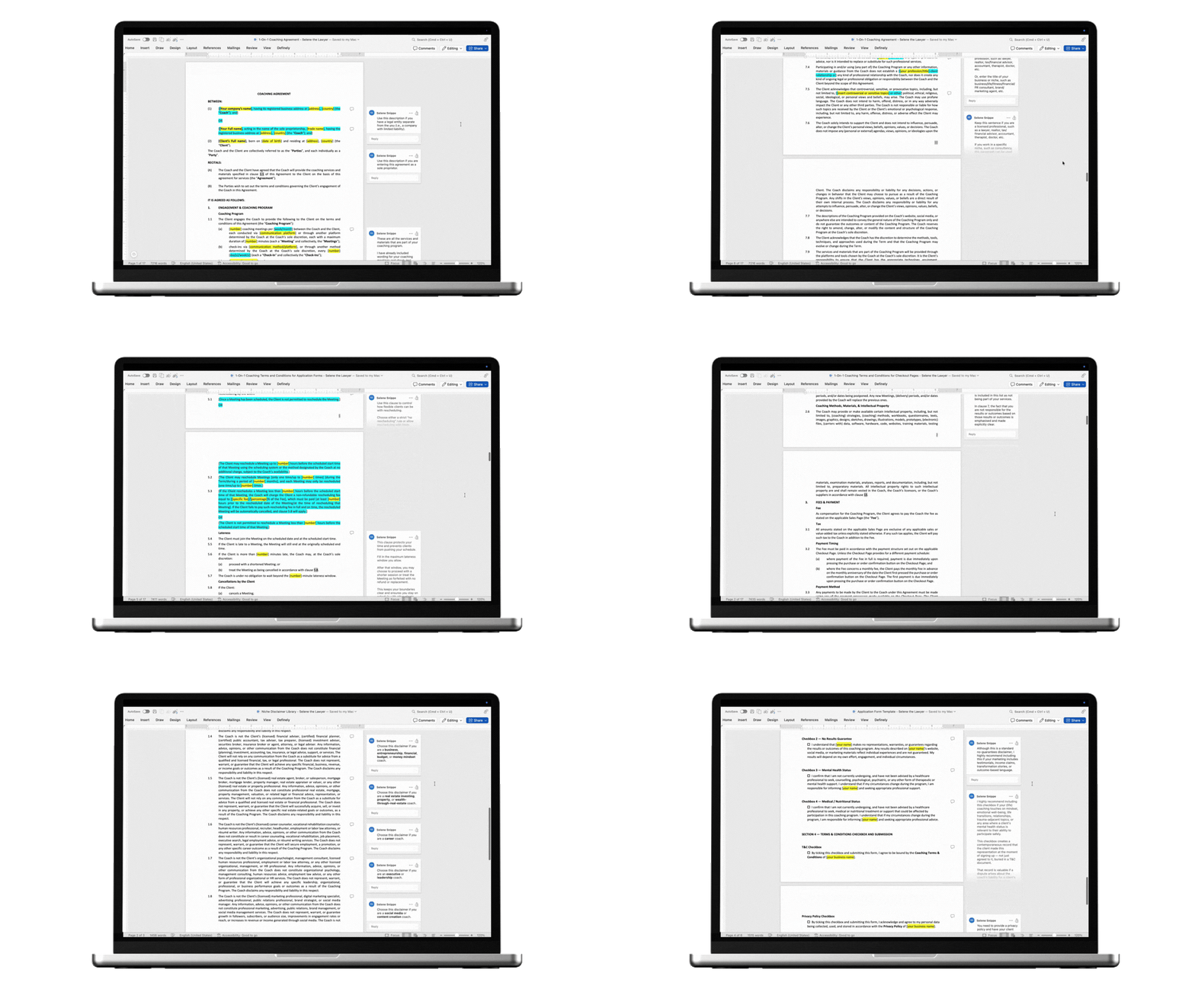
Yellow highlights → required fields you need to fill in: your name, fee, session frequency, platform, governing law
Blue highlights → optional clauses you can keep or delete depending on how you work
In-document comments → drafting notes that explain what each clause does and when to use it
Alternative clauses → so you can choose the version that fits your program, your pricing model, and your refund and cancellation policy
Beyond the document itself, there should be a clear instruction manual that walks you through the entire process — from choosing the right template format to finalizing the document before you publish or send it.
✅ My 1-On-1 Coaching Agreement Template Bundle includes a full instruction manual that walks you through every step — including a finalization checklist so nothing slips through before your first client signs or purchases.
The Best Terms and Conditions for Coaching Services Template
Most terms and conditions for coaching services templates give you a document. A good one gives you a complete system.
So before you download anything, run it through these seven checks:
Does it match how you actually sign clients — e-signature, application form, or checkout page?
Does it include every core clause your coaching business actually needs?
Does it have the right niche-specific disclaimer for your type of coaching?
Does it include the right coaching waivers — not just buried in the T&Cs, but as explicit acknowledgment checkboxes?
Does it come with matching sales page and checkout page language so all your documents tell the same story?
Does it actually work for your coaching platform?
Does it come with guidance so you can customize it correctly without breaking it?
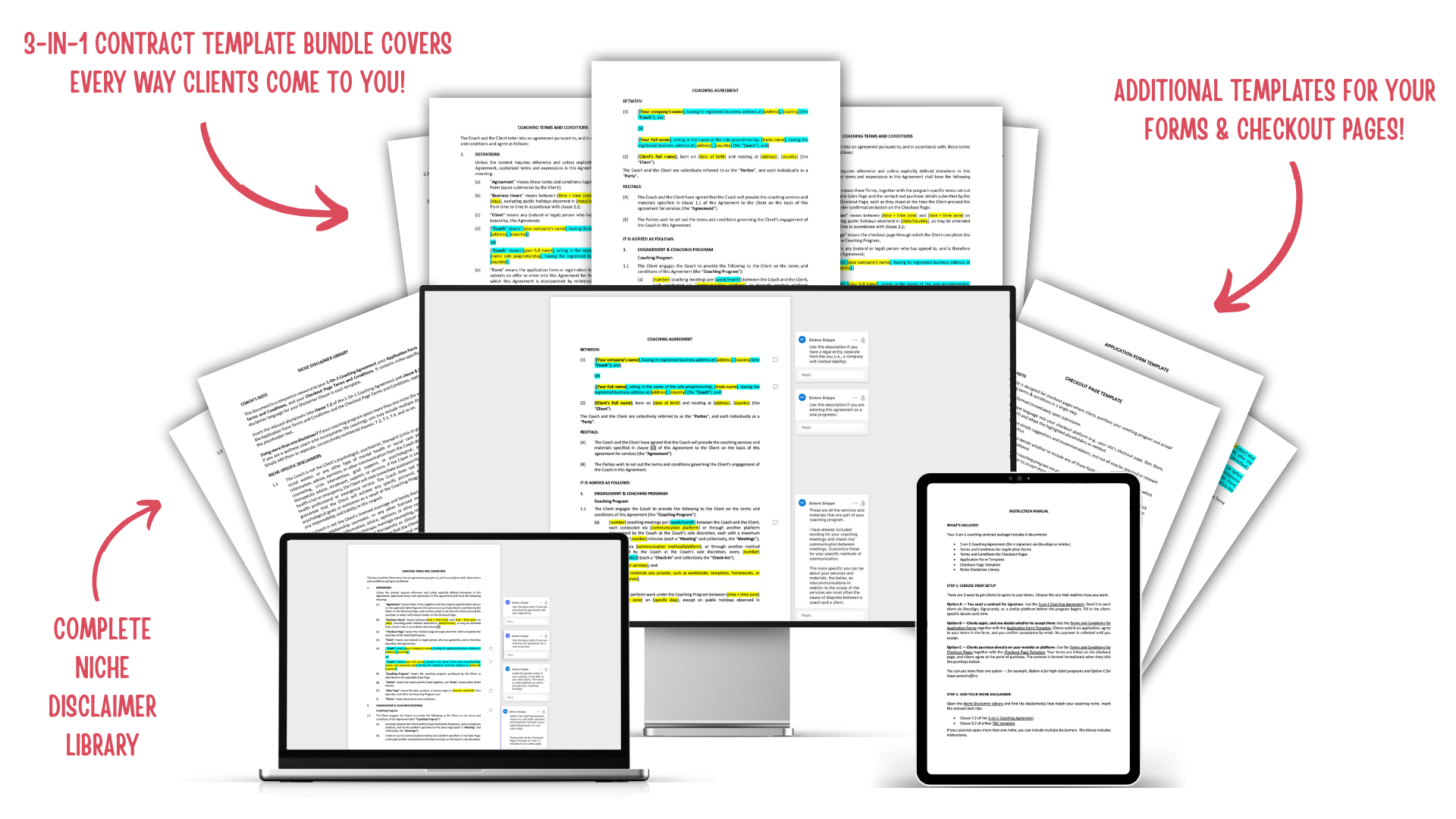
👉 My 1-On-1 Coaching Agreement Template Bundle checks all seven. Here's what's included:
A 1-on-1 coaching agreement for e-signature
Terms & conditions for application forms
Terms & conditions for checkout pages
A complete application form template
A complete sales and checkout page template
A Niche Disclaimer Library covering 10 coaching niches and 33 sub-niches
This Post Was All About Terms and Conditions for Coaching Services — and the 7 Things Every Coach Needs to Get Right
You may also like: