
Looking for a coach contract? Most coaches download the first simple template they find — wrong format, missing half the clauses, and no idea it won’t hold up when it matters.
I’m a business lawyer who creates contract templates for coaches across every niche — from life and health coaching to business, relationship, and career coaching, and everything in between.
And the two things I see most often are coaches using a coach contract that is way too simple to hold up when something goes wrong, and coaches using the completely wrong format for how they actually sell and onboard clients.
You may want a simple coaching agreement template that’s easy to understand (in the hopes that clients won’t ask questions). But when a client wants a refund, disputes a payment, or claims you never told them sessions would expire — that’s when you find out exactly what your contract does and doesn’t cover.
And most of the time? A traditional e-signature coach contract template isn’t even the right format to begin with.
In this post, I'm walking you through the 7 key things every coach needs in a coach contract — the right format for your sales setup, every clause your contract must cover, and the niche-specific disclaimers and waivers that simple templates always miss.
This post is all about exactly what you need in your coach contract — so you can stop patching together free templates and get it right once.
👉 Already know you just want it done? My 1-On-1 Coach Contract Template Bundle includes all 3 formats, plus every clause you need, including a full niche disclaimer library covering 33 coaching niches.
The Best Coach Contract
The 7 Key Essentials You Need in Your Coach Contract Template
1. The 3 Formats of a Coach Contract — And Why Most Sites Only Give You One
If you’ve ever searched for a coach contract template, you've probably noticed that almost every result gives you the same thing: a traditional coaching agreement for e-signature.
You fill it in, send it via DocuSign, and wait for your client to sign.
And then the back-and-forth starts.
They have questions about clause 4. They signed but haven't paid yet. They paid but never signed.
This is the reality of the traditional e-signature coach contract — and it's the only format most free and paid templates are built for.
But there are actually 3 ways to set up a coach contract, and each requires a completely different document.
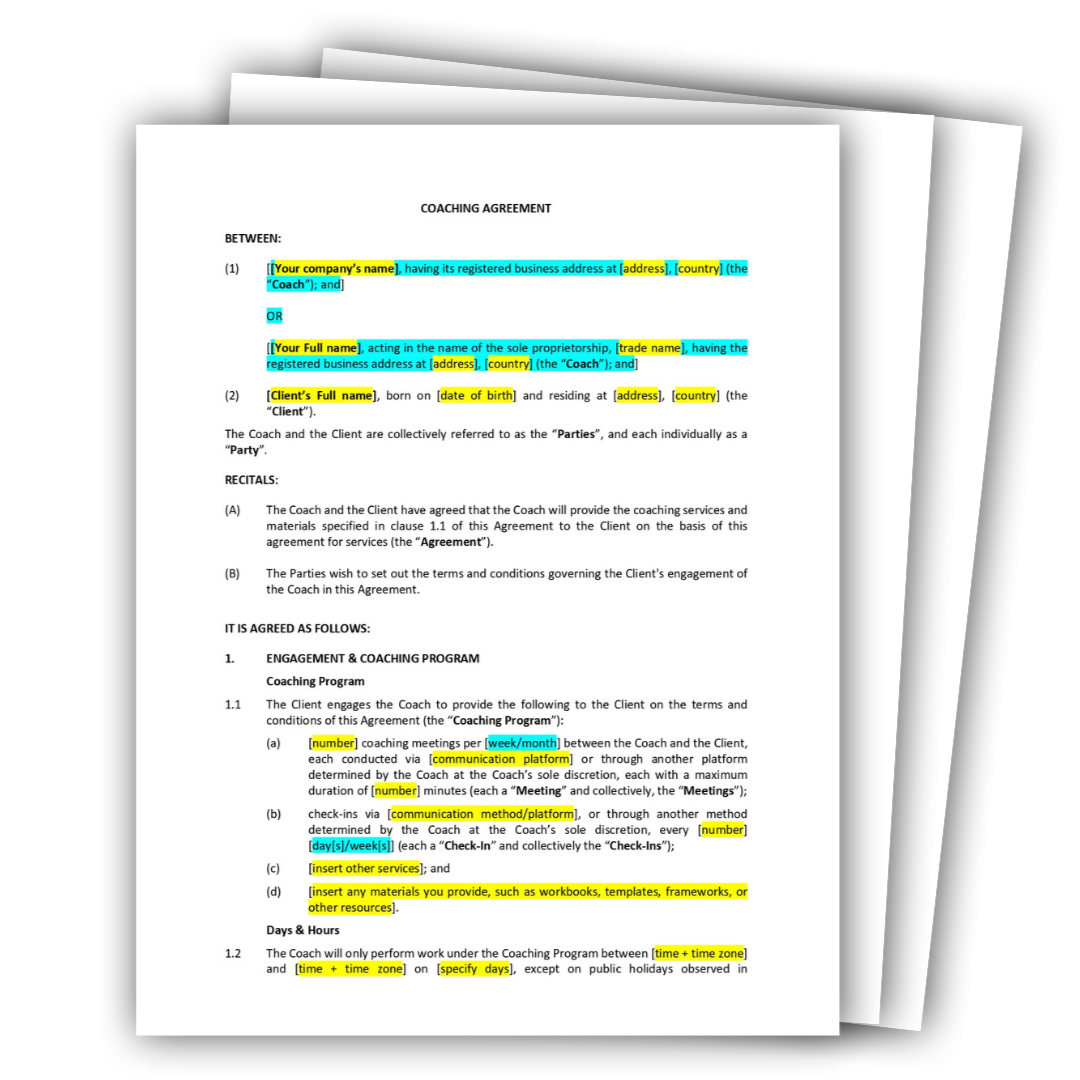
Option 1 — The traditional coaching contract for e-signature
You send a coaching contract, your client signs it, and the contract is formed at the moment of signature — with legal language that makes that signature binding.
It works — but it’s slow, manual, and creates friction before your program has even started.
It makes sense for high-ticket programs where you actually want your client to read every single clause before they sign. Just be prepared for the questions.
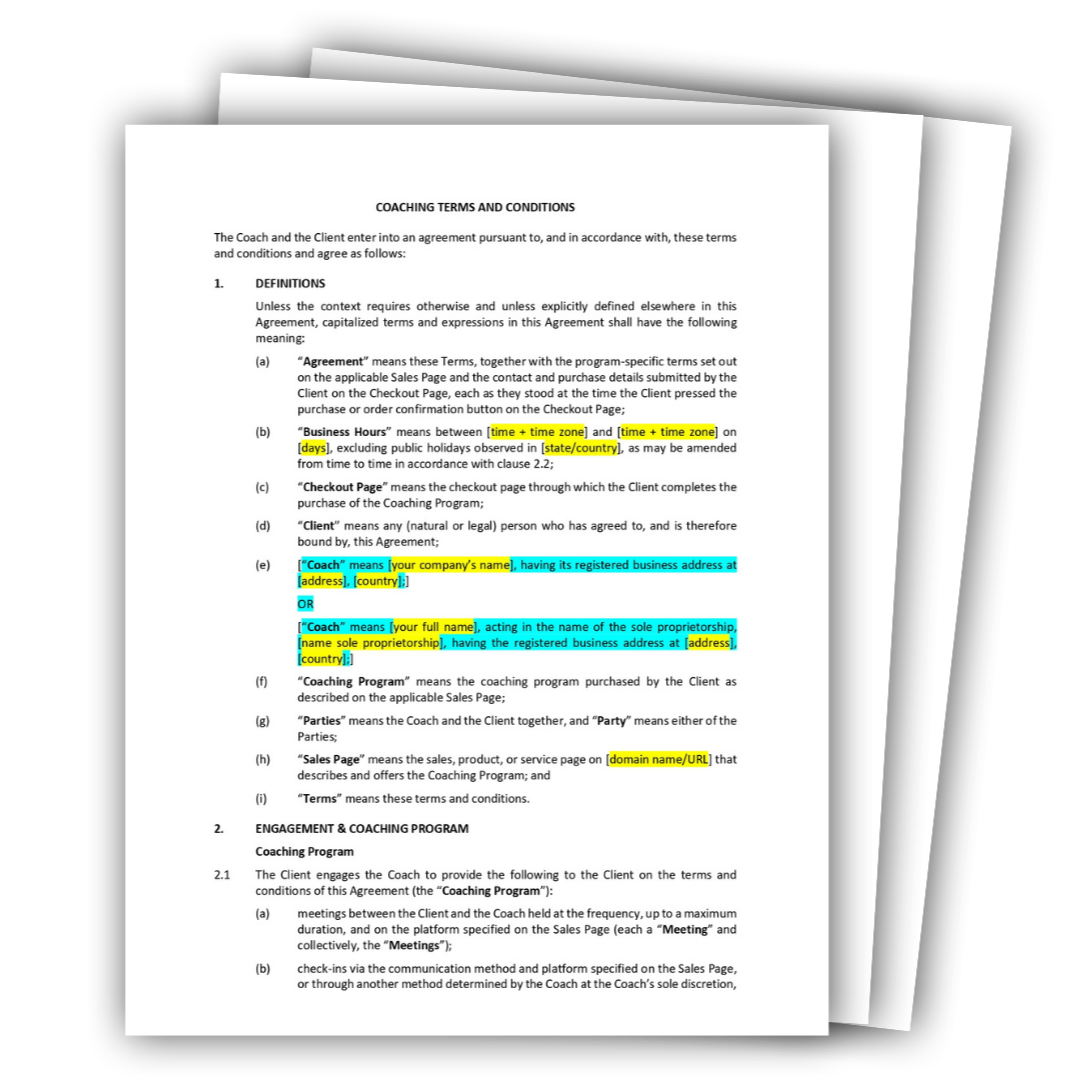
Option 2 — T&Cs for application forms
Your client applies via a form and ticks a checkbox to agree to your T&Cs. You review the application and confirm acceptance by email. The contract is formed only when you send that acceptance — not when they submit the form.
This format needs specific legal language to ensure the contract isn't formed until you've said yes.
Option 3 — T&Cs for checkout pages
Your client purchases directly through your website, Stan Store, ThriveCart, SamCart, or Paperbell. They agree to your T&Cs by ticking a checkbox at checkout — and the contract is formed the moment they hit the purchase button.
This format also needs specific legal language to make the coach contract binding at that exact moment.
A traditional coach contract template doesn’t have that language — and using the wrong format means your contract may not be legally binding at all, regardless of how well-drafted the rest of it is.
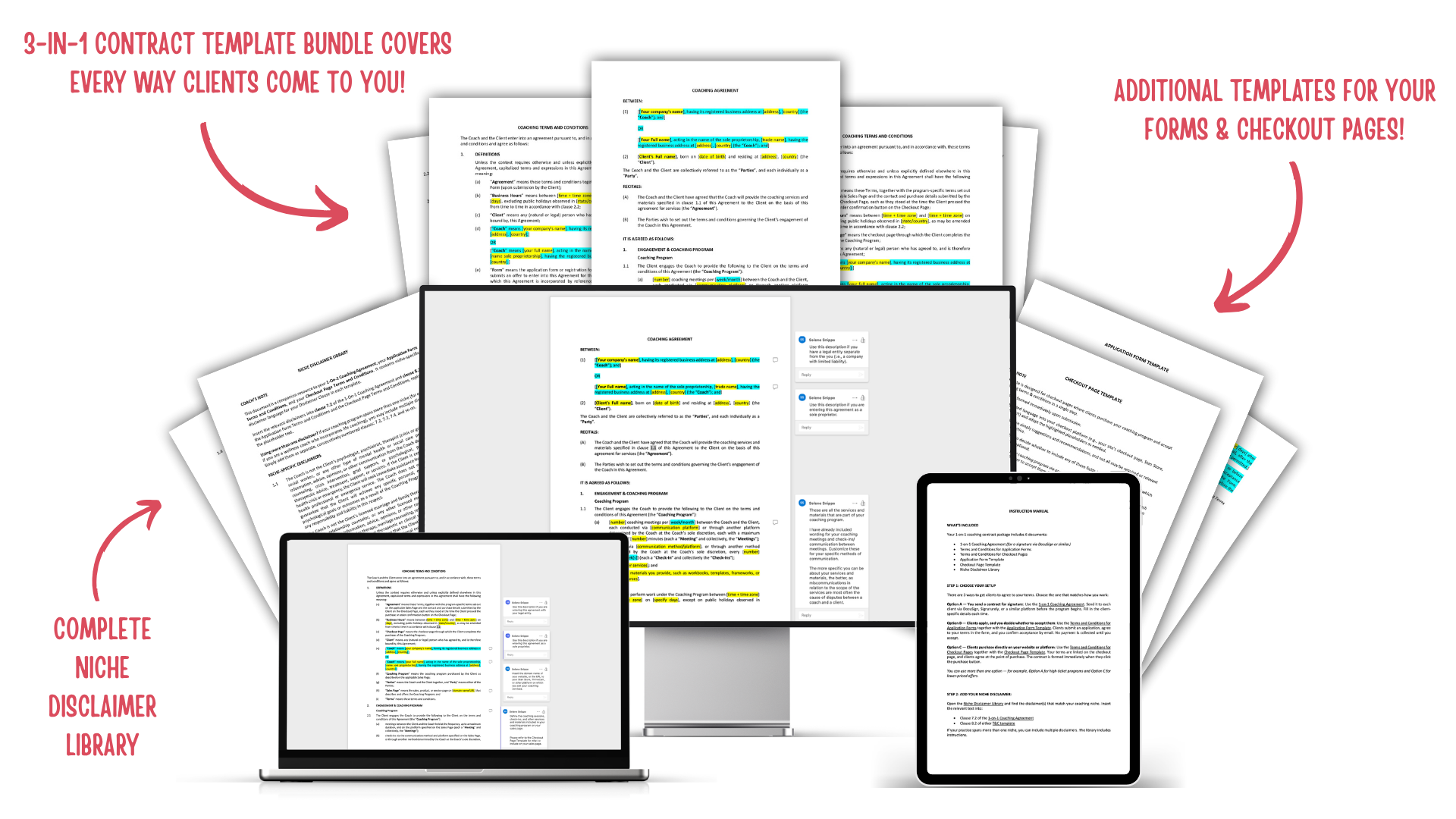
👉 My 1-On-1 Coaching Contract Template Bundle includes all 3 formats — plus a complete application form template and a sales and checkout page template designed to work together with your T&Cs.
2. Simple Coach Contract vs. Comprehensive Coach Contract — What You Actually Need
Many beginner coaches ask for a simple coaching agreement template that is short, clean, and easy to understand. Something clients won't push back on. Something that doesn't require a law degree to read.
That instinct makes complete sense.
But here’s what happens when a client wants a refund and your contract just says “no refunds.” Or when they claim unused sessions roll over, even though your contract never mentioned it. Or when they dispute a payment and your contract has no chargeback clause.
That’s when the average, simple coaching agreement template won't actually protect you.
You need a comprehensive coach contract that covers every single protection you need. One that is crystal clear on rights, obligations, and what happens when something goes wrong.
It may be longer than you'd like, but clarity in the legalities is what’s crucial and what makes a coach contract actually valuable.
And I completely understand that you don’t want to send a client a 20-page contract and either get a billion questions or be completely ghosted. But there’s a simple solution.
What you actually need is T&Cs with a checkbox.
Here’s why.
When you send a traditional coach contract for e-signature, your client reads it. Or at least skims it. And then they ask questions — about the refund clause, the cancellation policy, the session expiry. Every clause is an opportunity for a negotiation you didn't ask for.
When your client purchases through a checkout page or submits an application form, they tick a checkbox agreeing to your T&Cs. And 99% of the time? They don't read them at all.
Same comprehensive protection. Zero back-and-forth.
For most online coaches selling through a website, a platform, or an application process, T&Cs with a checkbox are the smarter, smoother choice. The traditional e-signature coach contract still has its place — but it's the exception, not the default.
👉 My 1-On-1 Coach Contract Template Bundle includes all three formats — so you can choose the right one for how you sell, with comprehensive protection built into every version.
3. What Every Coach Contract Must Include
Speaking of a comprehensive coach contract, here are the crucial terms your coaching contract template should include (but the average simple coaching agreement template doesn’t).
Scope — what's included and what's not
Your contract should define exactly what's included in your program — your sessions, check-ins, and coaching materials such as workbooks and templates. And just as importantly, what's not included.
Without clear boundaries on your scope, clients will assume more is included and keep pushing for more.
Business hours and availability
When does your coaching day start and end? Which days do you work? What time zone?
If your contract doesn't spell this out, clients will assume access whenever it suits them — including evenings, weekends, and public holidays.
Communication boundaries
Which platforms are you available on — and which ones are you not?
Your contract should specify the exact communication methods you use and make clear that anything outside of those — Instagram DMs, WhatsApp, text messages — is off-limits unless you've explicitly agreed to it.
Payment structure
Not just the fee, but when it's due, how it's collected, and what happens if a payment fails or is late.
A proper coach contract template should cover both (1) a single upfront payment for fixed-term programs and (2) monthly upfront payments for ongoing coaching.
Suspension for non-payment
Most templates only allow termination if a client stops paying. But you usually don't want to end the relationship immediately if a payment fails — you want the right to pause until they pay.
Your contract should give you the right to suspend sessions, cancel upcoming meetings, and pause access to materials the moment a payment fails — without having to terminate the entire agreement.
Rescheduling policy
Your coach contract should be customizable to define:
Through which scheduler sessions may be booked
How many hours before a session clients can reschedule (24, 48, or 72 hours?)
The maximum number of reschedulings allowed
Lateness policy
Your coaching contract should define exactly:
What happens if a client shows up late
That the session ends on time, regardless (no extension rights)
After how many minutes you’re entitled to treat the session as a no-show
Cancellation policy
Missed sessions should be non-refundable by default — including for personal circumstances, scheduling conflicts, incorrect time zone conversions, and tech issues on the client's side.
Because clients will use every single one of those excuses.
No-rollover clause
Unused sessions expire at the end of the term — automatically, with no extensions and no rollovers.
Without this clause, clients will ask to "pause" their program indefinitely or bank unused sessions for whenever they feel like it.
Check-in clause
Your contract should specify when check-ins begin (after the first session), how they're conducted, and — crucially — that they expire at the end of the term.
Check-ins should not become an ongoing, unlimited service.
Refund policy
A solid coach contract should have multiple options — from fully non-refundable to a partial refund window before the first session — including a legal waiver of statutory cooling-off and withdrawal rights.
Because in some jurisdictions, clients have a legal right to a refund unless they explicitly waive it.
Chargeback protection clause
Non-negotiable when you're selling coaching services online.
If a client disputes a payment with their bank, PayPal, or Stripe, your contract needs to require them to reimburse you for the full amount charged back, plus any bank fees and legal costs.
Digital materials clause
Any workbooks, templates, or other resources you share should be non-refundable the moment access is granted — regardless of whether the client actually uses them.
Disclaimers
A proper coaching contract should include these disclaimers (regardless of your niche):
No results & outcomes disclaimer — results are not guaranteed, any feedback is opinion-based, and responsibility for results lies entirely with the client
No professional relationship disclaimer — participating in your program does not create any professional relationship, fiduciary duty, or ongoing obligation beyond the contract itself.
Controversial topics and emotional response disclaimer — you are not responsible for how a client emotionally responds to the content of your sessions, including any harm, offense, or distress they experience.
No influence or agenda disclaimer — you don't impose agendas, and any shifts in a client's views, beliefs, or behavior are the result of their own internal process.
Program content disclaimer — you reserve the right to amend, change, or modify the content and structure of your program at your sole discretion.
Tech and platform disclaimer — your program runs on platforms you choose, and it's the client's responsibility to have the right technology and internet access to participate.
👉 For a deeper dive into coaching disclaimers and what each one covers, read my post on coaching disclaimers.
Termination rights
Both parties need clear rules for ending the agreement — including notice periods, what happens to the fee, and when termination can happen immediately and without notice.
Immediate termination should be available for serious breaches: non-payment, harassment, fraud, or any behavior that makes continuing the program unsafe or unreasonable for you.
IP protections
Your coaching frameworks, methods, workbooks, and materials stay yours. Clients cannot copy, share, or use them to coach others.
Non-disparagement clause
A disgruntled client cannot go on a social media rampage against you without legal consequences.
Limitation of liability
This caps what a client can ever claim against you — so one difficult coaching relationship can never threaten your entire business.
Confidentiality
Both directions: your client's information stays private, and everything they learn about how you work does too.
Coach unavailability
You should have the right to temporarily adjourn the program — for a holiday, an emergency, or a planned break — without having to refund everything. Especially if you run a long-term coaching program on a rolling monthly basis.
Governing law and jurisdiction
Customizable to your country or state — with options for court resolution or arbitration, depending on what makes sense for your situation.
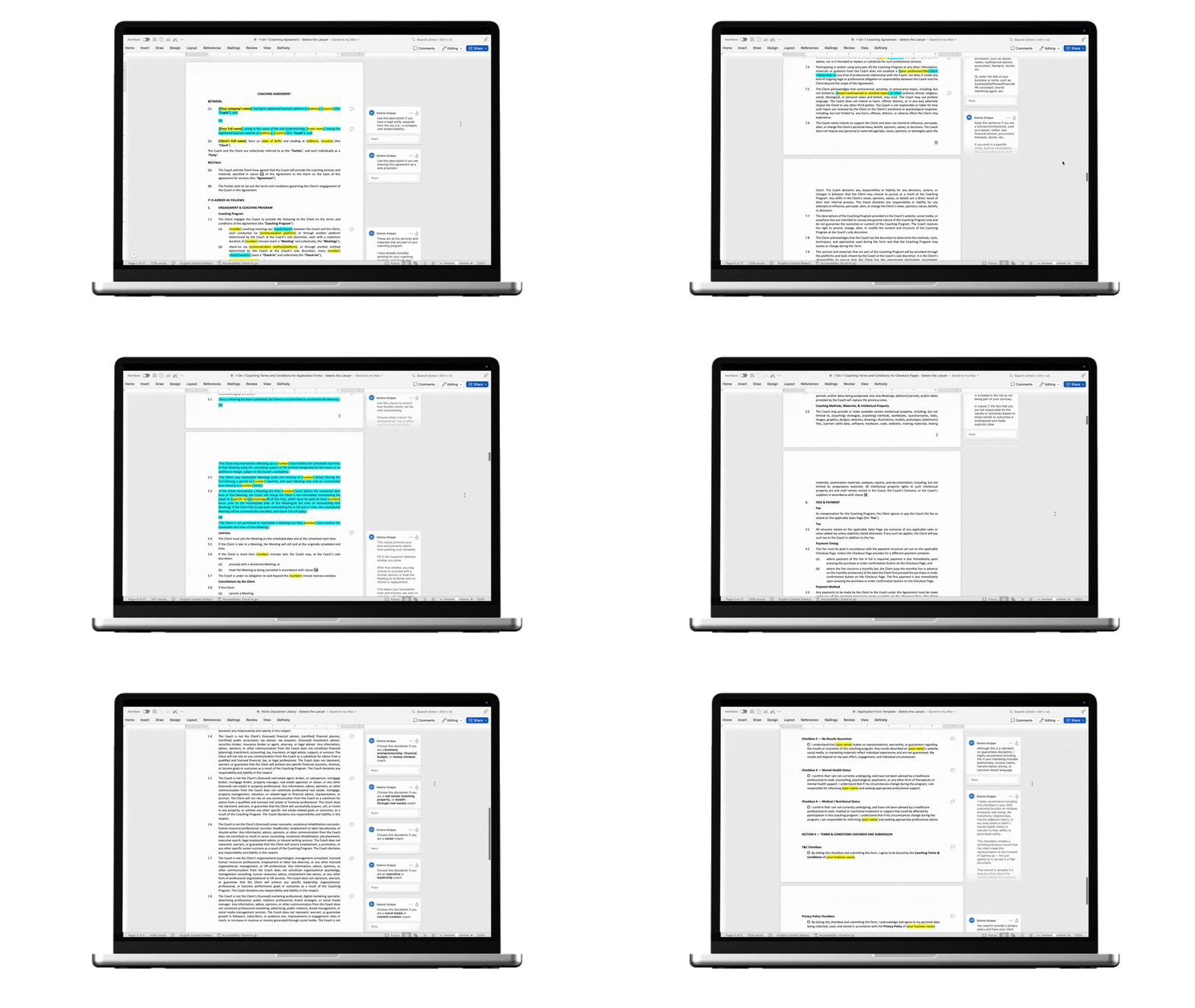
✅ Every single one of these clauses is included in my 1-On-1 Coach Contract Template Bundle — pre-written, customizable, and built for online coaches.
4. The Niche-Specific Disclaimer Your Coach Contract Needs
Every coach needs a disclaimer. But the right disclaimer depends entirely on what you actually coach.
A generic “I’m not your therapist” disclaimer might work for a life coach — but it does nothing for a health coach, a financial coach, or a real estate coach whose work touches on completely different areas of professional liability.
Here's the full library of niche-specific disclaimers your coach contract needs — and what each one covers.
Life, mindset, spiritual, accountability, and goal coaching
Your disclaimer should state that you are not your client's psychologist, psychiatrist, therapist, counselor, or social worker — and that your coaching does not constitute or replace mental health treatment or support.
Relationship and dating coaching
Your coaching disclaimer should state that you are not a licensed marriage and family therapist, couples therapist, sex therapist, or relationship counselor — and that your coaching does not constitute couples therapy, marriage counseling, or any other form of clinical relationship services.
Health, fitness, and nutrition coaching
Your disclaimer should state that you are not a doctor, physician, surgeon, dietitian, licensed nutritionist, physical therapist, or any other healthcare professional — and that your coaching does not constitute medical, dietary, or clinical advice, diagnosis, or treatment.
Business, budget, and financial coaching
Your disclaimer should state that you are not a licensed financial adviser, certified financial planner, accountant, tax adviser, investment adviser, or legal adviser — and that your coaching does not constitute financial, investment, tax, insurance, or legal advice.
Real estate coaching
Your coaching disclaimer should state that you are not a licensed real estate agent, broker, mortgage broker, property manager, or appraiser — and that your coaching does not constitute professional real estate, mortgage, or property advice, representation, or services.
Career coaching
Your disclaimer should state that you are not a licensed career counselor, vocational rehabilitation counselor, HR professional, recruiter, or employment attorney — and that your coaching does not constitute career counseling, job placement, or legal employment advice.
Leadership and executive coaching
Your coaching disclaimer should state that you are not an organizational psychologist, management consultant, licensed HR professional, or employment attorney — and that your coaching does not constitute organizational psychology, management consulting, or HR services.
Social media and content coaching
Your disclaimer should state that you are not a licensed marketing professional, digital marketing specialist, PR professional, or social media manager — and that your coaching does not constitute professional marketing, advertising, or social media management services.
It should also include a platform disclaimer stating that you are not responsible for changes to social media algorithms, platform policies, or account restrictions that occur during or after the program.
Parenting coaching
Your coach disclaimer should state that you are not a child psychologist, child psychiatrist, developmental pediatrician, family therapist, or social worker — and that your coaching does not constitute child psychology, developmental assessment, or family therapy.
This one also needs a crisis clause: if a client is concerned about their child's mental, physical, or developmental health, or is experiencing a family emergency, they are responsible for seeking immediate assistance from a qualified professional.
Writing and publishing coaching
Your coaching disclaimer should state that you are not a professional editor, copy editor, proofreader, ghostwriter, literary agent, or publisher — and that your coaching does not constitute professional editing, ghostwriting, literary representation, or publishing services.
It should also clarify that any feedback on the client's work is for informational and educational purposes only — not a legal clearance or review of the client's work for intellectual property purposes.
What if you’re a licensed professional besides a coach?
If you hold a professional license in your other professional life — as a therapist, doctor, financial adviser, or otherwise — your coach contract needs an additional clause explicitly stating that you are not acting in that licensed capacity during coaching.
Without that, a client could argue you owed them a professional duty of care you never intended to provide.
✅ My 1-On-1 Coaching Agreement Template Bundle includes the full Niche Disclaimer Library — all 10 pre-written disclaimers covering 33 coaching niches, ready to insert directly into your coach contract, your application form T&Cs, and your checkout page T&Cs.
5. The Coaching Waivers Your Coach Contract Needs
Most coach contract templates include generic disclaimers — but not specific client waivers.
That’s a crucial gap. Because a disclaimer tells clients what you are not. A waiver requires clients to actively confirm something about themselves — and that distinction matters enormously when something goes wrong.
If a client who needed therapy signs up for your coaching program and later claims they were harmed, a disclaimer alone won't protect you.
A waiver — where the client confirmed they didn't need therapy before signing up — gives you a clear contractual basis to defend yourself.
Your coach contract needs both appropriate disclaimers and appropriate waivers.
And those waivers should appear not just in the contract itself, but also as explicit checkboxes on your application form and checkout page.
The mental health waiver
Essential for life, spiritual, accountability, goal, and relationship coaches.
This waiver requires clients to confirm, before the program begins, that they are not currently undergoing — and have not been advised to seek — counseling, psychological, psychiatric, or any other form of therapeutic or mental health support.
If it later turns out a client wasn't honest about their mental health status, you have a clear contractual basis to terminate — and a written record that they represented themselves as suitable for coaching.
The medical and nutritional status waiver
Essential for health and fitness coaches.
This waiver requires clients to confirm they are not currently undergoing — and have not been advised to seek — medical or nutritional treatment that could be affected by participation in your program.
The no results guarantee waiver
This one applies to every coaching niche.
The waiver requires clients to actively acknowledge that results are not guaranteed, that any results described on your website or social media reflect individual experiences, and that their results will depend entirely on their own effort and engagement.
The scope of practice acknowledgment checkboxes
Beyond the waivers above, I also recommend adding niche-specific scope-of-practice checkboxes on your application form or checkout page for an extra layer of protection.
Depending on your niche, these cover clients actively acknowledging that:
You are not a psychologist, psychiatrist, therapist, or counselor (life, spiritual, accountability, goal, or relationship coaching)
You are not a doctor, physician, or licensed nutritionist (health or fitness coaching)
You are not a licensed financial, tax, or legal advisor (business, budget, or financial coaching)
You are not a licensed real estate agent, broker, or professional (real estate coaching)
You are not a licensed career counselor, HR professional, or recruiter (career coaching)
Although you hold a professional license, you are not acting in that licensed capacity during coaching (if you hold a separate professional license)
✅ My 1-On-1 Coaching Coach Template Bundle includes all of the above — built into the coaching agreement as client warranties, and as explicit acknowledgment checkboxes in both the application form template and the checkout page template.
6. What Makes a Coach Contract Actually Customizable
A coach contract template is only as useful as your ability to customize it for how you actually run your business.
And the average, simple coaching agreement template gives you a blank document with brackets to fill in.
How do you know what to fill in? You’re not a lawyer.
A well-built coach contract template should give you real options for every part of your business, tailored to each coach. Here’s what that actually looks like:
Scope framework
A proper scope clause gives you a framework to define your sessions, check-ins, and materials — not just a blank line that says “describe your program here.”
It should also include a clear list of what is not included, with options you can adapt to your specific offer.
Program term
Your coach contract template should have alternative clauses for both a fixed-term program (6 weeks, 3 months, 6 months) and an ongoing rolling monthly program — because the legal language for each is completely different.
Payment structure
Options for a single upfront payment for fixed-term programs and monthly upfront payments for ongoing coaching — with the correct legal language for each setup.
Refund policy
Multiple options — from fully non-refundable to a partial refund window before the first session — so you can choose the version that matches your business model without drafting anything from scratch.
Rescheduling policy
Customizable options based on your own boundaries: which scheduler you use, how many hours' notice you require, and the maximum number of reschedulings you allow.
Lateness policy
Options for how many minutes late a client can be before the session is forfeited, because that threshold is different for every coach.
Termination options
Alternative clauses covering different notice periods, what happens to the fee on termination, and the specific circumstances that trigger immediate termination without notice.
Communication boundaries
Customizable to specify exactly which platforms you’re available on — and which ones are off-limits.
Niche-specific disclaimers
A library of options so you can pick the right disclaimer for your specific type of coaching — rather than being stuck with a generic disclaimer that doesn't reflect your actual niche.
Governing law and jurisdiction
Customizable to your country or state — with options for court resolution or arbitration depending on your situation.
✅ My 1-On-1 Coaching Contract Template Bundle includes all of the above — with alternative clauses, a full niche disclaimer library, and a complete instruction manual so you know exactly what to customize and how to do it.
7. Sales Pages & Application Forms that Are Aligned with Your Contract
A coach contract protects you during the program. But your client’s journey starts long before they sign anything.
They find you on Instagram. They visit your sales page. They read your checkout page or fill out your application form.
And everything they read at that stage forms part of their expectations — whether your contract says otherwise or not.
Here’s a scenario I see constantly.
A coach has a solid contract. Clear refund policy, session expiry clause, all of it. But her sales page says “flexible, cancel anytime.” Her checkout page has no mention of her refund terms. And her application form has no acknowledgment checkboxes.
When a client wants out after month one, she points to the sales page. Not the contract.
And now the coach is spending her Sunday writing a formal dispute response instead of coaching.
Your contract, your T&Cs, your sales page, your checkout page, and your application form all need to tell the same story.
Especially on refunds, cancellations, session inclusions, and program duration. Any inconsistency between them is an opening that a difficult client will find.
That’s why a coach contract should always be part of a complete document ecosystem — where every document references the same core terms, and the T&Cs always prevail over the sales page in case of any conflict.
Here’s what that complete ecosystem looks like:
A coaching contract or T&Cs covering every clause your business needs
A sales and checkout page template with the exact refund policy wording, rescheduling summary, and niche-specific acknowledgment checkboxes
An application form template with the same core terms and the right client acknowledgments built in
✅ My 1-On-1 Coach Contract Template Bundle is designed as exactly that — a complete bundle where every document works together, with no gaps, no contradictions, and no room for a client to play one document against another.
The Best Coach Contract Template Free of Fluff
Before you download anything, run it through these seven checks:
Does it come in the right format for how you actually sign clients?
Is it comprehensive enough to hold up when something goes wrong?
Does it include every clause your coaching business actually needs?
Does it have the right niche-specific disclaimer for your type of coaching?
Does it include the right coaching waivers — not just buried in the contract, but as explicit acknowledgment checkboxes?
Is it actually customizable for how you run your business — or does it just give you brackets to fill in?
Does it include templates with the legal language you need for sales pages, checkout pages, and application forms? Probably not.
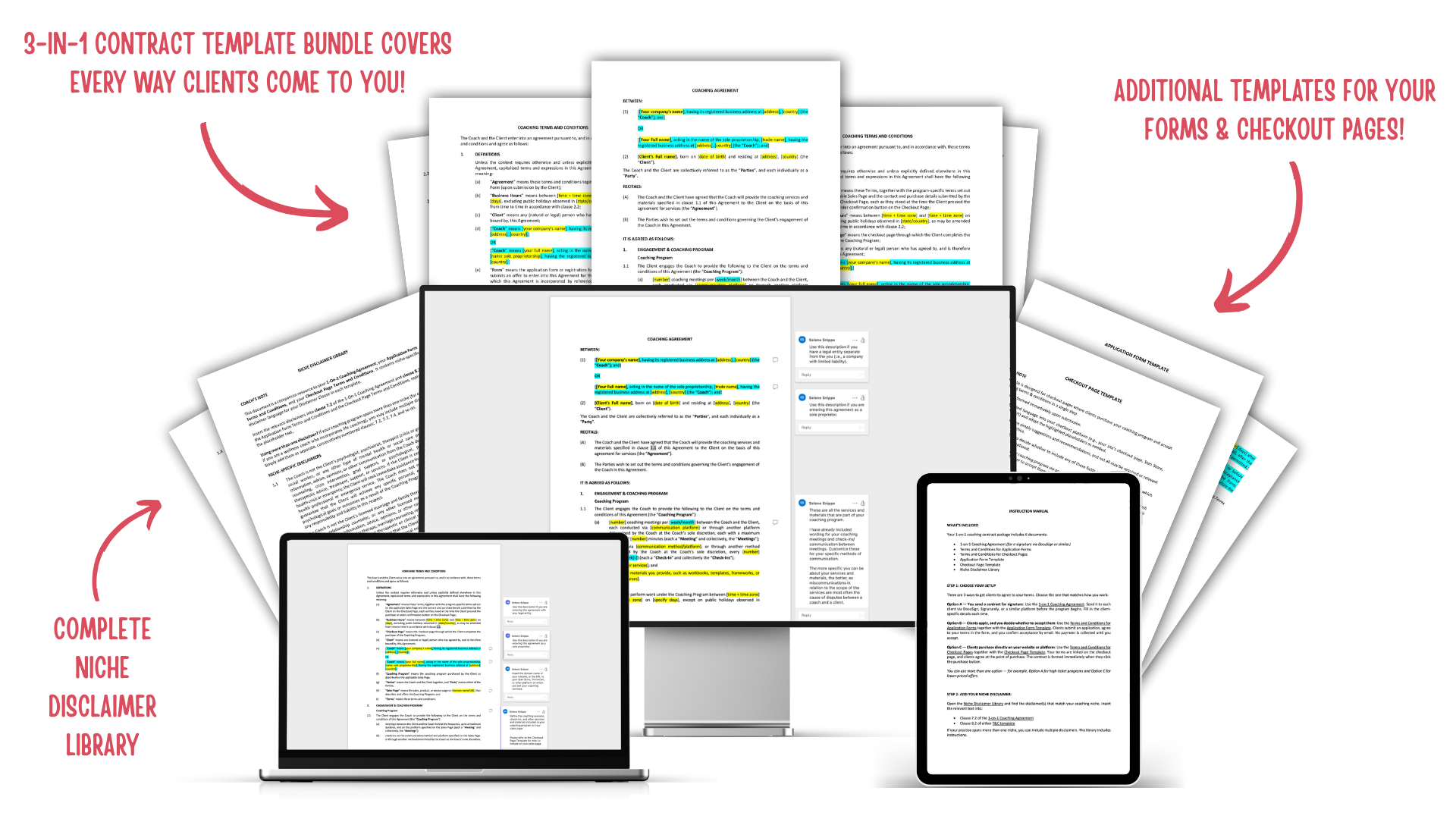
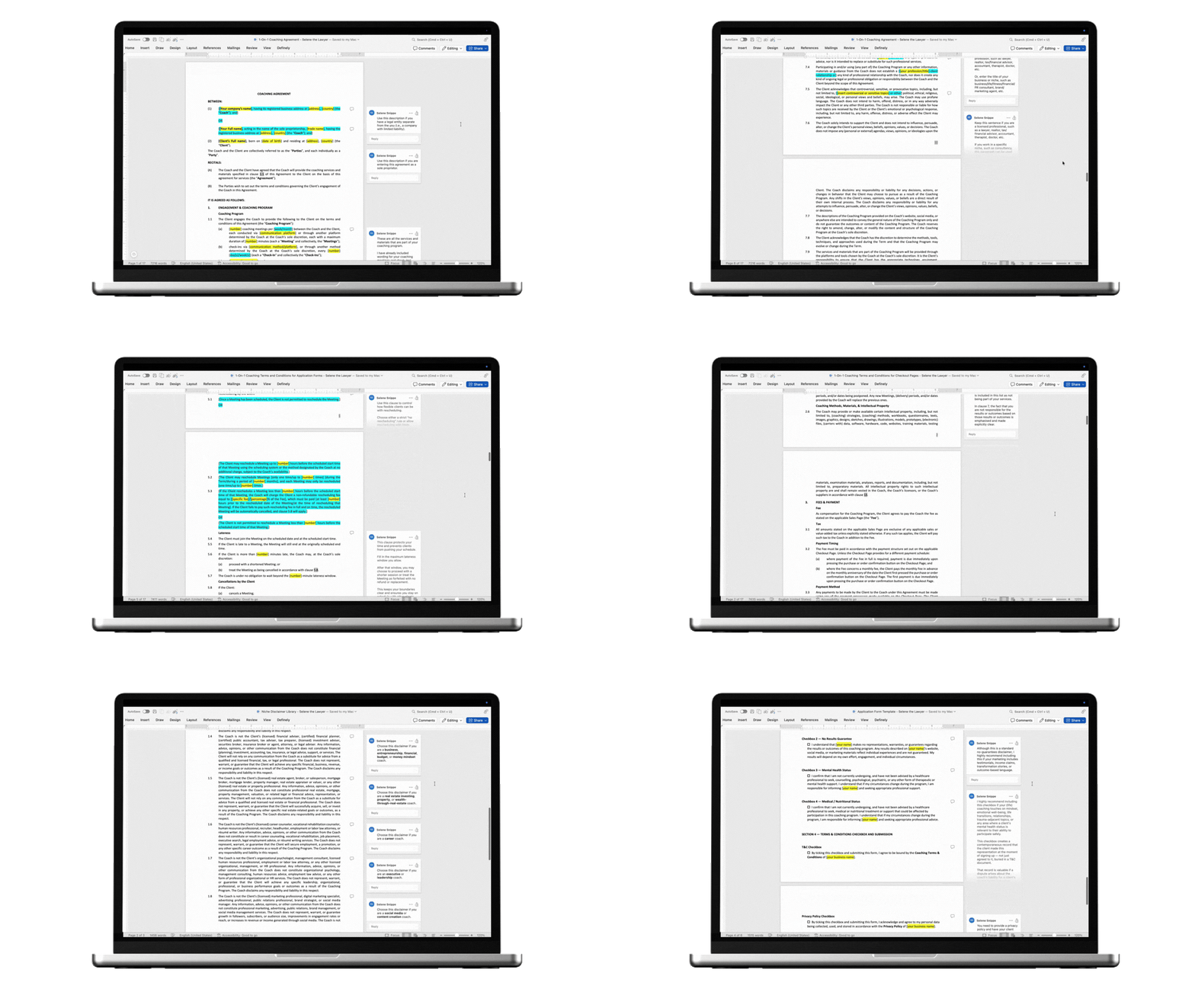
👉 My 1-On-1 Coaching Agreement Template Bundle checks all seven. Here’s what’s included:
A 1-on-1 coaching agreement for e-signature
Terms & conditions for application forms
Terms & conditions for checkout pages
A complete application form template
A complete sales and checkout page template
A Niche Disclaimer Library covering 10 coaching niches and 33 sub-niches
This Post Was All About Coach Contracts — and the 7 Key Things Every Coach Needs to Get Right
You may also like: