9 Things Your Coach Agreement Needs (That Most Templates Miss)
Looking for a coach agreement? Before you settle on a template, ask yourself: Does it cover what happens when a client misses a session — and then asks when you can make it up?
Most templates don’t. That clause just isn’t there, and neither are a few others no one talks about.
The basics — payment terms, refund policy, confidentiality — show up in almost every coach agreement example you'll come across.
What doesn’t show up are the specific clauses that cover these real-life client situations:
The client who shows up 20 minutes late and expects a full session.
The one who reschedules the same call 3 times.
The one who assumed check-ins meant unlimited Voxer access.
In this post, I’ll walk you through exactly what those clauses are — what to look for in a coach agreement template, and what most simple coach agreement templates skip.
This post is all about the coach agreement clauses most templates leave out — and what yours actually needs to protect your time, income, and sanity.
Want a contract that already has all of this built in?
Get the 1-on-1 Coaching Agreement Template →
Best Coach Agreement
The 9 Key Things Every Coach Agreement Should Cover (But Most Don’t)
1. A No-Rollover Clause for Unused Sessions
Let’s say your client misses two sessions. That client didn’t reschedule or let you know in advance that they couldn’t make it. They just didn’t show up. A few weeks later, they come back asking when they can make them up.
If your coach agreement doesn’t explicitly state that unused sessions expire at the end of the program, clients reasonably assume that missed time rolls over.
What an ironclad coach agreement needs here:
A clear statement that all sessions must be used within the program period — no banking, no rollover, no saving for later.
A clear rule stating that unused sessions are automatically forfeited and non-refundable at the end of the program.
An extra layer of protection stating that a forfeited session doesn’t pause, extend, or interrupt the program.
💡 My 1-on-1 Coach Agreement Template includes all three — so there’s no room for a client to claim their missed sessions are still waiting for them.
2. A Lateness Policy That Protects Your Time
Most contracts say nothing about what happens when a client is late.
So when a client joins 25 minutes into a 45-minute session, you're left deciding on the spot: do you run over? Squeeze in what you can? Cancel and absorb the loss?
A proper coach agreement gives you the following options:
If the client is late, the session ends at the originally scheduled time regardless.
After a defined lateness window — say, 15 minutes — you may treat the session as a cancellation under the no-show clause.
You are under no obligation to wait beyond that window.
Speaking of no-shows: the lateness clause and the cancellation clause should work together. A client who arrives late enough to miss the session should be treated the same as one who didn't show at all — and your contract should say so explicitly.
💡 My 1-on-1 Coach Agreement Template includes a lateness clause with a defined window, your discretion to cancel, and explicit language tying it to the no-show clause — so your time will never be wasted by no-shows.
3. Hard Limits on Rescheduling
The average coach agreement includes a simple reschedule policy. But the problem is usually that it’s not granular enough.
Stating a notice window for rescheduling (like 24 hours before the scheduled booking) is a good starting point. But what most templates don’t explain are the specifics: a total cap, per-session limits, and what happens when a client tries to reschedule at the last minute.
What your coach agreement should cover:
Whether rescheduling is permitted at all — some coaches don’t offer any rescheduling options once a session is booked.
If rescheduling is allowed: a total cap per program or per month, and a limit on how many times any single session can be moved.
A fee for last-minute reschedules, payable before the session is confirmed. This is optional.
What happens if that fee isn’t paid: the session is automatically canceled, and the no-show clause applies.
Without those caps, some clients will reschedule the same session 3 times without a second thought.
💡 My 1-on-1 Coaching Agreement Template lets you set rescheduling limits that work for your program — or block rescheduling entirely — with an optional late fee and automatic cancellation built in.
4. An Explicit “Not Included” List
The average coach agreement will leave a blank space for you to describe what's included in the program. Most don’t spell out what isn’t.
If you don’t define what’s excluded, clients will keep asking for things that were never part of the program. They’ll send quick questions over DMs, LinkedIn, email, or wherever they can reach you. They’ll ask for extra materials, additional feedback, or a quick look at something — and that something will often turn out to be a 47-page PDF.
Clients genuinely don’t know where the line is unless you draw it explicitly.
What your coach agreement template should include:
The specific “what’s included” list with clear boundaries written out for you (not just a blank space for you to fill in with no guidance) — and that anything not on that list is out of scope.
That communication channels not listed in the contract are not part of the program unless you agree otherwise.
That additional work or services outside the scope require your prior written approval and will be billed separately.
A customizable exclusions list so you can add anything else your clients specifically tend to ask for.
A niche-specific disclaimer making clear that you don’t provide professional advice that clients in your niche may ask for — whether that’s medical, financial, legal, psychological, or otherwise.
Without explicit boundaries, there's no clause to point to when someone asks for something that’s outside your scope.
💡 My 1-on-1 Coach Agreement Template includes a dedicated scope exclusions clause — an explicit list of what’s not part of the program, so you can point to your contract instead of having that awkward conversation around boundaries.
5. The Platform Clause (Communication Boundaries)
A generic coaching agreement will not specify which platforms clients can use to contact you.
Without that, clients will reach out wherever they can find you — email, WhatsApp, Instagram DMs, LinkedIn, Voxer, all of it.
What a proper coach agreement should include:
The specific platforms permitted for sessions and for check-ins.
That communication outside those channels is not part of the program unless you explicitly agree otherwise.
Your right to change platforms at your discretion — so if an app is discontinued or goes down (or if you found a solution that simply works better for you), you're not in breach of contract for switching.
Response time targets framed as goals, not guaranteed service levels, and not grounds for a breach-of-contract claim (so clients know what to expect but can't hold you to a deadline either).
Speaking of check-ins: if they're part of your program, define them separately from your sessions. The platform, the frequency, and the timing all need to be in writing.
There’s a significant difference between a weekly Voxer check-in and being available on WhatsApp whenever the client has a question.
💡 My 1-on-1 Coach Agreement Template specifies exactly which platforms are permitted for sessions and check-ins — and gives you the right to switch platforms without it counting as a breach.
6. A Coach Adjournment Clause
In all my years of drafting and reviewing contracts, I’ve never actually seen another coach agreement that actually addresses what happens if you need time off — whether that's a planned vacation, illness, or anything else that comes up.
When there’s nothing in writing, clients will assume their sessions are on hold, but the program period keeps running. That assumption leads directly to a refund request.
What your coach agreement should include:
Defined business hours, days, and time zone — including public holiday exceptions for your country.
Your right to pause the program for a set period by giving reasonable advance notice by email.
Options for handling pre-paid fees during that pause: either extend the program period pro-rata, or credit or reduce future charges — your choice.
A clear statement that no further compensation is owed beyond those adjustments.
💡 My 1-on-1 Coach Agreement Template includes an adjournment clause with both pro-rata options built in — so you’re covered whether you offer a time extension or a fee adjustment.
7. Payment + Access Gating
The average coach agreement treats the signature as the access trigger. But what happens when a client signs and then delays payment?
What a proper coach agreement should do instead:
Gate access on two conditions: the contract is signed by both parties, and the first payment (or full fee) has been received — both must be met before you're obligated to provide anything.
Make clear that sessions, materials, and onboarding only begin once both conditions are met — not before.
State explicitly that pre-signing communication doesn't create any obligation — intake calls, discovery sessions, or anything shared before both conditions are met don't guarantee access to the program.
Speaking of payment structure: a fixed upfront fee and a monthly recurring fee are two different arrangements with different billing and termination rules. Make sure your coach agreement template covers both models so that you can customize it to each type of coaching program you run.
💡 My 1-on-1 Coach Agreement Template includes clear access gating tied to both signature and payment, with separate billing options for fixed-fee and monthly clients.
8. A Minimum Term for Month-to-Month Coaching
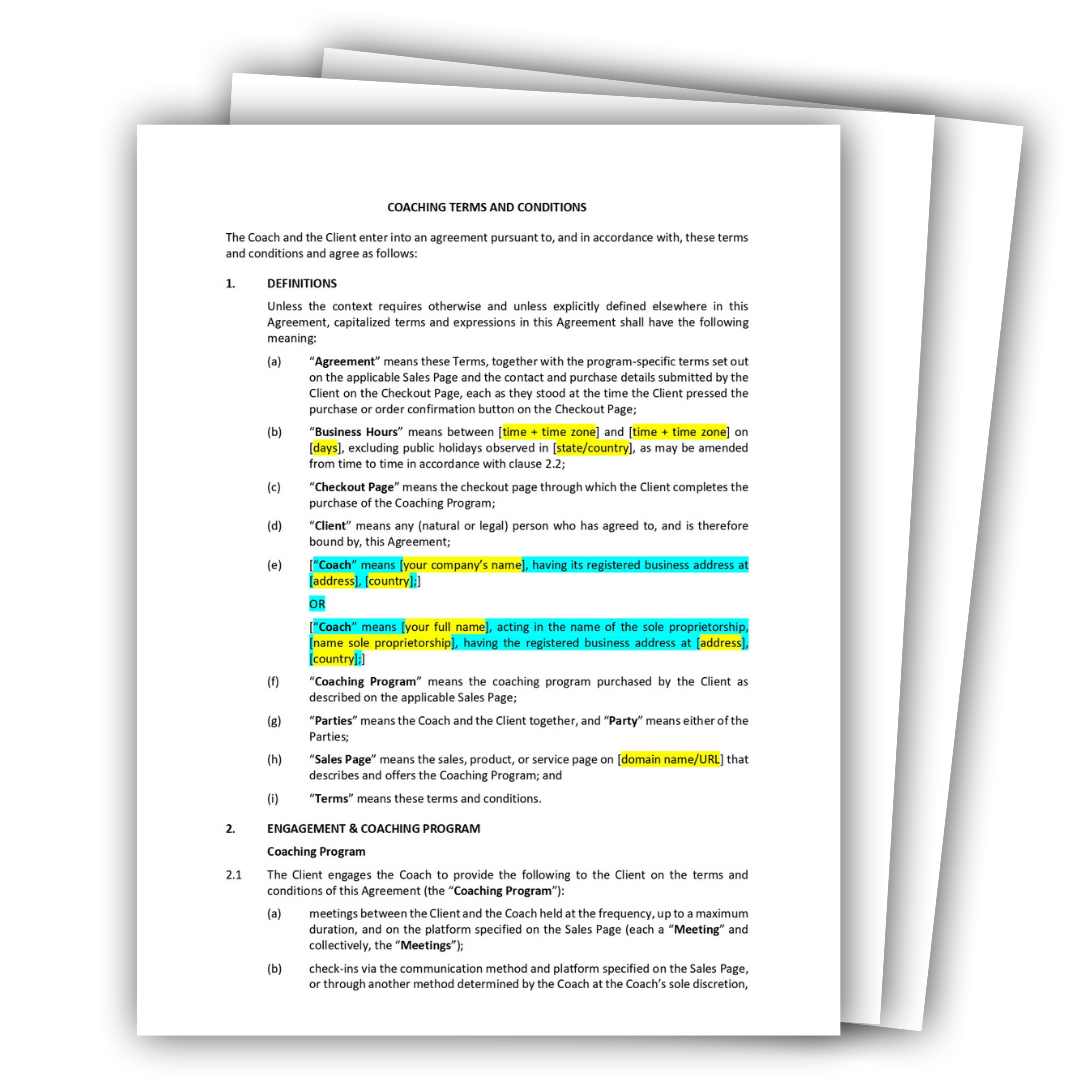
The usual coach agreement doesn’t include a minimum commitment period for monthly clients. That means a client can pay for one month, get through the first few sessions, and cancel before the next billing cycle — taking everything they came for without any further commitment.
If you offer ongoing month-to-month coaching, this is the clause that protects you.
What your coach agreement should include:
A minimum number of months before the client can exercise their right to terminate, so they can’t exit after the first billing cycle.
A notice period tied to billing dates — not just a number of days, but defined relative to the next billing date.
A rule for late notice: if the client gives notice too close to the next billing date, termination takes effect at the end of the following billing cycle — and that cycle's fee is due in full.
💡 My 1-on-1 Coach Agreement Template includes an optional minimum term for month-to-month clients — you can set the number of months that works for your program, or leave it out if you offer fixed-term coaching only.
9. Niche-Specific Disclaimers
Most coaches know they need a disclaimer. The problem is that a vague, one-line statement that coaching does not constitute professional advice often falls short.
A niche-specific disclaimer goes further — it names exactly what you are not and what your communication doesn’t constitute.
What the right coaching disclaimer covers depends on your niche:
Life and mindset coaches: mental health scope limits — what your program is not, and language directing clients in crisis to qualified professionals.
Relationship and couples coaches: clinical and therapeutic scope limits for relationship, marriage, and couples counseling — what your coaching doesn’t constitute and when clients should seek licensed support.
Health and wellness coaches: medical and nutritional scope limits — including the client’s responsibility to consult a healthcare professional before making any changes to their regimen.
Business and financial coaches: financial, investment, tax, and legal scope limits — making clear that your coaching isn’t financial planning, accounting, or legal advice.
Real estate coaches: property, mortgage, and valuation scope limits — making clear that your coaching isn’t licensed real estate advice, representation, or financial advice related to property.
Career coaches: scope limits for employment law, job placement, and vocational guidance.
Leadership and organizational coaches: management consulting, HR, and employment law scope limits — making clear that your coaching isn’t organizational consulting, HR advice, or professional leadership services.
Marketing and social media coaches: platform policy disclaimer — you're not responsible for algorithm changes, account suspensions, or shifts in platform rules.
Parenting coaches: child psychology, developmental, and child welfare scope limits — including language that directs clients to seek professional support when their child's health or well-being is a concern.
Writing and publishing coaches: editorial, ghostwriting, and literary representation scope limits — including the client’s responsibility for the originality of their work and any IP considerations.
💡 My 1-on-1 Coach Agreement Template comes with a full niche disclaimer library with 10 niche-specific disclaimers covering 33+ coaching niches — so you can select the one that fits, or stack multiple ones if your program crosses more than one area.
The Template That Covers Everything the Average, Simple Coaching Agreement Template Doesn’t
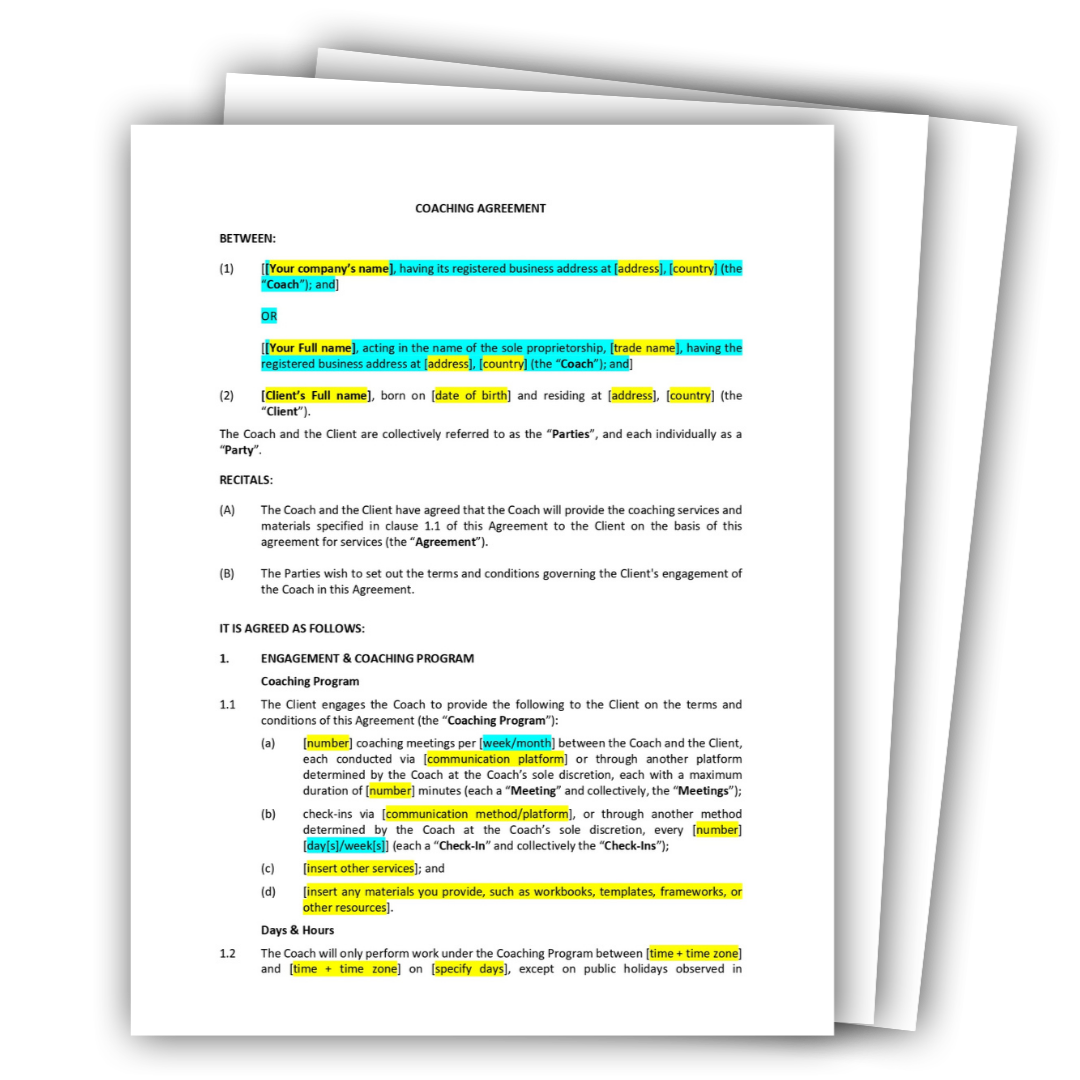
Every clause in this post is already built into my 1-on-1 Coach Agreement Template. Fill in your program details, select your niche disclaimers, and your contract is ready.
✅ What’s inside:
Airtight no-rollover and no-show protection
Ironclad lateness and rescheduling limits with optional late fees
Fool-proof scope and communication boundaries — with a full exclusions list
Flexible payment terms — lump sum or monthly, with an optional minimum term for ongoing clients
Business hours, adjournment rights, and force majeure coverage
Full niche disclaimer library with 10 niche-specific disclaimers covering 33+ coaching niches
Available in American English, customizable for your jurisdiction, with free updates
Get the 1-on-1 Coaching Agreement Template →
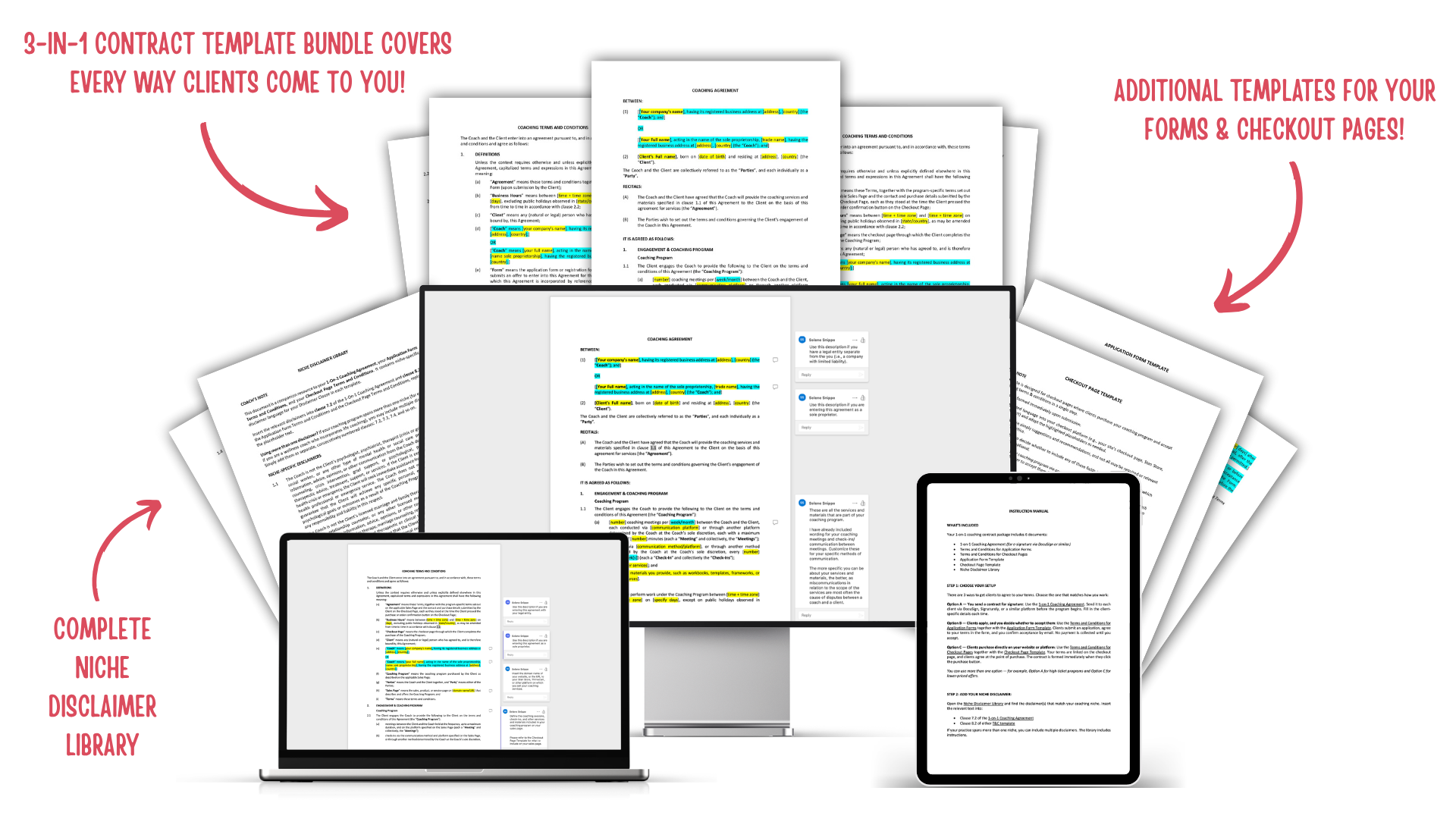
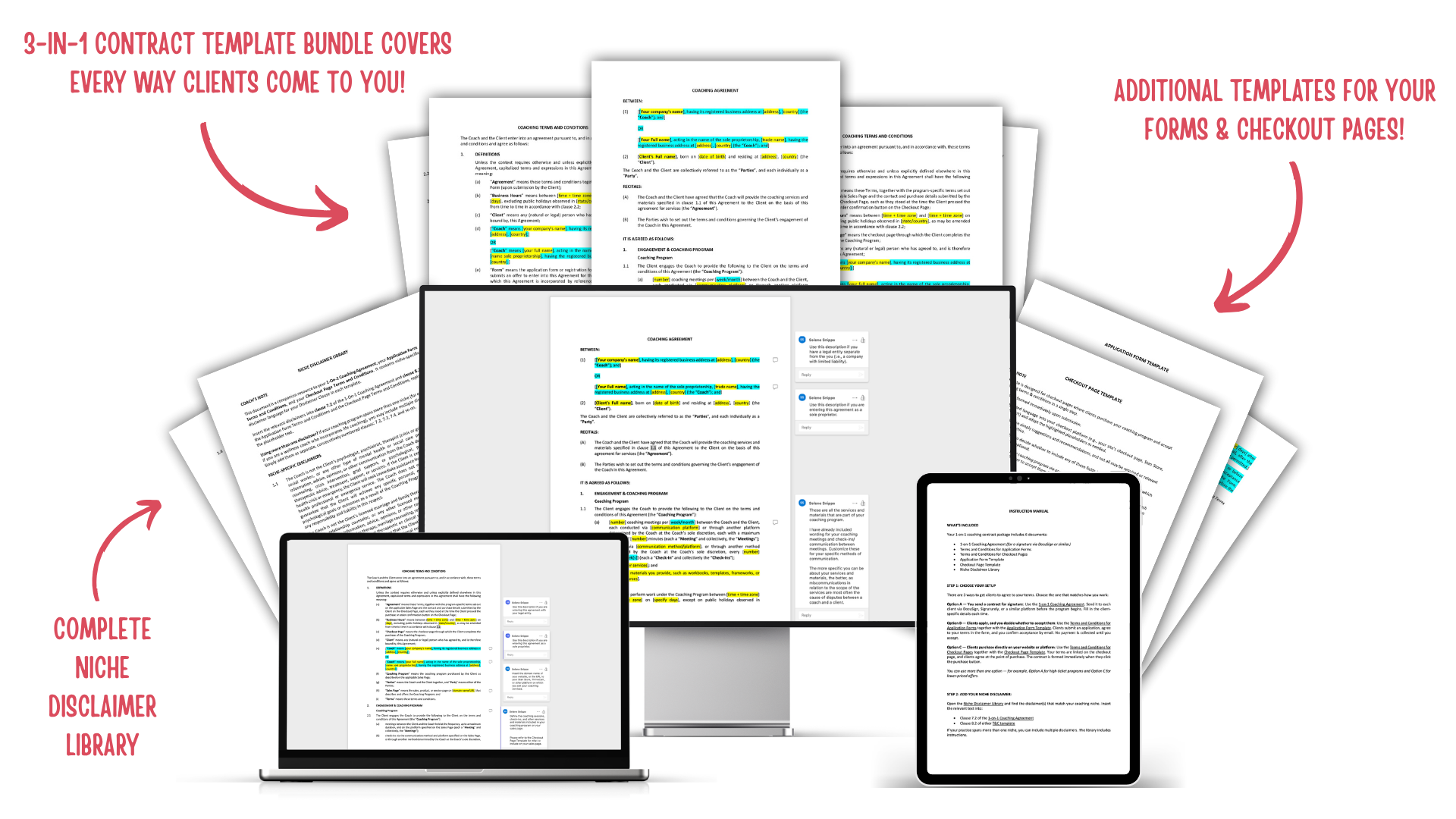
Also available as part of the Coach Contracts Bundle — which includes the Application Form T&C and Checkout Page T&C for coaches who sell through applications or checkout pages.
This post was all about the coach agreement clauses most templates leave out — and what yours actually needs to protect your time, income, and business.
You may also like to read this: