How to Start a Coaching Business Online: 10 Key Steps Most Beginners Skip

Wondering how to start a coaching business online? Here's the short version: pick a niche, build one clear offer, price it, set up your website and tech, lock down your legal foundation, then go get your first clients — and I’m sharing exactly how to tackle each step.
So, you have a dream of starting a coaching business. You want to work from anywhere, help people you actually like, no commute, no boss breathing down your neck. And it can be exactly that.
But, as a business lawyer for coaches, I've watched this story play out too many times. You can be incredible at coaching and still lose the business within a year — usually because no one handed you the setup part: the pricing, the contracts, the protection that keeps it all standing.
In this post, I’m walking you through exactly how to start a coaching business online in 10 steps — from picking your niche to landing your first paying client — so you know exactly how to start a coaching business from scratch without missing the pieces that protect it.
By the end, you'll know what to do first, what to charge, what tech you actually need, and how to keep your business protected from the stuff nobody warns you about.
This post is all about how to start a coaching business online — the right way, from day one.
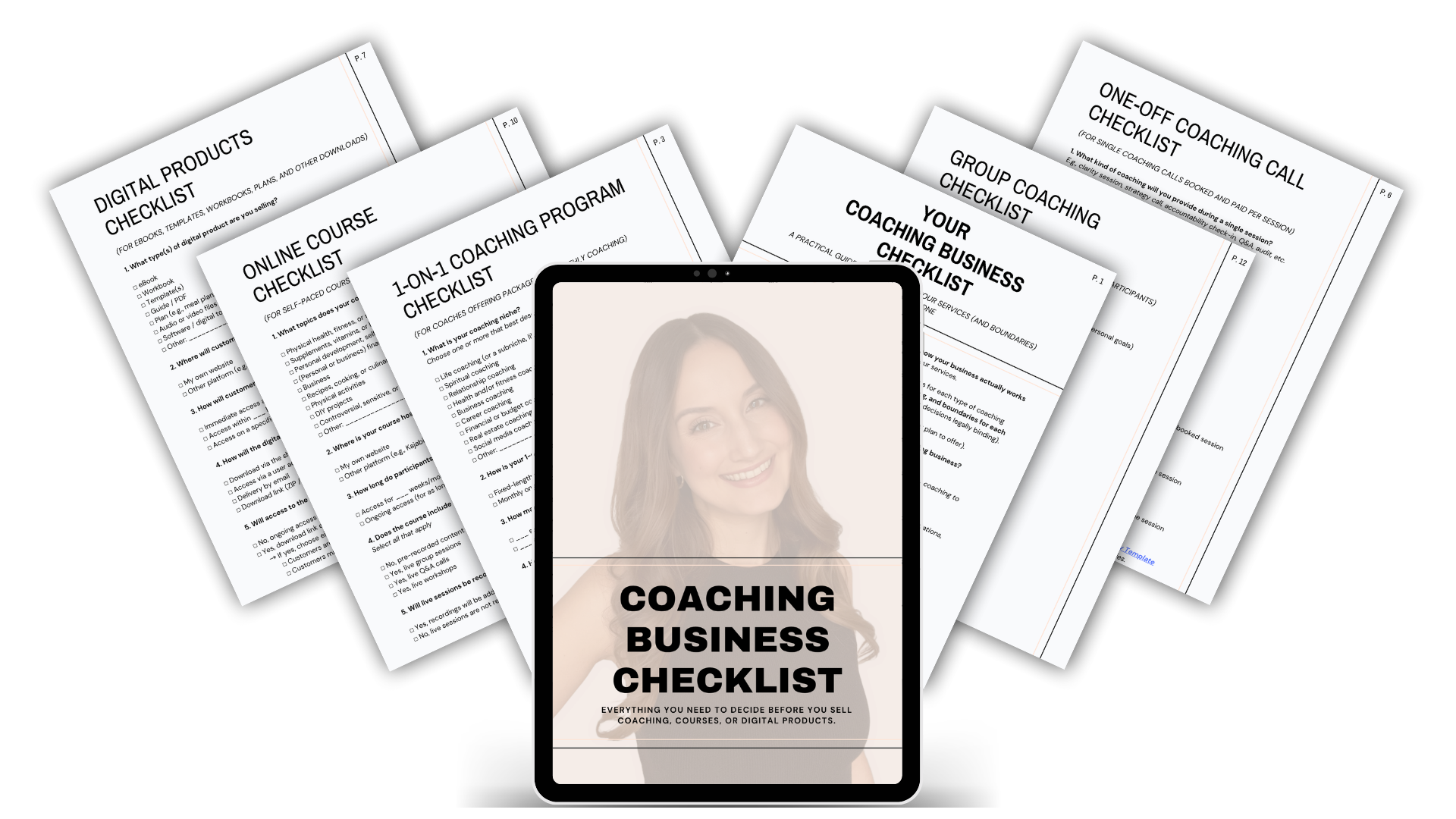
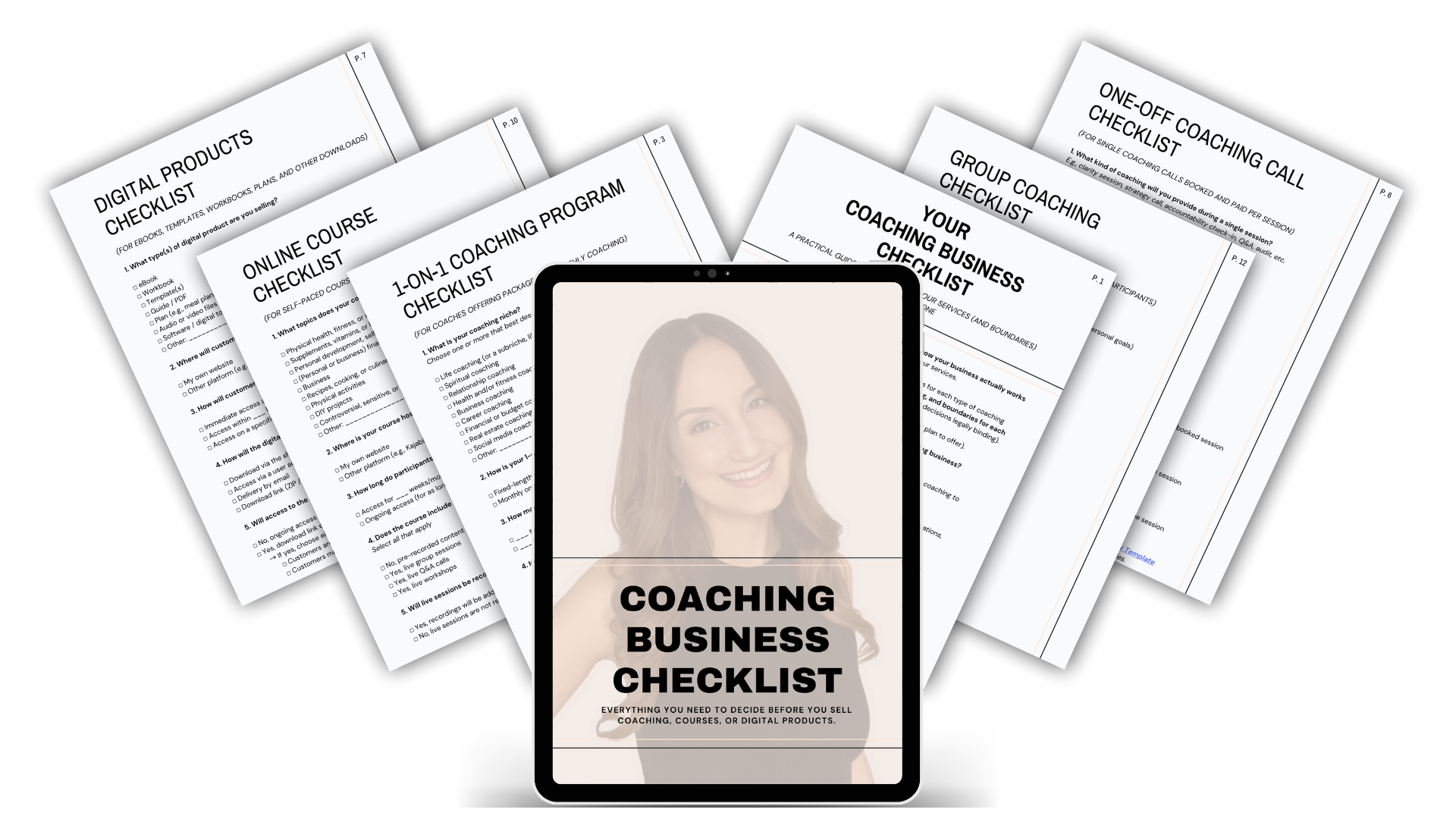
👉 Grab my free Coaching Business Checklistso you can tick off every step as you go (and not lie awake wondering what you forgot).
How to Start a Coaching Business Online
How to Start a Coaching Business Online from Home in 10 Steps
1. Pick a Niche (and Make Sure People Actually Want It)
Step one in how to start a coaching business online? Deciding exactly who you help.
I know — you want to help everyone. But online, you're a stranger competing with a thousand other coaches, and “I help people feel better” doesn't make anyone stop scrolling. “Confidence coach for women over 40 rebuilding after divorce” does.
So how do you find yours? You’re looking for the overlap between 3 things:
What you're genuinely good at. Two ways to figure this out. Either it's the thing people already come to you for — the friend everyone texts for meal-prep tips, debt-payoff advice, or how you actually stick to a morning routine — or it’s something you’ve pulled off yourself, like paying off $30k, going from corporate burnout to full-time freelance, or finally getting fit in your 40s.
What people will pay to fix. A real, painful problem they know they need to handle right now (not a nice-to-have).
Who you actually want to work with. Because you'll be talking to these people every single day.
Now validate it before you build anything. This is the part most beginners skip — they fall in love with an idea and spend three months on a website for it before checking whether a single soul wants it.
Here's how to pressure-test your niche online:
Search it. Type your niche + “coach” into Google, Pinterest, and TikTok. Real results and other coaches showing up mean there's demand. You can also search the problem you solve in Amazon’s books section — if people have written books about it, it's a problem people pay to solve (a tumbleweed situation usually means no one's looking).
Find where they hang out. Facebook groups, subreddits, hashtags — if you can find a pile of your people in one spot, you can reach them.
Talk to five of them. Not a survey — actual conversations. Ask what they’re struggling with and what they’ve already tried.
Nail this step and everything after it gets easier. Your offer, your pricing, your content — it all flows from knowing exactly who you’re for.
Still brainstorming? I’ve got a whole post on online coaching business ideas to help you land the angle that fits you.
2. Build One Strong Signature Offer (Not Ten)
I see so many beginners trying to build an entire business empire in 2 days. They want a 1:1 program, a group membership, 3 eBooks, an online course, and a 7-day retreat — and they end up accomplishing nothing because they're stretched in 10 directions.
You're here because you want to know how to start a coaching business online from scratch. That means starting with one clear offer.
My rule for any entrepreneur — coach or not — is to pick one offer and give it a full year before you even think about a second. And I mean a real year: actually selling it, listening to your clients, and tweaking it until it works. Building something that lasts takes longer than the gurus let on, so don't panic if the money takes a year or two to show up. That part's normal.
But how to start a coaching business online with just 1 offer? You've basically got 3 ways to deliver it:
1:1 coaching. Just you and one client. Highest-touch, easiest to sell when you're new, and you can charge a premium for the personal attention (the catch: it caps out — there are only so many hours in your week).
Group coaching. You coach a handful of people simultaneously via live calls, a shared chat, and a set curriculum. More income per hour of your time, and the group itself becomes part of the magic (you just need enough of an audience to fill it).
A self-paced course. You record it once and sell it on repeat. Sounds great in theory, but courses are the toughest to sell with a small audience (save this one for once you've got proof and reach).
My honest advice? Start with 1:1 — even if your big dream is passive course income. Coaching real people one-on-one teaches you the exact words they use, the objections they raise, and the result they’ll happily pay for. That's the raw material you'll use to build a group program or course that sells later.
And make sure to grab free Coaching Business Checklist. It walks you through everything you need to decide for your offer, from program length to schedule to pricing...
3. Price It for Where You Are Right Now (You're Not Worth $5K Yet)
Pricing is the part of how to start a coaching business online that makes everyone sweat.
Here's a trend that needs to stop: fake coaches on TikTok telling you to charge $5,000 for a 4-week program when you've barely started. I hate to be the one to break it to you, but you're not worth $5,000 yet.
But don't swing the other way and price yourself too low, either. Low prices tend to backfire: you'll attract the clients who haggle, ghost, and demand the most, while the people who'd happily invest assume something's off. A low price signals low value — even when your coaching is brilliant.
So how do you land on a number? Look at 2 things:
Price the transformation. People pay for the result — getting out of debt, landing the job, finally feeling calm. Base your price on that outcome, not on the hours you spend with each client. You're not a lawyer charging by the hour (and honestly? I don't even agree with the lawyers who do).
What the market charges. Check what other coaches in your niche price (you did this digging back in Step 1). You don't have to match them, but you need to know the range.
A few logistics worth sorting now:
Upfront or month-to-month. You can charge the full amount upfront for a fixed 4–6-week program, or run an ongoing month-to-month program. Either way, your clients always pay before the work — the full program upfront, or each month before it begins.
Payment plans. Got a longer, pricier program? A payment plan makes it feel doable (think 3 monthly payments instead of one big lump sum). Just tie each chunk of your program to each payment, so you're never working for free if a client conveniently "forgets" the next one.
One-off coaching calls. Not everyone's ready to pay for a 4-week package before they know you. Back in Step 2, I said don't build 10 offers — and I stand by that — but one low-risk entry point earns its place: a one-time coaching call people can book straight through your scheduler. Make it a single strategy or planning session, and it becomes the easy “yes” that turns a stranger into a full 1:1 client later.
Get it in writing. The moment money changes hands, your payment terms — amounts, due dates, late fees, refund policy — need to live in a signed coaching agreement (or click-to-agree T&Cs if people buy online without a call). That's what protects you when someone stops paying halfway through. And even for your one-off calls, put a virtual meeting policy in place — with an iron-clad refund policy and niche-specific disclaimers.
👉 Grab my free Coaching Business Checklist— it walks you through pricing, setup, and the admin bits so you're not piecing your business together from 14 open browser tabs.
Got your offer and your price sorted? Now people need somewhere to find you — and a reason to trust you when they get there. That's your online presence, and it's up next.
4. Build an Online Presence People Actually Trust
When you're figuring out how to start a coaching business online, here's the mindset shift that matters: your website is the one piece of real estate you actually own. Your Instagram can vanish overnight (algorithms change, accounts get hacked, platforms die). Your website doesn't go anywhere.
So before you pour months into growing a following, build your home base. A good coaching website does just a few jobs:
Says who you help on your home page. Something like: “I help [specific person] achieve [specific result].” A confused visitor clicks away.
Shows your one offer. The signature offer from Step 2.
Earns trust on your about page. Your story, why you do this, any results or credentials. This is where people decide whether to believe you.
Makes the next step obvious. A single, clear button. Send it straight to checkout if you accept everyone, or to an application form if you screen clients first with a discovery call or a quick review.
For the actual build, I point most coaches to Squarespace — yes, it's an affiliate link (so I earn a small commission if you sign up), but it's genuinely what I use. It's the Apple of website builders: looks professional without hiring a designer, and you can have a real site live in a weekend.
Then there's the part everyone forgets: getting found. A gorgeous website nobody visits won’t book you a single client. You've got a few main ways to get in front of people:
Social media (Instagram, TikTok). The obvious one — good for getting your face out there, but it's rented land that eats your time, so use it to funnel people back to the site you actually own.
Pinterest. It works more like a search engine than a social feed, which means one pin can send people to your site for months. It's become one of my biggest traffic sources. If you want to do it properly, Perfecting Pinterest by Sophia Lee is the course I learned from (not an affiliate link — I genuinely use her stuff).
Blogging + SEO. Helpful posts that answer your ideal client's real questions get found on Google for years. Her Perfecting Blogging course covers that side (also not an affiliate link).
One last thing: don’t overcomplicate the design. I've watched people spend 3 months agonizing over fonts and zero days talking to actual humans. Get a clean, clear site up, then go get found. Done beats perfect every time.
Your presence is sorted. Now let's wire up the behind-the-scenes tech that makes the whole thing actually run — that's Step 5.
5. Set Up Your Tech Stack (You Need Less Than You Think)
There's a shiny app for everything, and it's easy to lose two weeks comparing tools instead of booking clients.
Here's the truth about how to start a coaching business online from home: you need a handful of basics, and that's it.
The non-negotiables:
Video calls. Zoom or Google Meet. The free plans are fine to start.
A scheduler. Calendly or Acuity, so clients book and reschedule themselves — no more email ping-pong across time zones.
Payments. Stripe or PayPal handles cards and, importantly, recurring billing for your month-to-month clients. Most schedulers and site builders plug straight into them.
A way to get contracts signed. Your coaching agreement needs a signature before any work begins — use a simple e-sign tool, or add your click-to-agree T&Cs to the checkout page (like in Step 3) so it's handled the second someone buys (and there’s no awkwardness of sending a contract and waiting for it to get signed).
Email. A professional email address to make your business legit (not jane123@icloud.com). Also, it’s incredibly valuable once you start building an email list (no algorithm required).
The rest can wait. Things like a fancy client portal from Dubsado, a course platform, or async voice apps like Voxer can be added later. Chasing every app a YouTuber (who earns affiliate commissions) recommends is how you end up paying for a stack you never touch.
But here’s something that is worth your investment: the legal foundation. Let's make sure yours is solid.
6. Make It Official: Form Your LLC
Your legal foundation has two layers, and the first is your business structure. How you handle it depends a lot on where you live.
In the US, this matters more than almost anywhere. Lawsuits are common, and as a sole proprietor, your personal savings, your car, and your home are all fair game if a client comes after you.
An LLC fixes that. It legally separates you from your business, so your personal assets aren't on the line if something goes sideways.
Most US beginners learning how to start a coaching business online skip this step entirely. They run everything under their own name and hope for the best.
You don't need a lawyer for this part. ZenBusiness handles the paperwork in an afternoon — you only pay the state fees on top.
Full disclosure: that's an affiliate link, so I earn a small commission. But I'm a lawyer, and I use it myself — it does what an expensive attorney does, just a lot faster and cheaper (you only pay your state fees).
Outside the US, the math changes. In plenty of countries, a formal entity is overkill on day one — in the Netherlands, for instance, most coaches happily start as a sole proprietor (eenmanszaak) and incorporate later.
So check what's normal where you are. Wherever you land, sort your structure early; it's far easier to start clean than to untangle a year of mixed-up finances later.
With your structure sorted, it's time for layer two: the contracts that protect every client relationship. That's next.
7. Put Your Contracts in Place (Before You Need Them)
Here's the unsexy side of how to start a coaching business online: contracts. They're also what saves you when a client turns difficult — and the other big thing most beginners skip.
Picture this. A client signs up for your 12-week program, pays the first installment, and does great for three weeks. Then she goes quiet.
In week 6, she resurfaces, demanding a full refund because "it didn't work." With nothing in writing, you're negotiating from zero — and you'll probably hand the money back just to end the stress.
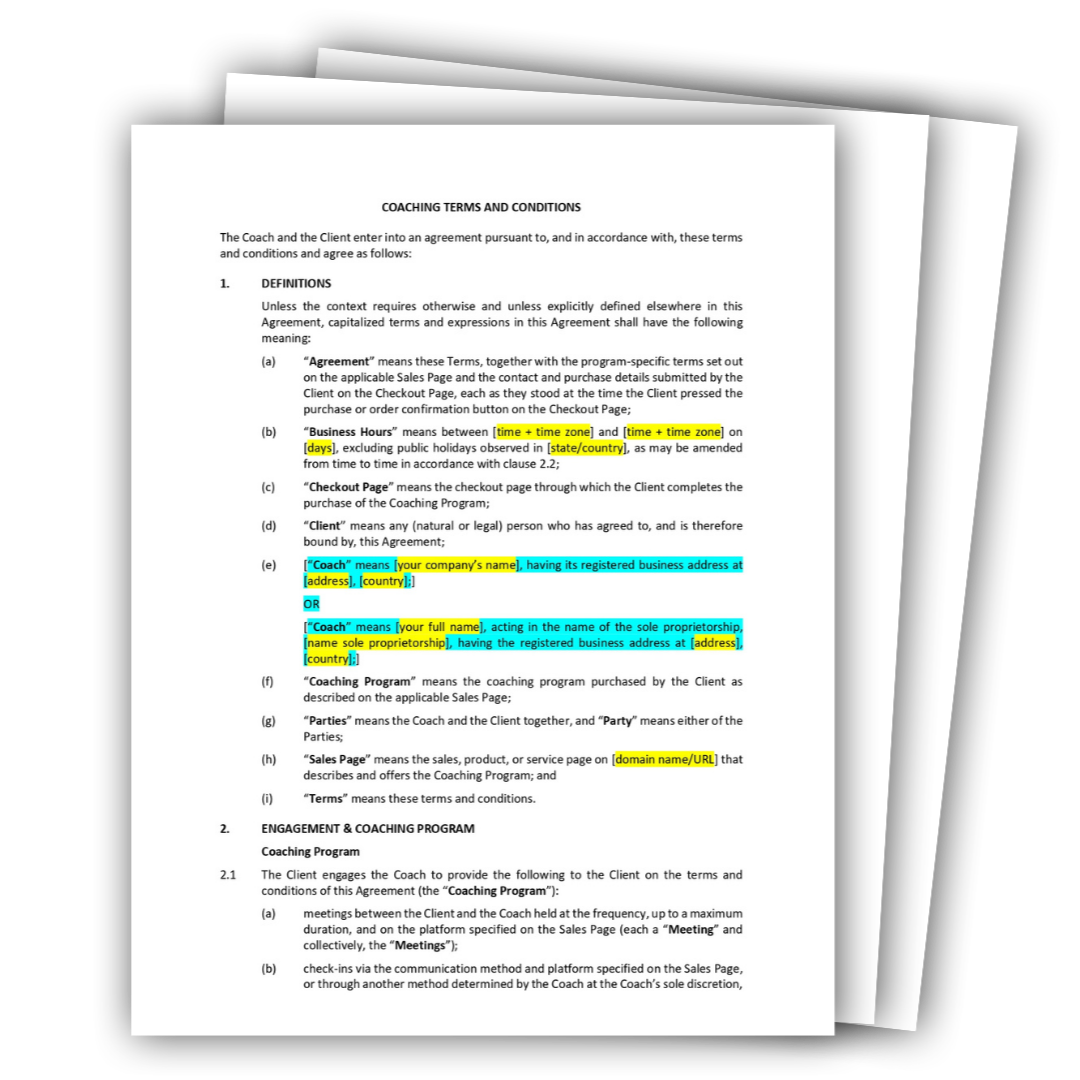
A solid coaching contract closes that door before it opens. At a minimum, yours should spell out:
Scope — what's included, what isn't, and exactly how many sessions they get.
Payment terms — amounts, due dates, late fees, and what happens when a payment is missed.
Cancellation and rescheduling — your no-show and late-cancel rules, in black and white.
Refund policy — clear and firm, decided long before anyone sends an angry email.
A liability disclaimer — the clause making clear you're a coach, results aren't guaranteed, and you're not on the hook for your clients' choices.
That last one is where your niche matters most, and where a single line won't cut it.
A health or wellness coach needs to make it clear that you're not diagnosing, treating, or providing medical advice — clients should run any changes past their doctor first.
A life coach needs a hard line between coaching and therapy: you're not a licensed mental-health professional, and you'll refer out when a client needs clinical help.
A business or money coach needs to disclaim providing financial, tax, or legal advice—and steer clear of promising specific income or results, which is a regulatory minefield (especially in the US).
Free, generic contracts skip these — and they're the exact clauses that save you.
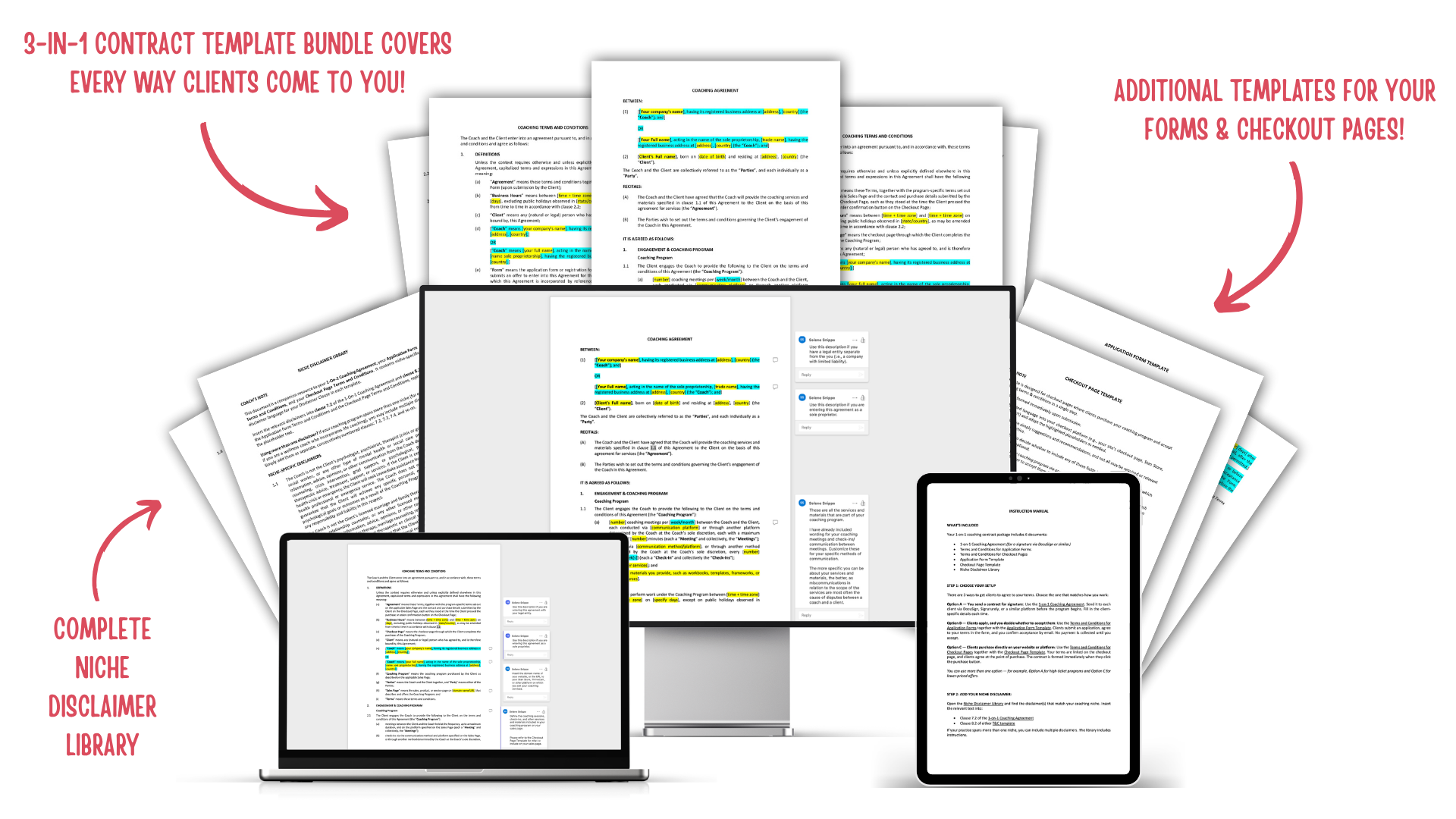
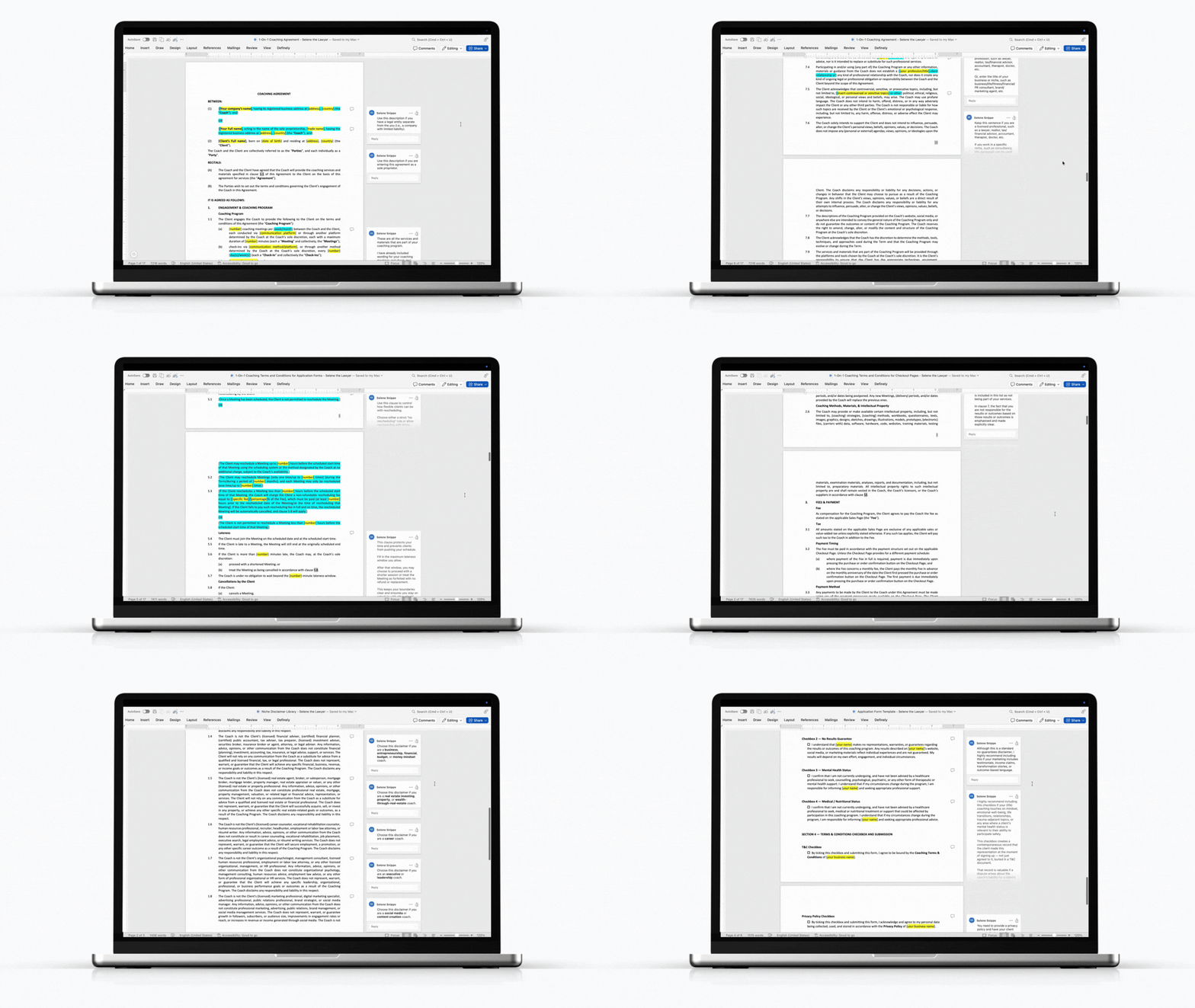
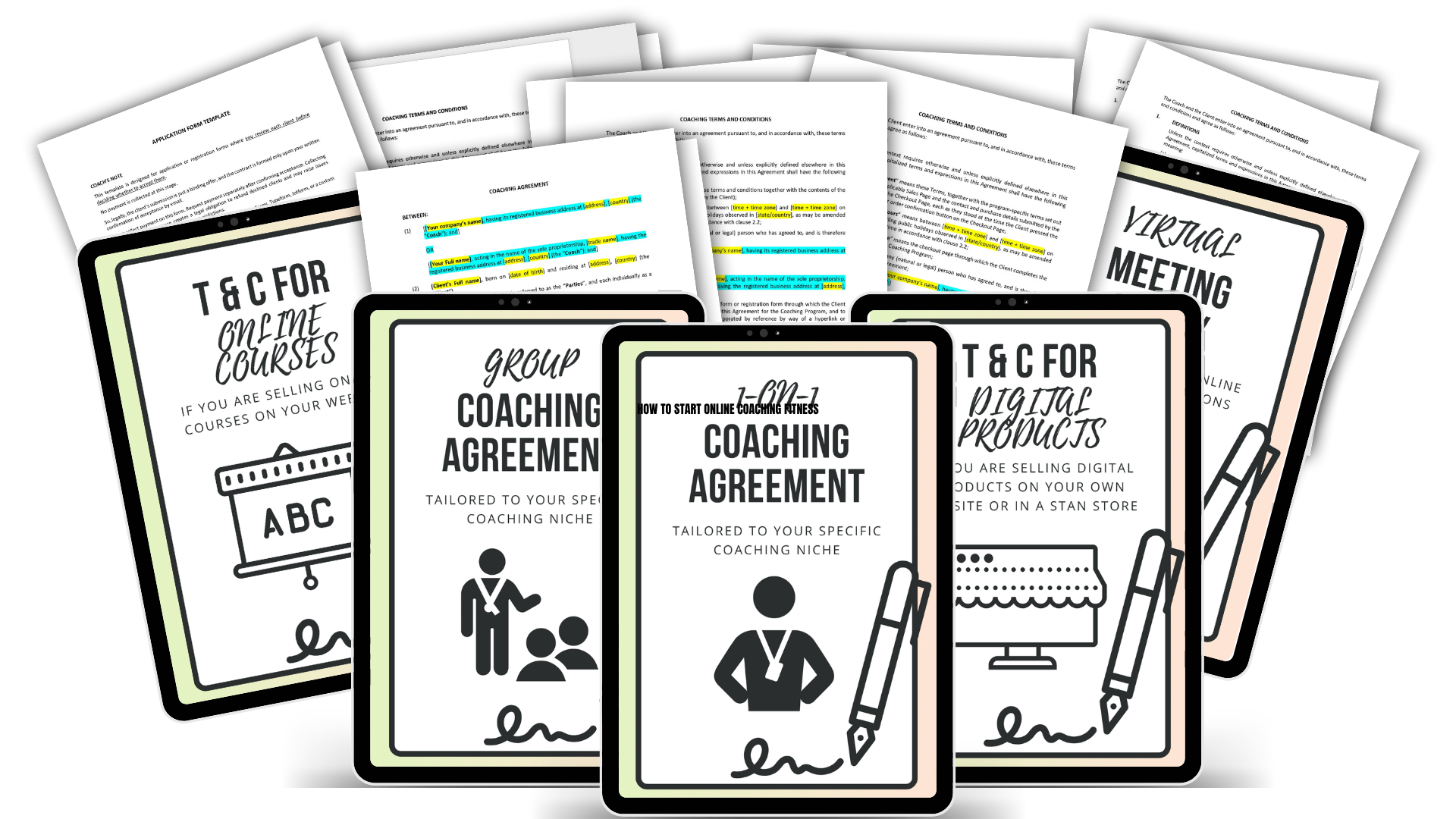
This is what I do all day. My coaching agreement template is built for precisely the ghosting-client, refund-demand mess above.
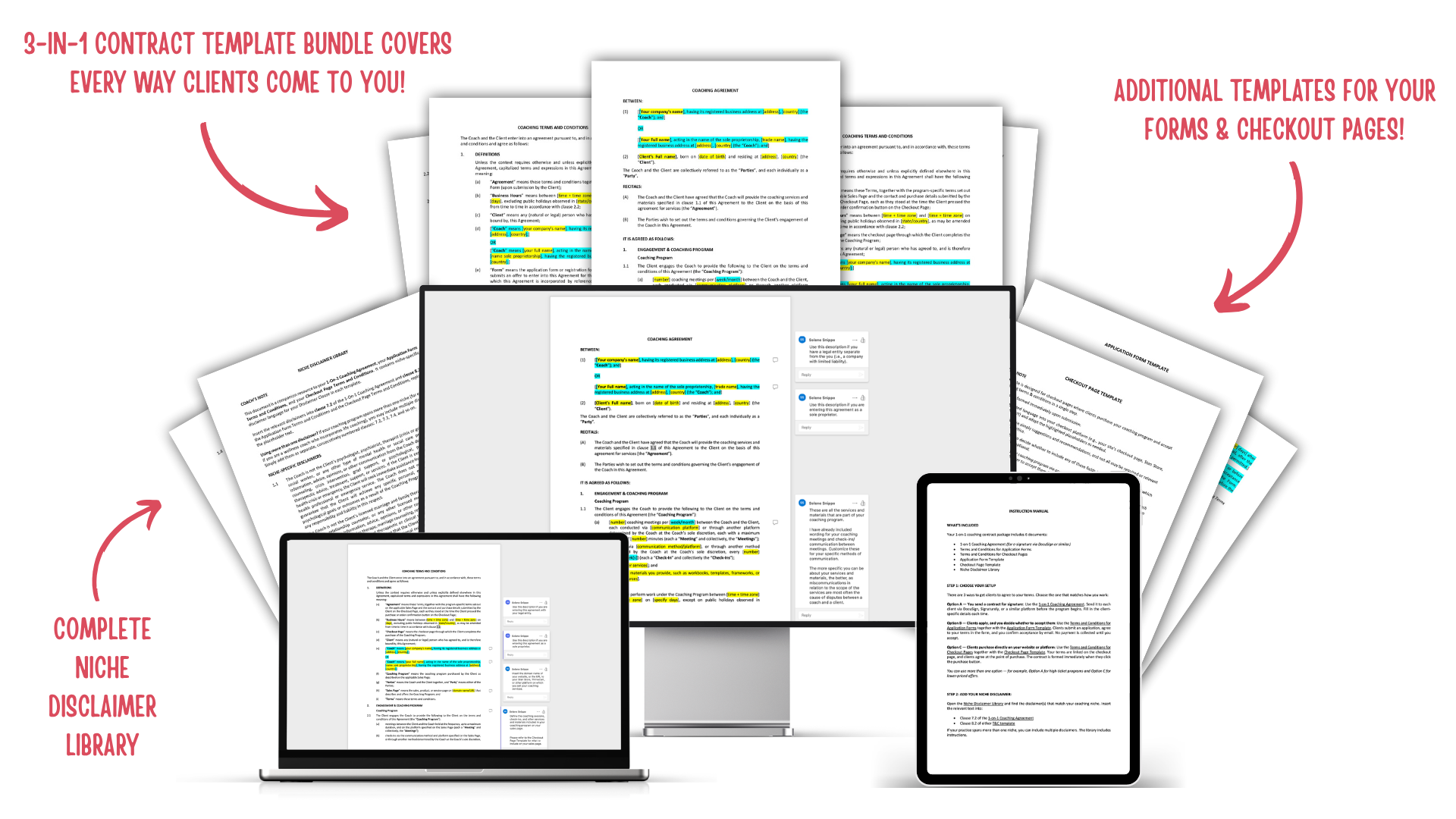
It's got airtight payment, cancellation, and refund clauses, plus the niche-specific disclaimers your business actually needs. It's peer-reviewed across multiple jurisdictions, customizable for your country, and includes free updates whenever the law changes.
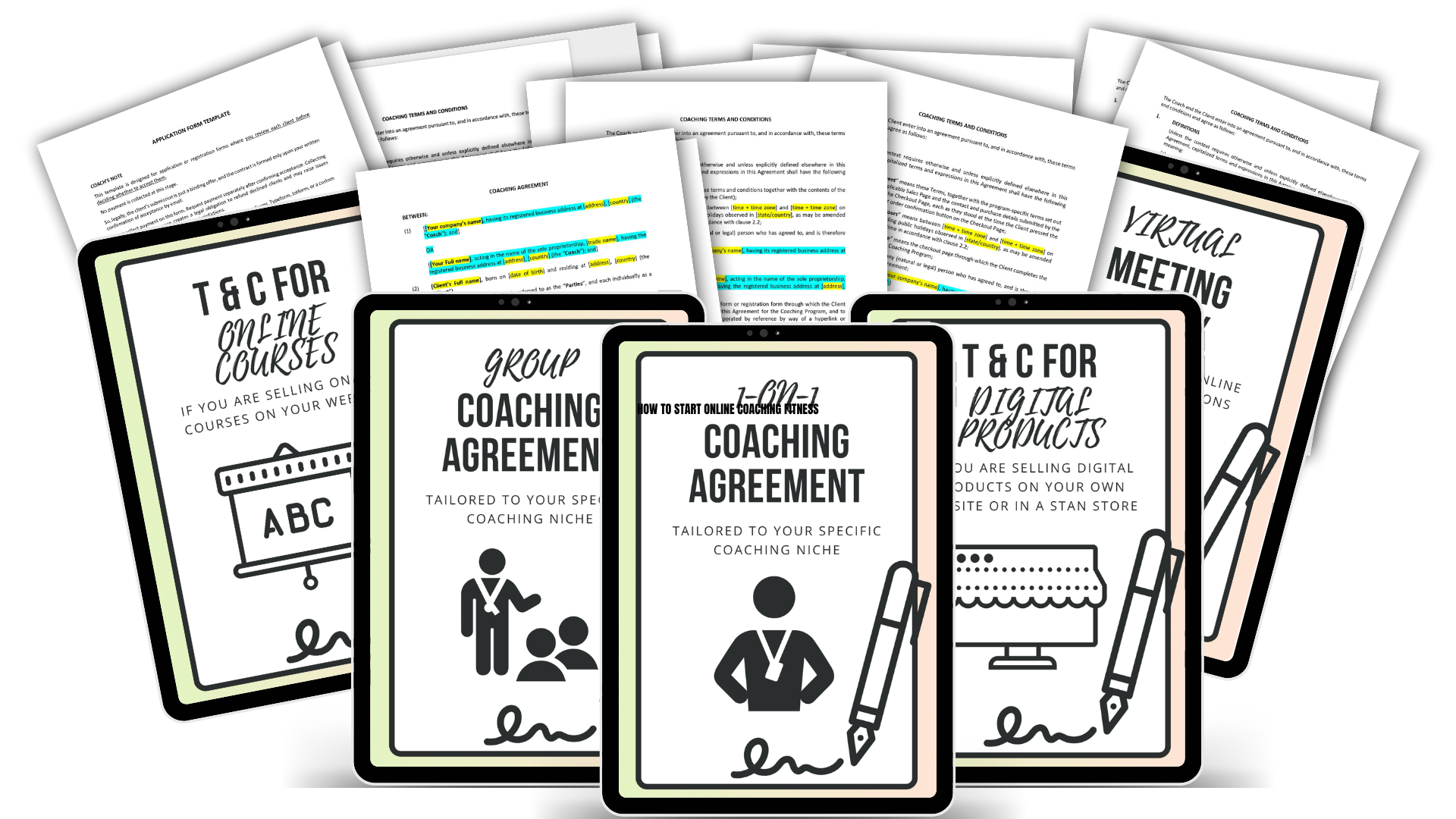
For group programs, there's a group coaching version. And for the one-off calls from Step 3, the virtual meeting policy includes iron-clad refund terms.
One last piece people forget: your website's own legal pages. The second you start collecting email addresses (hello, Step 5), privacy laws like GDPR and CCPA expect a privacy policy on your site.
P.s., you can get all 3 essential contracts at a discount with my Coach Contracts Bundle!
Once your contract's signed, the very next thing a client experiences is your onboarding. Let's make that feel smooth and professional— Step 8.
8. Build a Smooth Onboarding Flow
Let's talk about the moment someone decides they want to work with you. This is where a shocking number of sales leak away — and it's completely avoidable.
The traditional way is exhausting. Someone finds you, so you go back and forth trying to book a discovery call. They show up, it goes well, and then the admin marathon begins.
You ask for their details. You draft a contract. You send it over and wait. They reply with a dozen questions, or they go silent. And even then, you still have to chase them to actually pay.
By the time money changes hands (if it ever does), you're drained, and they've half-talked themselves out of it.
Two smoother paths exist, and setting one up is a real part of how to start a coaching business online without drowning in admin.
Path 1: They buy online (the easiest). For lower-priced or open-enrollment offers, let people buy right from your sales page. They click, accept your click-to-agree T&Cs at checkout, and pay — bound and paid in one motion, nothing to chase.
Path 2: They apply (when you screen clients). For higher-touch programs where you choose who you work with, use an application form that includes your coaching terms and conditions. The sequence:
They submit the application — agreeing to your terms as they do.
(Optional) You do a discovery call to check the fit.
You send an acceptance email. That's the moment the agreement is formed, and they’re bound by the terms they already agreed to.
You send the payment link.
That's the magic of it. The terms are already agreed and the contract's already formed, so there's nothing to draft or chase — they became your client the second you said yes.
Whichever path they take, your onboarding then runs automatically:
A warm welcome email confirming what happens next.
An intake form (or their application answers) so you're ready for session one.
A booking link to grab their first session from your scheduler.
Clear expectations on how and when to reach you.
That last one saves your sanity. Spell out your hours and response times up front, and you sidestep the client who texts you at 11pm expecting an instant reply.
With this flow humming in the background, you're set up to receive clients without lifting a finger on admin. Now you just need people to fill it — let's get your first clients in Step 9.
9. Land Your First Paying Clients
This is the step that scares people most. You’ve built the offer, the site, the contracts — and now you need actual humans to say yes.
Here’s what nobody tells you about how to start a coaching business online: your first clients almost always come from people who already know you, plus a handful of real conversations. Going viral has nothing to do with it.
So forget the 10,000-follower fantasy — 3 to 5 paying clients is all it takes to get going, and they're closer than you think.
The Pinterest and SEO work from Step 4 will bring leads in over time. But your first clients come faster from conversations, so lead with those while the content engine warms up.
Where to actually find those first few:
Your existing network. Tell people exactly what you do and who you help. Most folks have no idea you started coaching, so say it out loud, often.
Where your people already gather. Remember those Facebook groups and forums from Step 1? Show up and be useful. Answer questions without pitching anything — trust comes first, clients follow.
A few founding-client spots. Offer your first 3–5 clients a reduced rate in exchange for honest feedback and a testimonial. You get paid, you get proof, they get a deal.
The one-off call from Step 3. A single paid strategy session is a low-pressure yes for someone who isn't ready for a 12-week commitment — and it's often what turns a stranger into a full client later.
The biggest mistake here is waiting. Waiting until your funnel is perfect, your logo is just right, and your following is bigger. Start the conversations now, while everything's still a little scrappy.
Your first few clients are the hardest to land. After that, momentum and referrals do a lot of the lifting — which brings us to the final step: building the systems that let this grow without you. That's Step 10.
10. Build Systems So It Can Grow Without You
You’ve got clients. Now the goal shifts: build a business that grows without swallowing your whole life.
Scaling comes down to systems — the repeatable stuff that runs the same way every time, so you're not reinventing the wheel for every new client.
Here's where it pays off: most of your systems are already half-built from the earlier steps.
Your onboarding flow (Step 8) runs on autopilot — the welcome email, intake, and booking are all handled without you.
Your contracts are templated. Each new client signs the same coaching agreement or clicks the same coaching terms & conditions, so you never draft from scratch again.
Payments and scheduling run themselves through the tools you set up in Step 5.
A simple session framework. A repeatable structure for your calls and a template for your follow-up notes, so every client gets a consistent, polished experience.
Know your numbers. Track where clients come from and which offer converts, then double down on what's working.
Once your 1:1 calendar is full, you'll hit the ceiling every coach hits: you run out of hours before you run out of demand.
That's your cue to package what you do into a group program or course (remember those from Step 2). It's how you break the time-for-money trap and help more people at once.
And protect your energy as fiercely as your time. Batch your calls into set days, guard your off-hours, and let your systems carry the load they were built for.
That's the real reward of learning how to start a coaching business online the right way: a business that runs, grows, and hands your time back to you.
That Was My Guide on How to Start a Coaching Business Online Free of Fluff
Starting a coaching business online can feel like a mountain when you see all 10 steps at once. You don't have to do it all in one day. Pick the next step, do that one, then the one after.
But there’s one step that I’ve already made for you, so you don’t have to work for it: your coaching contract.
My 1-on-1 Coaching Agreement Template Bundle gives you both formats in one: the traditional contract for e-signature, and the click-to-agree T&Cs for your checkout page.
It's airtight, peer-reviewed across multiple jurisdictions, customizable to your country, and updated for free whenever the law shifts — so the scariest step becomes the easiest.
But you probably also need legal pages for your website and a virtual meeting policy for your one-off coaching calls.
For beginners like you, I’ve created the Coach Contracts Bundle, including all the contracts you need at a major discount.
This post was all about how to start a coaching business online — from that first niche decision all the way to the systems that let it grow without you.
Here's what to read next:
The coach contract every new coach needs — what actually belongs in a coaching contract, and what it costs you to skip it.
How to start a nutrition coaching business — the niche-specific playbook, including the health disclaimers that genuinely matter.
Starting a life coaching business — your step-by-step for the life-coaching niche.